

Your bright child tore up her poster over one crooked letter? The free Bright Heart Kit puts the words for those moments on three pages.

AGES 3–8 YEARS · 22 MIN READ
"It's ruined."
Your seven-year-old says it about her Saturn poster. She worked on it all weekend. The R in "Saturn" leans a little to the left.
You tell her calmly that it still looks wonderful. She tears it in half.
At breakfast that morning, she explained why black holes bend light. You followed about a third of it.
She can explain black holes. So why can't I get her through one crooked letter?
You are not getting this wrong. Many people expect a child who thinks like a grown-up to cope like one. That expectation can make evenings much harder for both of you.
This guide brings together scientific research and the Qur'an and authentic Sunnah. You'll see why she is two ages at once, and what to say tonight.
The Short Answer
Right for your child? Ages 3 to 8: a bright child whose thinking races ahead of their feelings. Your child does not need a gifted test for this to fit.
What's probably happening: your child's thinking runs ahead of their age. Their coping with big feelings stays closer to their age.
Try tonight (2 minutes): at the next big moment, name the feeling and what caused it. Then sit close, and fix nothing yet.
You'll know it's working when: the storm passes a little sooner, or your child names a feeling first. A loud evening is not failure.
Get help if: worry keeps growing, or gets in the way of sleep, eating, school or friends. Start with your child's doctor or pediatrician.
The rest of this guide explains why, and what to do if it does not work.
How to Read This Guide
3 minutes: The Short Answer above is enough for tonight.
7 minutes: The Short Answer, then Knowledge in Practice and If Things Don't Go to Plan.
The whole guide: read on for the scientific research, the Qur'an and Sunnah, and the References.
To share: the bold lines and the pull quotes are made to be shared.
To listen: open this guide in the free Substack app and tap Listen.
Inside This Guide
Being clever and being able to cope are two different things. Your child may need help with the second.
Myth Check: "Gifted Children Are Born Perfectionists"
Think of the recitation that ended in tears over one slip, or the spelling sheet with one red cross. It is easy to decide that perfectionism comes with being clever.
What the belief gets right. Gifted students do tend to strive harder for high standards than other students. [1]
What the evidence says. The anxious kind of perfectionism, the dread of mistakes and of being judged, was no more common in gifted students than in others. [1] The study's authors concluded that perfectionism is not a core part of giftedness. [1] So what happens around a child may have a real say in which kind takes root.
Keep the high standards. Add a gentler attitude to getting things wrong.
Why This Happens
Why Does a Child Who Thinks Like an Adult Melt Down Like a Toddler?
Picture the poster again, in two pieces on the floor. The size of the reaction doesn't fit the size of the mistake. You know it, and she probably does too.
Gifted children often show strong sensitivity, uneven development and high standards for their own work, and some show early moral sensitivity. [2] None of these is a disorder. Together, though, they can make an ordinary Tuesday feel loud.
A group of specialists, the Columbus Group, gave the uneven part a name in 1991: asynchronous development. [3] A child's thinking can run well ahead of their age, while their emotional maturity stays closer to their age. [3] So a six-year-old can grasp what extinction means, and then has to carry that grief with a six-year-old's tools.
It looks different at different ages.
3–5: the meltdown may come when it's time to stop drawing, because the picture still holds twenty details that exist only in their head.
6–8: it may be lying awake over a falling-out at recess, or over one wrong answer the rest of the class forgot by lunch.
In tarbiyah (raising a child upon good character), big feelings are something to steer. A child shamed for them often learns to hide them.
Why Does One Small Mistake Feel Like the End of the World?
A bright child often knows the reaction is too big. Hearing an adult say so can pile embarrassment on top of the upset, which is why "It's only a drawing" can make things worse.
Some bright children also coast through their early years without ever having to struggle. When real difficulty finally arrives, it can feel like proof of failure instead of a normal part of learning.
Why Does Every Rule Turn Into a Debate?
It's 8:58pm. Your son is near the end of a chapter, and he has built a careful case for finishing it before sleep. He knows the rule. He wants to know why it should win.
A specialist in young gifted children sees this rule-challenging as driven mostly by strong reasoning, with defiance a much smaller part. [4] That changes how it feels to be on the receiving end.
Why Do the Biggest Questions Come After Lights Out?
"If Allah is in charge, why do earthquakes happen?" Your eight-year-old asks with the lamp already off, and bedtime grows by forty minutes.
Some gifted children ask big questions young, and underneath, many of those questions are about fear. Worry about the planet is a common one. A sensitive child can soak up dread from one news report, and an enormous problem in a small person's head can leave them feeling stuck.
Why Does My Child Head for the Grown-Ups?
Maybe your son heads straight for his teenage cousins at every family dinner. Maybe your daughter spends the whole Eid gathering talking about space with an uncle while the other children race around the yard.
Quick, deep thinkers often see things through someone else's eyes, so many make caring friends. The same depth can leave them feeling like the odd one out with children their own age. Drifting toward older people usually happens because their interests and thinking sit closer together. [5] It isn't a fault. Children still gain from friends near their own age who love the same things, and finding them can take a while. [5]
Why Is She Fine at School and Falling Apart at Home?
She seemed fine at pick-up. Twenty minutes later she's sobbing over the wrong cup.
A gifted child who isn't challenged enough can show it in disguise. Some hold back from activities or from other children at preschool or school. Some seem content all day, then fall apart, cry or go quiet once they're home. Others distract the children around them instead of doing the set work. Some parents call the evening collapse "after-school restraint collapse."
Writers on gifted education describe how fast an unchallenged learner can switch off. [6] A review of the field adds that some difficulties come from classrooms that don't fit the pace and level of a gifted child's learning. [2] Few children walk up to the teacher and ask for something harder.
This is also the answer to the poster. At breakfast, the reasoning part of your daughter was running the show, and it is ahead of her years. By dinnertime she has held herself together all day. The part that takes over at home is her emotional coping, and that part is her own age. She is two ages at once. Evenings may be when the younger one finally gets a turn, at home, with the people she trusts most.
Often, it isn't drama. Your bright child is two ages at once, and the younger one is tired.
What the Scientific Research Shows
The strongest evidence is the 2020 meta-analysis behind the Myth Check, which combined 10 studies of 4,340 students. [1] Gifted students scored higher on perfectionistic strivings but the same as other students on perfectionistic concerns. [1]
Who was studied: students in the United States (6 studies), Europe (3) and Hong Kong (1), with average ages of about 10 to 13. Ethnicity, family income and additional needs were not reported. [1]
How strong this is: Strong. A meta-analysis of several studies pointing the same way.
What we do not know yet: whether the same holds for children under 10. No study has yet tested this with Muslim families.
Where the dread may come from. In interviews, gifted high school students with high perfectionism named an early education that did not challenge them among its influences. [7] The full study could not be read for this guide, so who took part is not given here. Suggestive: one interview study, of older students.
Why naming a feeling helps. In a brain-imaging study of 30 adults at a US university, putting feelings into words lowered the response of the amygdala to upsetting pictures. [8] The amygdala is a part of the brain involved in emotional alarm, and the comparison was with other ways of processing the same pictures. Ethnicity and family income were not reported. Early: one small study, in adults.
With young children, the evidence points the same way. In an Australian trial, 216 parents of preschoolers aged about 4 to 5 were randomly assigned to an emotion-coaching program or a wait list. [9] Parents in the program became less dismissive of their children's feelings, and the children's understanding of emotions improved. [9] Who was studied: families in Melbourne; ethnicity, family income and additional needs were not given in the study summary. Suggestive: one trial.
Self-compassion. Among 235 teenagers and 287 young adults in a US city, those with more self-compassion reported greater well-being, in both age groups. [10] Most were white and middle class, and additional needs were not mentioned. Suggestive: one study that shows a link, not a cause.
Moving ahead a year. A large review of a century of studies found that accelerated students did significantly better academically than same-age peers who were not accelerated. [11] Strong: it combines earlier meta-analyses. An earlier meta-analysis of 38 studies found the social and emotional effects slightly positive on average, though not statistically certain. [12] Suggestive for the social side. Most of the studies did not report ethnicity or family income.
What this means for you: fear of mistakes isn't part of being gifted, and naming the feeling has evidence behind it.
What the Qur'an and Sunnah Teach
The Qur'an and Sunnah speak to three moments in this guide: a heavy feeling, an honest mistake, and a question asked again.
وَلَقَدْ نَعْلَمُ أَنَّكَ يَضِيقُ صَدْرُكَ بِمَا يَقُولُونَ
فَسَبِّحْ بِحَمْدِ رَبِّكَ وَكُن مِّنَ ٱلسَّـٰجِدِينَ
"And We already know that your breast is constrained by what they say. So exalt [Allāh] with praise of your Lord and be of those who prostrate [to Him]."
Al-Hijr 15:97–98 · Sahih International [13]
Text. Allah names the distress the Prophet ﷺ felt at the insults he heard, and then gives him a practice. Ibn Kathir explains that the distress should not weaken his resolve or stop him from conveying the Message. [14] He names the remedy: stay busy remembering, praising and glorifying Allah, and worshipping Him, which he explains means the prayer. [14]
Our reflection. These verses speak to the Prophet ﷺ facing mockery, so bringing them to a child draws on their pattern. The distress is named first, plainly and without blame. Then comes a practice that turns the heart toward Allah. A child who feels everything at full volume needs the same order. Name the feeling first. Then go somewhere steady together: your lap, a quiet minute on the prayer mat, or salah (the prayer; namaz, solat) side by side.
The Prophet ﷺ also spoke of a judge doing his honest best:
"If a judge gives a verdict according to the best of his knowledge and his verdict is correct," he receives a double reward. If he does his best and gets it wrong, he still receives a reward.
Sahih al-Bukhari 7352 · sunnah.com [15]
Text. This hadith is about judges deciding hard cases.
Our reflection. The principle behind it is that careful, sincere effort counts with Allah even when the result is wrong. A child frozen by the fear of mistakes needs to hear that often, from the people who love them.
Text. Questions have an honored place too. 'A'ishah, the wife of the Prophet ﷺ, used to ask again about anything she heard and did not understand, until she understood it. [16] Once he said that whoever is called to account will be punished. She asked about the Qur'an's promise of an easy reckoning, and he explained how the two fit together. [16]
Our reflection. Your child's "but why?" may come from the same wish to understand. It deserves a real answer, and the rule can still stand afterward.
وَإِذْ قَالَ إِبْرَٰهِـۧمُ رَبِّ أَرِنِى كَيْفَ تُحْىِ ٱلْمَوْتَىٰ … قَالَ أَوَلَمْ تُؤْمِن ۖ قَالَ بَلَىٰ وَلَـٰكِن لِّيَطْمَئِنَّ قَلْبِى
"And [mention] when Abraham said, "My Lord, show me how You give life to the dead." … [Allāh] said, "Have you not believed?" He said, "Yes, but [I ask] only that my heart may be satisfied.""
Al-Baqarah 2:260 · Sahih International [17]
Text. Prophet Ibrahim عليه السلام asked to see how Allah gives life, so that his heart would be at rest. Ibn Kathir explains that he wanted to make his knowledge firmer by seeing it with his own eyes. [18] He also records that Ibn 'Abbas said, "To me, there is no Ayah in the Qur'an that brings more hope than this Ayah." [18]
Our reflection. A child who keeps asking big questions may be looking for a heart that can rest more than an argument to win.
Name the heavy feeling first. Then give your child somewhere steady to go.
The Lab Verdict
The science: gifted children are not built to dread mistakes, and putting a feeling into words can help settle it. (Strong for perfectionism; Suggestive for naming feelings with children)
The Qur'an and authentic Sunnah: Allah named the distress of the Prophet ﷺ before giving him a practice, and honest effort is rewarded even when it gets the answer wrong.
Where they meet: the science shows why naming feelings and allowing honest mistakes help; the Sunnah gives the order to do it in. The science gives the steps; the Sunnah gives them mercy.
So at home: name the feeling, sit close, and praise the honest try before the right answer.
Knowledge in Practice: Name It, Then Steady It
Knowing why your child falls apart is half the work. The other half happens on the floor, next to the torn poster.
If you can only do one thing, do step 1. It is enough.
1. Name the feeling before you fix anything (2 minutes). Naming it first lets your child feel understood. Four moves are enough:
Notice. Watch your child's face and body for a few seconds before you speak.
Name the feeling, and tie it to what happened.
Pause. Sit close, offer a hug or a glass of water, and let the wave pass.
Solve it later, once your child can think clearly again.
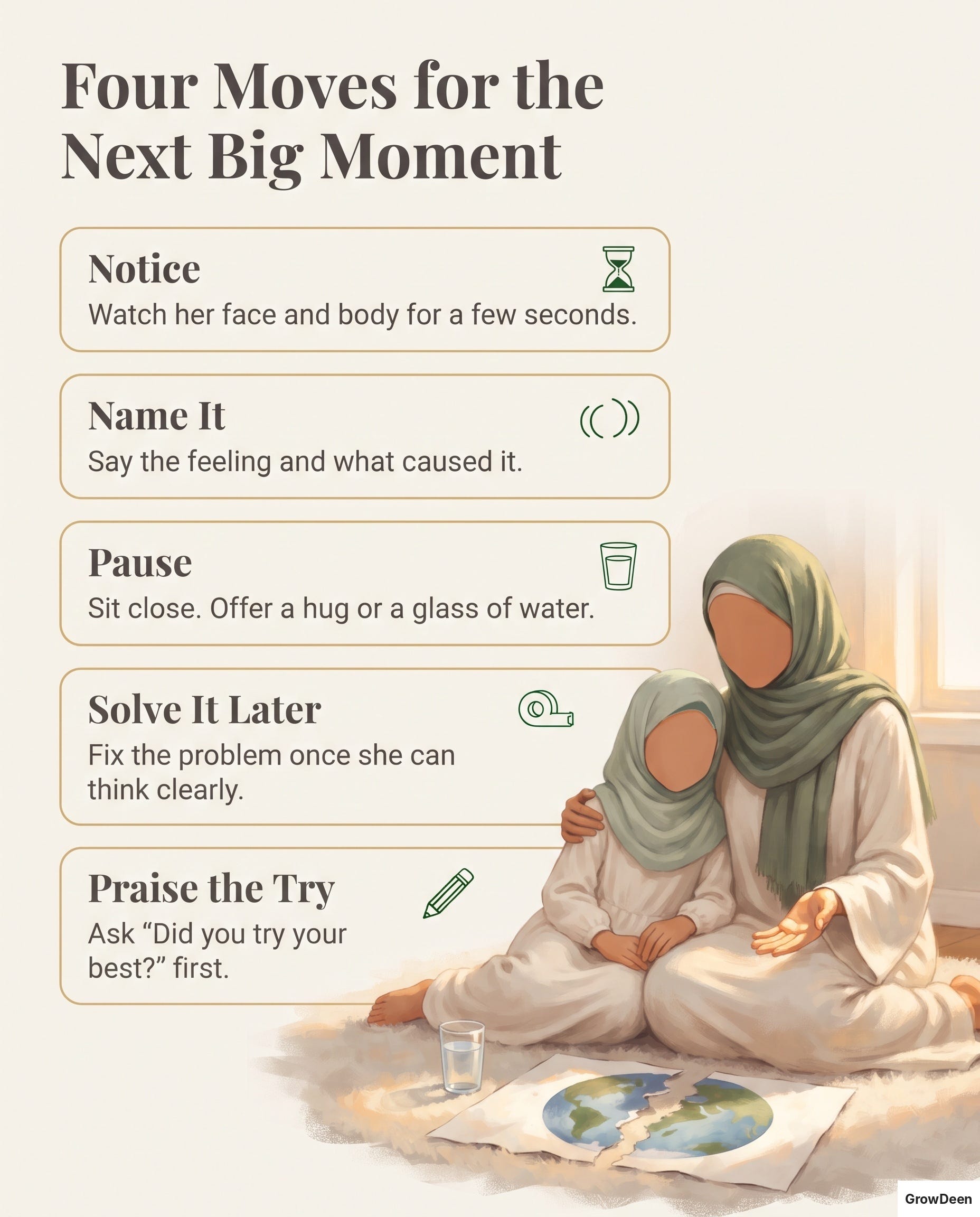
Say this: "You're frustrated because the poster didn't come out the way you pictured it. Let's sit for a minute." (Say it in the language your child knows best.)
Instead of: "It's only a drawing." Try: "You're frustrated it didn't match the picture in your head."
More lines to borrow:
"You're sad the tower fell. You worked hard on it."
"You're upset you got that one wrong. It mattered to you."
"You're angry it's time to stop. Your picture isn't finished yet."
3–5: follow the name with a soft suggestion. "That poster has frustrated you. How about your favorite Islamic picture book for a bit? The poster can wait until after Asr (the afternoon prayer)."
6–8: ask more and suggest less. Let your child come up with the first idea, even when you can see a better one.
2. Praise the honest try, and let them see you get it wrong (1 minute, after any mistake). One model of talent development describes natural gifts growing into talents through years of learning and practice. [19] Practice is mostly made of attempts that fall short, and each miss shows a child what to adjust next time.
Say this: "Careful effort counts, even when the answer's wrong. What would you try next time?"
Ask this first: "Did you try your best?" Then, if it still matters, "Did you get it right?"
Then show it. Self-compassion means speaking to yourself gently in a hard moment, remembering that everyone struggles, and not letting one bad mark take over the day. Children may pick it up fastest by watching you. "I've burned the rice. Annoying. Lower heat next time." Then a Bismillah (in the name of Allah), and a fresh pan.
3. Give your reason once, then close the debate (2 minutes at bedtime).
Decide which expectations are fixed, such as lights-out time on school nights and kindness between siblings.
Give your reason once, as clearly as you can, and then close the debate.
Bend on small things. A reader who can't stop at lights out could swap the book for a short recording of gentle Qur'an recitation, listened to in the dark.
Ask your child to draft one or two family rules with you. It's hard to battle a rule you wrote yourself.
Say this: "Good question. Here's the reason, once. Lights out is still nine o'clock." (Use your own family's time.)
Brothers and sisters need agreements about each other's space too. A knocking rule is a good start: knock, wait, then give your name. The Sunnah has a small, rather funny moment about this. The Companion Jabir رضي الله عنه once knocked on the door of the Prophet ﷺ. From inside came the question, "Who is that?" He answered only, "I," and the Prophet ﷺ repeated, "I, I?" as if he disliked the answer. [20]
A one-word "I" tells the person inside nothing. Younger children often enjoy practicing "It's Layla. May I come in?", and older ones are grateful for the privacy.
4. Meet the big question, then hand it to Allah (5 minutes at bedtime). Resist the urge to shut the question down or slide past it. Say it's a good one. Share what you know and admit what you don't. Offer to take it together to your local imam or a local scholar, perhaps after Jumu'ah (the Friday prayer).
Say this: "That's a big one. We'll find out together tomorrow, and make du'a about it tonight." (du'a: asking Allah; doa)
For worry about the planet, point it at something small hands can do. The Prophet ﷺ spoke of the Muslim who plants a tree or sows seeds. Whenever a bird, a person or an animal eats from it, it counts as a charitable gift for the one who planted it. [21] A pot of mint on the windowsill, or seeds for the sparrows each Saturday, can turn dread into a deed. Add a du'a for the earth at bedtime, so your child does their part and then hands the outcome to Allah.
5. Snack first, talk later, then plan with the teacher (about 15 minutes to prepare, once this term).
Say this (at pick-up): "You held a lot in today. You're home now. Snack first, talk later."
Later, ask about the day and listen for clues. A child might say:
"I already know all of it but my teacher keeps giving me the same sheets."
"They won't let me play because I always win."
Two good openers: "What was the best part of today?" and "Was any of the work too easy, or the same as before?"
Then arrange a talk with your child's teacher. Share what you've seen at home: the worries, the behavior and what your child seems to need. Ask about extension work, moving ahead in one subject, a gifted program, clubs built around their interests and a check-in plan for worries. Whatever route you choose, children generally grow keener on learning when home and school work on their needs as a team. [22]
'Ali ibn Abi Talib advised speaking to people according to their level of understanding, and Imam al-Bukhari recorded it in his chapter on teaching. [23] He meant religious teaching, so using it for a classroom extends his principle. Teaching that meets each learner where they are has room for the child who is far ahead.
Make It Work in Your Home
On your own at pick-up, with a toddler too? Snack first, talk later works in the car, on the bus or on the walk home. The talk can wait for bath time.
Several children at home? Use the knocking rule for everyone, and avoid comparing siblings or cousins out loud in either direction. A quick child notices exactly who is being measured against whom.
Family gatherings? If your child stays with the grown-ups, widen the circle gently.
Say this: "You love talking with your uncle. Is there anyone here who likes space too?"
Humility belongs here too. A child used to finishing first can start to show it, and other children notice at once.
The Prophet ﷺ said: Allah has revealed to me that you must be humble, so that no one oppresses another and boasts over another.
Sunan Abi Dawud 4895 · Sahih (Al-Albani) · sunnah.com [24]
Say this: "How could you help someone else enjoy the game too?"
Helping a friend quietly, instead of correcting them in front of the group, is a good place to start. Cleverness never excuses unkindness or a skipped salah, and saying so plainly is part of the same lesson.
For the youngest, practice happens at parent-and-child groups and preschool. Older children can try a hifz circle (memorizing the Qur'an) or children's group at the masjid (mosque), or clubs such as chess, coding or Scouts.
No printer? The Bright Heart Kit works on a phone, or you can copy the fridge card by hand.
Say this to the teacher: "Thank you for all you do with her class. She often seems fine at school and falls apart at home. Could we look together at whether the work stretches her?"
Say this to Grandma: "Mama, she's clever, and she's still seven. When she cries over something small, could you sit with her for a minute before we fix it?"
The family question: ask your spouse, or your own mother or father, "When you were small, who let you get things wrong?"
Try It Seven Times
Any seven times in the next week or two, name the feeling before you fix anything. Seven is a starting goal, not a magic number. Keep a sticky note on the fridge: one tick each time, and one word for the feeling you named. Tell us in the comments which word came up most.
Name it first, then steady it: that is the whole practice.
If Things Don't Go to Plan
If your child pushes the name away: "I'm not frustrated." That's fine. Offer your guess as a question, or sit close without words.
If it only improves a little: a storm that ends a few minutes sooner is real progress. Keep going.
If you start doubting yourself: Am I making her soft by not telling her it's fine? No. Naming a feeling doesn't agree that the poster is ruined. It can help her learn to carry the feeling herself.
If you lose your patience: it happens to many parents. Come back and say, "I snapped about the poster. I'm sorry. Can we start again?" Repair is part of the lesson.
If the school says she's fine: keep your notes, and ask for a check-in plan for worries and a date to talk again.
Speak to someone if:
worry is strong, getting worse, or not going away [25]
it gets in the way of sleep, eating, school, friends or things your child used to enjoy [25,26]
your child has a lot of negative thoughts, such as often calling themselves stupid [25]
your child starts avoiding school or seeing friends [25]
Signs are clearer looking back. Seeing them late is not neglect. A gifted child's emotional needs are easier to support with the right people around you, including teachers and professionals who understand giftedness. [27] For questions of deen, ask your local imam or a local scholar, and share the details with him.
Who to turn to: your child's doctor or pediatrician, or a counselor who understands gifted children. In an emergency, call your local emergency number.
Support Muslim Parenting Lab ❤️
Think your amount is too small to matter? Give whatever you have with the button below.
The Prophet ﷺ said to shield yourself from the Fire even with half a date. (Sahih al-Bukhari 1417)
Your Companion Pack: The Bright Heart Kit
The free Bright Heart Kit is one PDF of three pages, made for the evenings this guide describes. Inside:
The Big Moment Decoder: seven moments bright children often run into, from "It's ruined" to falling apart after school. Each has what may be underneath and the words to try first, plus a "This week" checklist.
The School Conversation Planner: signs you've noticed at home, questions to ask your child first, notes for the teacher and options to ask about.
When the Chest Feels Tight: two reflections, on Al-Hijr 15:97–98 and on the hadith of the judge rewarded for honest effort. Each has one thing to try.
Parents Also Ask
Why does my gifted child melt down after school but behave there?
Many children hold themselves together all day and let go at home, with the people they trust. For a gifted child, a day without enough challenge can add to the strain. "Why Is She Fine at School and Falling Apart at Home?" above explains more.
Are gifted children more emotional?
Many gifted children feel things strongly, and their thinking often runs ahead of their emotional maturity. [2,3] Specialists call this asynchronous development. It is not a disorder.
How do I help my gifted child with perfectionism?
Keep the high standards and soften the attitude to mistakes. Praise the honest try first, and let your child see you get things wrong. A meta-analysis found that gifted students strive harder for high standards but dread mistakes no more than other students. [1]
What can I do if my gifted child is bored at school?
Start at home: ask about the day and listen for clues. Then meet the teacher with two or three examples. Ask about extension work, moving ahead in one subject, a gifted program or interest clubs.
Should my gifted child skip a grade?
It depends on the child, so plan it with the school. A review of a century of studies found that accelerated students did significantly better academically than same-age peers. [11] An earlier meta-analysis found the social and emotional effects slightly positive on average, though not statistically certain. [12]
What does Islam say about a child who asks a lot of questions?
Text, with our reflection. Questions asked in order to understand have an honored place. 'A'ishah used to ask the Prophet ﷺ again about anything she had not understood. [16] The Qur'an records Prophet Ibrahim عليه السلام asking to see how Allah gives life, so that his heart could be satisfied. [17] Answer what you can and find out the rest together. For your own family's situation, ask your local imam or a local scholar, and share the details with him.
When should I worry about my gifted child's anxiety?
Talk to your child's doctor or pediatrician if worry is strong, getting worse or not going away. [25] The same goes if it gets in the way of sleep, eating, school or friends, or if your child starts avoiding school. [25,26] The full list is under "If Things Don't Go to Plan" above.
Final Reflection
Dear parent,
You read a whole guide about one child's big feelings. That care is already part of the answer.
If you have been saying "It still looks great," you were trying to help. Many of us were taught to reassure first.
You are not failing when the poster tears. You are not spoiling her when you sit with her tears.
Your child doesn't have to represent anyone, or be the clever one every day. She can be ordinary.
Start with step 1, once this week. Name one feeling before you fix anything. Make the intention for Allah, and let that be enough.
Often, the crooked letter isn't the problem. A fast mind still needs a slow hug.
A Du'a for This
For you: this is the du'a of Prophet Musa عليه السلام, asking Allah to ease his task. Say it when your own chest feels tight.
رَبِّ ٱشْرَحْ لِى صَدْرِى وَيَسِّرْ لِىٓ أَمْرِى
Rabbish-raḥ lī ṣadrī, wa yassir lī amrī
"My Lord, expand [i.e., relax] for me my breast [with assurance]. And ease for me my task."
Ta-Ha 20:25–26 · Sahih International [28]
With your child: say it together before homework or a hard question, from about age 3, or over a child who isn't talking yet.
رَّبِّ زِدْنِى عِلْمًا
Rabbi zidnī 'ilmā
"My Lord, increase me in knowledge."
Ta-Ha 20:114 · Sahih International [29]
Share the Khayr
Think of one parent right now. Maybe it's the mother at the school gate whose bright daughter has started refusing to go in. Maybe it's your brother, whose son corrects every adult and then cries over a lost game of chess. Send this to them. The Prophet ﷺ said that one who guides to something good has a reward like the one who does it. [30]
Tell us in the comments: what feeling did you name the first time you tried step 1? We'd love to know.
Parents Also Read
Parents who read this guide also found these helpful.


References
[1] Stricker, J., Buecker, S., Schneider, M., & Preckel, F. (2020). Intellectual giftedness and multidimensional perfectionism: A meta-analytic review. Educational Psychology Review, 32(2), 391–414.
[2] Reis, S. M., & Renzulli, J. S. (2004). Current research on the social and emotional development of gifted and talented students: Good news and future possibilities. Psychology in the Schools, 41(1), 119–130.
[3] Tolan, S. S. (2013). Hollingworth, Dabrowski, Gandhi, Columbus, and some others: The history of the Columbus Group. In C. S. Neville, M. M. Piechowski & S. S. Tolan (Eds.), Off the charts: Asynchrony and the gifted child (pp. 1–9). Royal Fireworks Press.
[4] Porter, L. (2005). Gifted young children: A guide for teachers and parents (2nd ed.). Routledge.
[5] Hébert, T. P. (2021). Understanding the social and emotional lives of gifted students (2nd ed.). Prufrock Press.
[6] Cathcart, R. (2020). Understanding and working with gifted learners: 'They're not bringing my brain out'. Routledge.
[7] Speirs Neumeister, K. L., Williams, K. K., & Cross, T. L. (2009). Gifted high-school students' perspectives on the development of perfectionism. Roeper Review, 31(4), 198–206.
[8] Lieberman, M. D., Eisenberger, N. I., Crockett, M. J., Tom, S. M., Pfeifer, J. H., & Way, B. M. (2007). Putting feelings into words: Affect labeling disrupts amygdala activity in response to affective stimuli. Psychological Science, 18(5), 421–428.
[9] Havighurst, S. S., Wilson, K. R., Harley, A. E., Prior, M. R., & Kehoe, C. (2010). Tuning in to Kids: Improving emotion socialization practices in parents of preschool children: Findings from a community trial. Journal of Child Psychology and Psychiatry, 51(12), 1342–1350.
[10] Neff, K. D., & McGehee, P. (2010). Self-compassion and psychological resilience among adolescents and young adults. Self and Identity, 9(3), 225–240.
[11] Steenbergen-Hu, S., Makel, M. C., & Olszewski-Kubilius, P. (2016). What one hundred years of research says about the effects of ability grouping and acceleration on K–12 students' academic achievement: Findings of two second-order meta-analyses. Review of Educational Research, 86(4), 849–899.
[12] Steenbergen-Hu, S., & Moon, S. M. (2011). The effects of acceleration on high-ability learners: A meta-analysis. Gifted Child Quarterly, 55(1), 39–53.
[13] Qur'an, Al-Hijr 15:97–98. Translation: Sahih International.
[14] Tafsir Ibn Kathir on Al-Hijr 15:94–99.
[15] Sahih al-Bukhari 7352.
[16] Sahih al-Bukhari 103.
[17] Qur'an, Al-Baqarah 2:260. Translation: Sahih International.
[18] Tafsir Ibn Kathir on Al-Baqarah 2:260.
[19] Gagné, F. (2005). From gifts to talents: The DMGT as a developmental model. In R. J. Sternberg & J. E. Davidson (Eds.), Conceptions of giftedness (2nd ed., pp. 98–119). Cambridge University Press.
[20] Sahih al-Bukhari 6250.
[21] Sahih al-Bukhari 2320.
[22] Clark, B. (2012). Growing up gifted: Developing the potential of children at school and at home (8th ed.). Pearson.
[23] Sahih al-Bukhari 127.
[24] Sunan Abi Dawud 4895. Graded: Sahih, by Al-Albani.
[25] NHS. (2026). Anxiety in children.
[26] Centers for Disease Control and Prevention. (2026). Anxiety and depression in children.
[27] Wardman, J. (2018). Supporting the affective needs of gifted learners. In J. L. Jolly & J. M. Jarvis (Eds.), Exploring gifted education: Australian and New Zealand perspectives (pp. 66–81). Routledge.
[28] Qur'an, Ta-Ha 20:25–26. Translation: Sahih International.
[29] Qur'an, Ta-Ha 20:114. Translation: Sahih International.
[30] Sahih Muslim 1893a.
We combine scientific research with Qur’an and authentic Sunnah, and we cite our sources. Even so, this is general guidance and no substitute for a doctor who can examine your child.
Sources & confidence
The hadith in this guide are from Sahih al-Bukhari, Sahih Muslim and Sunan Abi Dawud, and the Qur'an translations are Sahih International. The tafsir is Ibn Kathir, read on quran.com's API. Checked November 2026. Found a source that looks wrong? Email us at info@growdeen.com.
Words in this guide
asynchronous development (two ages at once) · scientific term: thinking that runs ahead of a child's age while emotional maturity stays closer to it.
perfectionistic strivings · scientific term: the drive toward high standards.
perfectionistic concerns · scientific term: the anxious dread of mistakes and of being judged.
affect labeling (naming feelings) · scientific term: putting a feeling into words.
emotion coaching · scientific term: noticing, naming and guiding a child's feelings instead of dismissing them.
self-compassion · scientific term: speaking to yourself kindly in a hard moment.
amygdala · scientific term: a part of the brain involved in emotional alarm.
meta-analysis · scientific term: a study that combines the results of many studies.
acceleration (skipping a grade, moving ahead) · scientific term: letting a child learn at a higher grade level, in one subject or in all.
gifted child (bright, highly able, gifted and talented) · everyday term: a child whose thinking runs well ahead of their age.
meltdown · everyday term: a burst of feeling too big for a child to manage in the moment.
after-school restraint collapse · everyday term: falling apart at home after holding it together all day.
tarbiyah · Islamic term: raising a child upon good character.
du'a (doa) · Islamic term: asking Allah; a supplication.
salah (namaz, solat) · Islamic term: the prayer.
Asr · Islamic term: the afternoon prayer.
Jumu'ah · Islamic term: the Friday prayer.
Bismillah · Islamic term: "in the name of Allah".
hifz · Islamic term: memorizing the Qur'an.
tafsir · Islamic term: an explanation of the Qur'an.
masjid (mosque) · Islamic term: a place of prayer.
deen · Islamic term: Islam as a whole way of life.
Sunnah · Islamic term: the teachings and practice of the Prophet ﷺ.
hadith · Islamic term: a report of what the Prophet ﷺ said or did.
Eid · Islamic term: one of the two festival days of Islam.
khayr · Islamic term: good.
recess (break, playtime) · country word: the play break in the school day.
program (programme) · country word: a planned set of classes or activities.
counselor (counsellor) · country word: a trained person who helps with feelings and worries.
pediatrician (paediatrician) · country word: a doctor for children.
grade (year, class) · country word: a school year group.