

Your toddler ignored the craft and painted the table instead? With the free Make and Move Pack, her art table takes one minute.
AGES 1–3 YEARS · 21 MIN READ
The craft took forty minutes to set up. Pre-cut petals. A paper plate with the middle drawn in.
Your 2-year-old looks at it for four seconds. Then she pushes the plate away. Both hands go flat in the green paint.
The box the craft came in? She climbs inside and chats to herself for most of an hour.
I spent all evening on that, and she didn't even look at it.
She did look. You did nothing wrong, and she did not turn you down. She chose the part of play that was still hers to do.
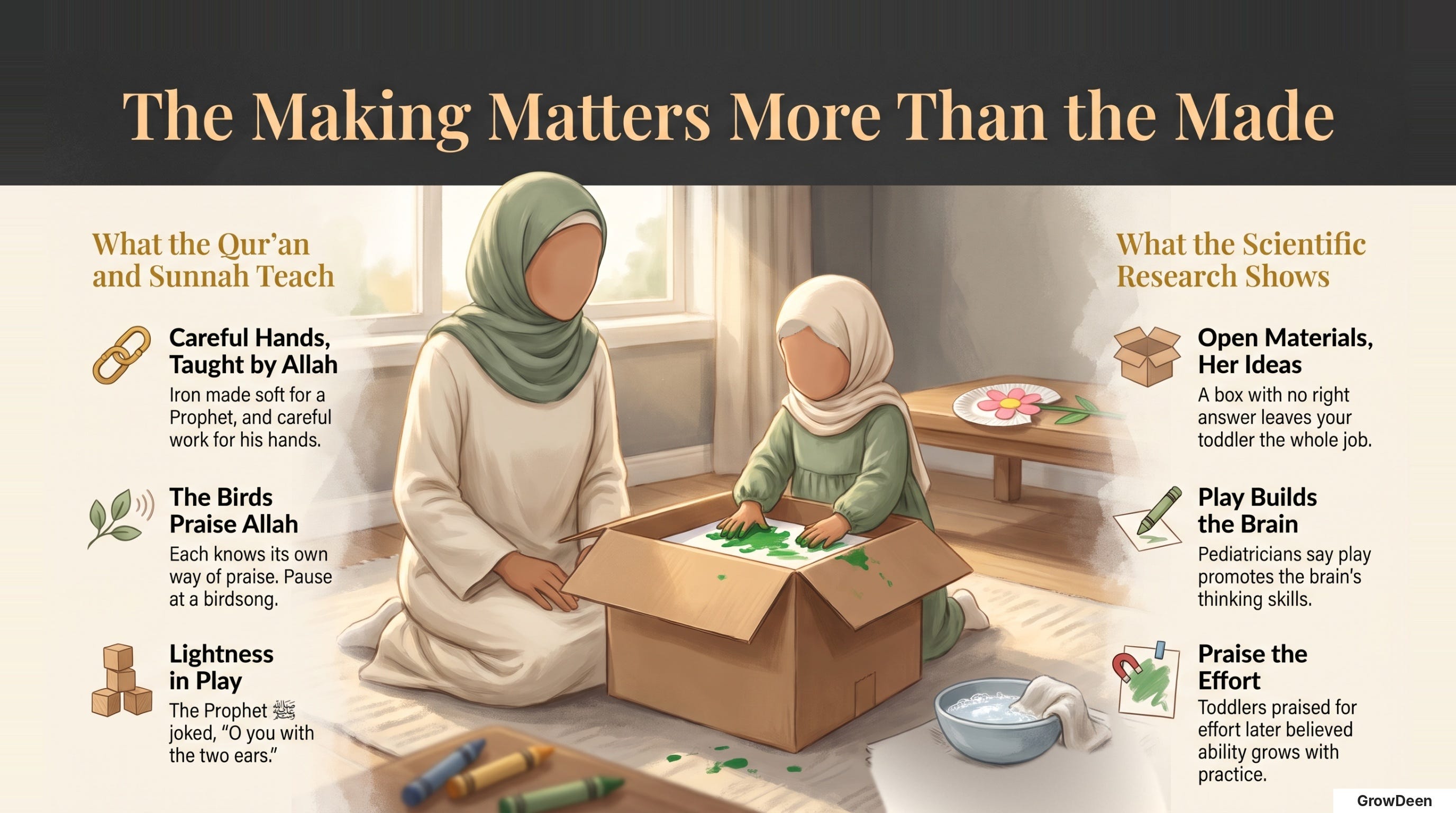
This guide brings together scientific research and the Qur'an and authentic Sunnah. You'll see why the box won, what the Sunnah adds, and what to try tonight.
The Short Answer
Right for your child? Ages 1–3 who ignore set crafts but love boxes, paint, mess and noise. Additional needs? See Make It Work in Your Home.
What's probably happening: a box has no right answer, so your toddler gets the whole job. A pre-cut craft keeps that job for you.
Keep safe: anything small enough to fit inside your child's mouth stays up high. That includes coins, button batteries and pen caps. [1]
Try tonight (5 minutes): put one empty box and two crayons on the floor. Say nothing for a full minute, then describe what you see.
You'll know it's working when: she plays a little longer, or brings you what she made. If she ignores the paper, that is her idea at work.
Get help if: your child loses skills, or shows little pretend play by about 30 months. Start with your child's doctor or pediatrician. [2]
The rest of this guide explains why, and what to do if it does not work.
How to Read This Guide
3 minutes: The Short Answer above is enough for tonight.
7 minutes: The Short Answer, then Knowledge in Practice and If Things Don't Go to Plan.
The whole guide: read on for the scientific research, the Qur'an and Sunnah, and the References.
To share: the bold lines and the pull quotes are made to be shared.
To listen: open this guide in the free Substack app and tap Listen.
Inside This Guide
Myth Check: "A Good Toddler Craft Ends in Something You Can Photograph"
Knowledge in Practice: Set Out, Step Back, Praise the Effort
A toddler who ignores your craft is often busy with a better one: her own.
Myth Check: "A Good Toddler Craft Ends in Something You Can Photograph"
You wanted to give her something lovely, and a finished flower on the fridge feels like proof that you did. That wish is kind. Keeping a child's work and showing it off is a warm thing to do.
The trouble is the belief underneath. Craft kits and polished paper-plate projects in our feeds pull our eyes toward the finished object. A toddler does not care about the finished object.
A standard early-years art textbook takes a child-directed approach and stresses the process of making. [3] A pre-cut kit has already made most of the choices for her. Paint, dough and an empty box leave every choice open.
So keep the fridge gallery. Fill it with handprints, scribbles and torn paper instead of the kit's flower. The making matters more than the made.
Why This Happens
Why did the box beat my craft?
Think back to the box. It had no instructions, no right answer and no adult picture of what it should become. It could be a cave at ten o'clock and a boat by half past.
Early years educators call this an open-ended material. Unstructured, unhurried play with ordinary things, from seedpods to felt-tip pens, can help children become imaginative, inventive thinkers. [4] The pre-cut flower had already been invented by an adult. The box was still waiting for her ideas.
What is she learning in all that mess?
Watch her squash playdough. Her fingers are working out how hard to press. A bigger idea is forming too: my hands can change things.
The American Academy of Pediatrics (AAP) says play enhances brain structure and function and promotes executive function. [5] That is the set of skills for switching between ideas, self-control and holding information in mind. The same report says play builds safe, stable bonds with caregivers and can help buffer stress. [5] Creative play exercises many of these skills at once. [6]
Through painting, pretending, noise and movement, toddlers practice:
trying out an idea and seeing what happens
using every sense, from cold paint to the smell of crushed leaves
showing feelings they have no words for yet
sharing, taking turns and noticing another child
new words and a stronger memory
hand control for crayons and leg control for climbing, with eyes and hands working together [6,5]
For a Muslim family there is one more layer. A child turning a pinecone over, or freezing to watch a ladybird, is meeting Allah's creation through the senses He gave her. A quiet "SubhanAllah, look at that" over a beetle is tarbiyah (raising a child toward good) in its smallest form.
Why does she keep pretending to pray, cook and shop?
A wooden spoon becomes a phone. A bucket of blocks becomes the weekly shop. She unrolls a mat, bows, stands and bows again after watching you pray.
Pretending helps toddlers make sense of their own lives. By about 30 months, most children use things to pretend, like feeding a block to a doll as if it were food. [2] A child who feeds, rocks and tucks in a doll is replaying the care she receives every day. Acting out a caring role may help a child begin to see through someone else's eyes, which is where empathy starts. [7]
Why all the banging, stamping and noise?
Toddlers drop things to hear the clatter, tap spoons on every surface and chatter through every game. That racket is listening and language practice, and the scientific research section below shows one link with early reading.
Movement matters as much. Through movement, toddlers learn about their bodies and the space around them, let feelings out, and practice walking, balancing, jumping, galloping and hopping. [8]
The box didn't win on looks. It won because it left your toddler the whole job.
What the Scientific Research Shows
The strongest evidence here is an official report. The AAP's clinical report on play says play "is not frivolous": it enhances brain structure and function and promotes executive function. [5] It also warns that busy schedules and enrichment programs leave children little time for free play. [5]
Who wrote it: the American Academy of Pediatrics, US, 2018, reaffirmed in January 2025.
How strong this is: Strong. An official clinical report from a professional body.
One long-term study looked at praise. Scientists filmed 53 children at home with a parent during ordinary daily activities, at about 14, 26 and 38 months. [9] Some parents gave a larger share of praise for effort, strategy and actions. Five years later, their children were more likely to believe ability grows with practice. [9] The study did not find that praise for traits, like "You're so clever," was linked with later fixed beliefs. [9]
Who was studied: 53 children in the Chicago area, US. Families were 64% White, 17% African American, 11% Hispanic and 8% two or more races. Incomes ran from under $15,000 to over $100,000 a year. Children with additional needs: not reported.
What was measured: the kind of praise parents gave, and the children's beliefs about ability at 7 and 8.
How strong this is: Suggestive. One good long-term study that observed families. It shows a link and cannot prove a cause. No study has yet tested this with Muslim families.
The noise has a finding of its own. In one study of kindergarten children, rhythm skills were linked with phonological awareness, the ability to hear the separate sounds inside words. They were also linked with word reading two years later. [10]
Who was studied: kindergarten children of about 5, older than this guide's age band. Country, ethnicity, family income and additional needs: not given in the study summary.
How strong this is: Suggestive. One study, read as a summary only, in older children.
The official guides set the floor for active days. The World Health Organization (WHO) advises at least 180 minutes a day of varied physical activity for 1- and 2-year-olds. [11] It also advises no more than 1 hour at a time restrained in a stroller (pram), high chair or carrier. [11] From age 3, at least 60 of those minutes should be moderate to vigorous. [11] Sedentary screen time is not recommended for 1-year-olds. For 2- to 4-year-olds it is no more than 1 hour a day, and less is better. [11] (WHO, international, 2019 · Strong.)
The Centers for Disease Control and Prevention (CDC) list what most children can do by age 3. They can draw a circle when shown how, and string large beads or macaroni. [12] Before then, scribbling, tearing and squashing are the work. (CDC, US, page reviewed 16 May 2026 · Strong.)
The Center on the Developing Child at Harvard University calls the back-and-forth between a child and a caring adult "serve and return". These exchanges build connections in the brain that support communication and social skills. [13] (Expert summary, US · Suggestive.)
What we do not know yet: whether the praise finding holds in other countries and cultures, and in larger families.
What this means for you: give her open materials and unhurried time, answer what she shows you, and praise the effort.
What the Qur'an and Sunnah Teach
Careful work with the hands has a place in the Qur'an. Allah tells of Prophet Dawud عليه السلام, for whom He made iron pliable, and of the mountains and birds repeating His praises with him. [14]
أَنِ ٱعْمَلْ سَـٰبِغَـٰتٍ وَقَدِّرْ فِى ٱلسَّرْدِ
[Commanding him], "Make full coats of mail and calculate [precisely] the links…
Saba 34:11 · Sahih International [14]
Text. Allah made iron pliable for Dawud عليه السلام and taught him to make coats of armor. [14,15] Tafsir Ibn Kathir records al-Hasan al-Basri, Qatadah and al-A'mash saying he could twist the iron in his hands like a thread. [16] It also records Mujahid explaining that the rivets were to be neither too loose nor too tight, but made to fit exactly. [16]
Our reflection. When you sit beside a toddler pressing dough into shape, hold on to that picture. Careful work with the hands was taught to a Prophet by Allah Himself.
The same Book says the birds praise Allah too.
كُلٌّ قَدْ عَلِمَ صَلَاتَهُۥ وَتَسْبِيحَهُۥ
Each [of them] has known his [means of] prayer and exalting [Him]…
An-Nur 24:41 · Sahih International [17]
Text. Ibn Kathir explains that the birds glorify their Lord as they fly, in the way they are inspired and guided to. [18]
Our reflection. When your child freezes at a birdsong on a sound hunt, the two of you are listening to that worship together. Pause there and whisper SubhanAllah (glory be to Allah).
The Prophet ﷺ was light-hearted with children too.
Anas ibn Malik said: "The Prophet ﷺ addressed me as: O you with the two ears."
Sunan Abi Dawud 5002 · Sahih (Al-Albani) · sunnah.com [19]
Text. Jami' at-Tirmidhi places the same words in its chapter on joking, and one of its narrators adds that it was only meant as a joke. [20]
Our reflection. A silly voice for the teddy, or a mock gasp when the tower wobbles, tells your toddler you enjoy being there. Joining her play with that lightness costs nothing.
Scholars differ on drawing living beings. Many scholars hold that drawing people and animals is not permitted, while drawing things without souls, like trees, mountains, cars and planes, is fine. [21] Some Maliki scholars treat a flat drawing of a living being as disliked rather than forbidden. [22] Shaykh Ibn 'Uthaymeen explained that pictures and stuffed toys with no clear face (no eyes, nose or mouth) are not counted among forbidden images. [23]
Scholars differ on dolls as well, and the majority permit dolls and similar toys for children, as an exception to the ruling on images. That permission covers boys as well as girls. [24] A little boy giving his teddy a pretend bottle is rehearsing the tenderness of a caring father.
In practice, a toddler loses almost nothing. Things without souls fill a whole sketchbook, and a plain-faced puppet can hop and wave all afternoon. For your own family's choice, ask your local imam or a local scholar, and share the details with him.
Allah taught a Prophet careful work with his hands. Your toddler's lump of dough is a small start.
The Lab Verdict
The science: toddlers learn through play they lead, with a warm adult who answers them (Strong). Praise for effort was linked with later beliefs that ability grows (Suggestive).
The Qur'an and authentic Sunnah: Allah taught Dawud عليه السلام careful work with his hands, the birds praise Him in their own way, and the Prophet ﷺ met a child with lightness.
Where they meet: the science shows why open materials and warm answers help a toddler learn. The Sunnah gives the spirit: careful hands, wonder and joy. Together, they ask the same of us: set out, step back, delight.
So at home: put out open materials, keep your hands still, and praise the effort when she brings it to you.
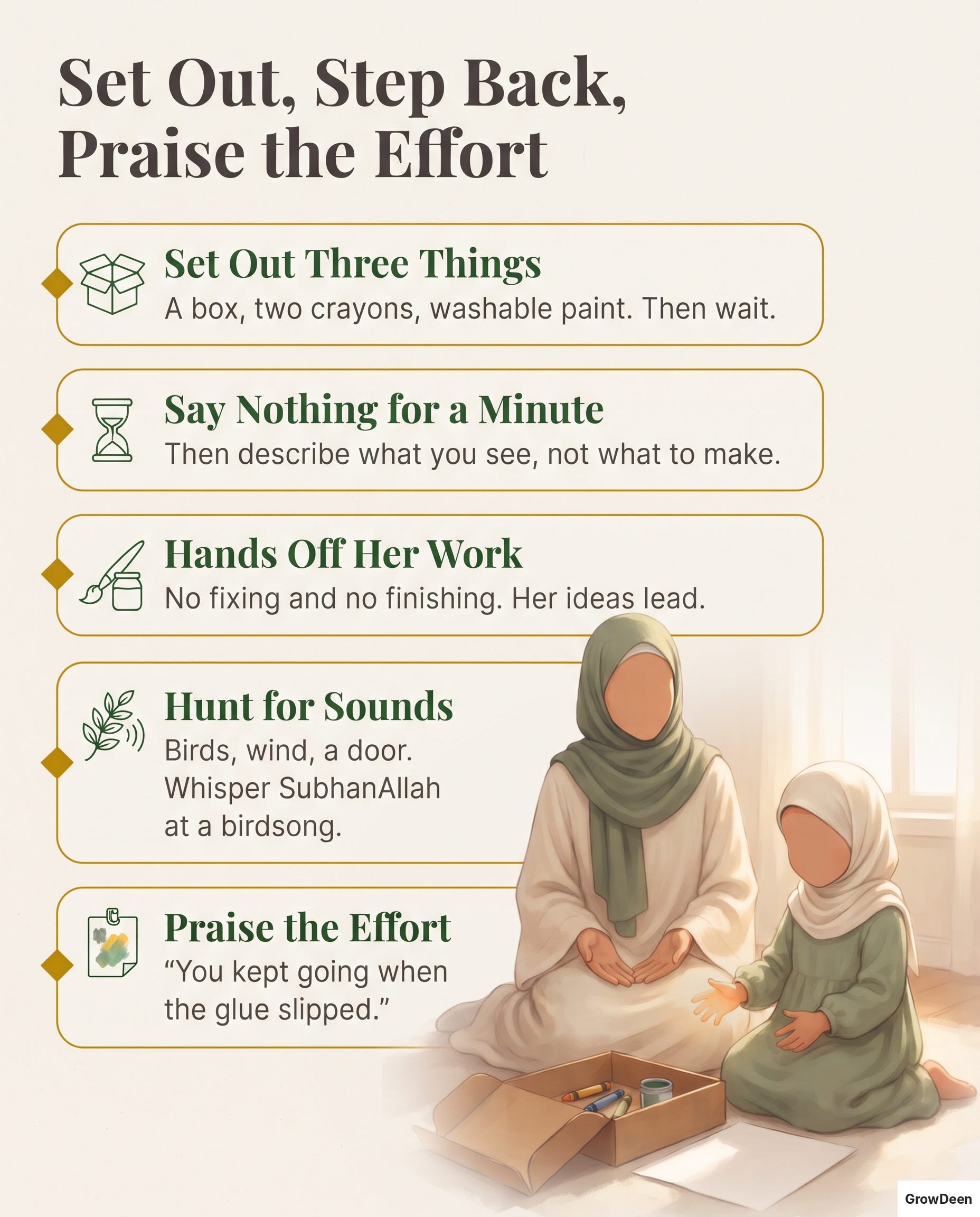
Knowledge in Practice: Set Out, Step Back, Praise the Effort
Knowing why the box won is half the work. The other half happens at your table, on the next ordinary afternoon.
If you can only do one thing, do step 1. It is enough.
1. Set out three open things, then wait (2 minutes). Open materials leave the ideas to your child.
A busy box makes this easy. Fill one container with clean odds and ends:
stickers, paper plates and scraps of colored paper
large bottle lids and empty boxes of different sizes
egg cartons, fabric scraps and short pieces of ribbon
chunky crayons, thick brushes and washable paint labeled nontoxic [25]
Choose three things and put the rest away. Put them on the floor or a low table, and wait.
Say this: "These are for you. I'm right here." (Say it in the language your child knows best.)
More ideas that ask little of you:
Flour paint: flour, water and a drop of food coloring, stirred into a paste she spreads with a whole hand.
Water painting: a bucket of water and a wide brush, aimed at a fence or a path. The "paint" vanishes as it dries, so there is nothing to clean.
A cardboard world: one big box and some crayons, turned into a house, a cave or a little masjid with a doorway to crawl through.
Pretend props: old scarves and bags, soft toys, pans and wooden spoons. Set up a pretend iftar with play food, a quiet "masjid" corner with a small mat, or a sadaqah tin for large play coins.
When she wants a picture, things without souls fill the page. Try the sun and moon, stars, rain and rainbows. Add trees, flowers, fruit, houses, buses, boats, the family car, patterns, swirls and dots. Make puppets and soft toys with a plain face, like a kitchen-roll tube wrapped in a fabric scrap.
Under 2: offer fewer, bigger things and stay within arm's reach. 2–3: let her choose the three things herself.
Plan the mess before it happens: an old shirt or smock, newspaper over the table, and a bowl of soapy water with a towel nearby. Say Bismillah as you start. At the end, say it again as you wash hands together, then Alhamdulillah.
Keep anything small enough to fit inside your child's mouth up high: coins, marbles, small balls, pen caps and button batteries. [1] Make sure toys and parts are larger than your child's mouth, and follow the age recommendations on toy packages. [25,1] Take off loose ribbons and long strings to prevent strangulation. [25] Keep plastic bags out of reach, because they can cause suffocation. [26] Guarding her body in these ordinary ways is part of the amanah (trust) of parenthood.
2. Say nothing for a full minute, then describe (1 minute, then as long as she plays). Toddlers explore best when they choose the direction.
Picture laying out paper and three crayons. She ignores the paper, lines the crayons up by color, then rolls them off the table one at a time. She drew nothing. Still, she learned plenty: matching, cause and effect, and an experiment of her own.
Say this: "You made the yellow go all the way to the edge."
Instead of: "Now draw a sun." Try: "You're making big circles with the blue."
More lines that describe without steering:
"You pressed hard there."
"That one rolled all the way down."
"You're using both hands."
"You put the green next to the red."
Keep your hands off her work: no fixing and no finishing. Fixing a painting, or showing the "right" way to make a puppet, can tell a child her own ideas fall short.
When she holds up a lump of dough for you to see, answer with a look or a word. That is serve and return. [13] Bring some lightness too: a silly voice or a mock gasp tells her you enjoy being there.
Protect a long, unhurried stretch. Five minutes between a nap and the school run rarely goes well. Let the activity change shape: a collage that turns into a leaf-throwing game has not failed.
Under 2: sit close and copy what she does, with few words. 2–3: describe what she did, then wait for her reply.
3. Hunt for sounds and move together (10 minutes, any time before dinner). Listening and moving are making too.
Open a window or step outside and listen together. Listen for birds, wind in the leaves, a tap turned on slowly and footsteps. Listen for a door, a dog, or the adhan from a nearby masjid. Ask, "What was that?" At a birdsong, whisper SubhanAllah. When the adhan comes, stop and listen together.
Say this: "Shh. Who is chirping outside? The birds are saying SubhanAllah in their own way."
Your voice is all the sound play a toddler needs. Use spoken rhymes and chants for diaper (nappy) changes, bath time and car rides. Clap the syllables of familiar words: "Al-ham-du-lil-lah", "ap-ple", "Bis-mil-lah". Recite short surahs slowly: your toddler may catch the rhythm of Al-Ikhlas long before she knows its meaning.
Fill a clear bottle with rice or lentils, seal it tight with strong tape, and check the seal before each use. Tell stories with sound effects, such as Nuh عليه السلام building the ark or Yunus عليه السلام inside the big fish. Let her make the rain and the waves.
Then move. Chant "Hop, hop, hop and freeze," and let her keep time with your voice. Crawl like a cat, roll like a log across the rug, or plod across the sand. Sway like a palm tree in a storm, or curl up small like a seed and grow toward the sun. Then step back and let her call the moves. These minutes count toward the WHO's 180 minutes of varied activity a day. [11]
Say this: "Hop, hop, hop and..." Then pause, and let her shout the "freeze."
4. Praise the effort and take it as a gift (30 seconds). What you say when she hands you her work carries further than it seems. [9]
Say this: "You kept going when the glue slipped."
More effort lines for the fridge moment:
"You chose blue and green together. Tell me about them."
"Look how carefully you pressed those leaves down."
"You tried lots of ways to make it stick."
"You worked on that for a long time."
Instead of: "You're so clever." Try: "You kept trying until it stuck."
Then receive it as a gift: "JazakAllahu khairan, this is going on the fridge." Being thanked can teach her to give thanks. Say mashaAllah over the effort too, so admiration and the remembrance of Allah arrive together.
Make It Work in Your Home
No spare money, or a small flat? A cereal box and two crayons on the floor make a complete art table.
On your own with several little ones? Give each child their own three things and their own patch of newspaper. Siblings and cousins create differently, and comparing can make a toddler less willing to try.
A grandparent who loves a neat, finished craft? Give them the describing job instead of the fixing job.
Say this to Grandma (or Nani, Teta or Grandpa): "You always made such lovely things with us. Would you sit with her and tell her what you see? She loves showing you."
Slow to get started? Show one simple action, like pressing a palm into dough, and give her time to copy you.
Sensitive to textures or noise? Bring new textures in slowly, dry before wet, keep sounds soft, and let her watch before she touches.
Vision or hand-control difficulties? Choose big oak leaves over small petals, fat crayons and thick brushes, and add things with interesting smells or textures.
Plenty of energy? Big movements can be part of the session too: jumping, swinging arms, stretching and shaking.
Limited mobility? You can gather the materials and set them within her easy reach.
The family question: ask your own mother or father, "What did you love making when you were small?"
Try It Seven Times
Any seven times in the next week or two, set out three open things and wait a full minute before you speak. Seven is a starting goal, not a magic number. After each one, note one word for what she did. Tell us in the comments what changed. We'd love to know.
Set out, step back, then praise the effort. That is the whole practice.
If Things Don't Go to Plan
If everything goes in her mouth: go back to big things only, like large lids, big boxes and fat crayons, and stay within reach. The mouth-size check still applies to every item. [1]
If she ignores everything you set out: try one thing tomorrow, or bring out the box on its own. Walking away is information too.
If she wants you to draw it for her: draw a tree or a bus on your own paper, then hand the crayon back. "Your turn. What will you make?"
If the mess gets to you: it happens to most parents. Breathe, wipe one thing, and say, "I'm sorry I snapped. Let's clean up together." Planning the mess ahead makes gentleness easier next time.
If screens keep winning: the WHO advises no sedentary screen time at age 1. From 2 to 4, it advises no more than an hour a day, and less is better. [11] A busy box by the sofa makes the swap easier.
If the days are packed: back-to-back activities leave children little time for free play. [5] One unplanned afternoon a week is a good start.
If you start doubting yourself: Shouldn't I be teaching her something? You are. Each table you set teaches her, and so does each minute you wait before you speak.
Speak to someone if: your child loses skills she once had. Speak up, too, if by about 30 months she shows little interest in pretend play or in playing next to other children. Talk to your child's doctor, share what you have seen, and ask about developmental screening. [2] Signs are clearer looking back. Seeing them late is not neglect. Seeking help early sits comfortably alongside du'a for your child. For questions of deen, ask your local imam or a local scholar, and share the details with him.
Who to turn to: your child's doctor or pediatrician. In an emergency, call your local emergency number.
Support Muslim Parenting Lab ❤️
Would you like the most rewarded kind of charity there is? Use the button below now, while you are well, rather than later.
Asked which charity is best, the Prophet ﷺ said the one given while you are healthy, not deferred until death is near. (Sahih al-Bukhari 1419)
Your Companion Pack: Make and Move Pack
That is a lot to hold in your head between nap time and dinner. The free Make and Move Pack keeps it on paper: one PDF of three pages, for the kitchen drawer and the fridge.
Page 1, The Art Table Set-Up Card: a before, during and after checklist for one creative session. It adds the mouth-size check, a "keep up high" list and things without souls to draw.
Page 2, Sound Hunt and Move Cards: twelve cut-out cards to keep in a jar. Six are for listening, from birds to the adhan, and six are spoken-chant movement games.
Page 3, The Birds Say SubhanAllah: two reflections with words to say. An-Nur 24:41 and Tafsir Ibn Kathir are for a birdsong; Saba 34:11 is for when your child makes something. The "two ears" hadith closes the page.
Parents Also Ask
Why does my toddler play with the box instead of the toy?
A box has no right answer, so your toddler decides what it becomes: a cave, a boat, a bed for a teddy. Unstructured play with ordinary things can help children become imaginative, inventive thinkers. [4] Why This Happens explains more.
What if my toddler isn't interested in crafts?
A craft with fixed steps leaves a toddler little to decide, so she may wander off. Offer open materials instead, like paint, dough or a box, and let her lead. Knowledge in Practice has the steps.
What is process art for toddlers?
Process art puts the making first: your child explores paint, paper or dough with no finished model to copy. A standard early-years art textbook takes this child-directed, process-focused approach. [3] Handprints across the table count.
Is it haram for kids to draw animals or people?
Scholars differ. Many scholars hold that drawing people and animals is not permitted, while drawing things without souls is fine. [21] Some Maliki scholars treat flat drawings as disliked rather than forbidden. [22] For your family's choice, ask your local imam or a local scholar, and share the details with him.
Are dolls haram for kids?
Scholars differ, and the majority permit dolls and similar toys for children, as an exception to the ruling on images. The permission covers boys as well as girls. [24] For your own family, ask your local imam or a local scholar, and share the details with him.
How should I praise my toddler's drawing?
Name the effort and the choices, like "You kept going when the glue slipped," rather than your child's traits. In one study, toddlers who heard more praise for effort were more likely at 7 and 8 to believe ability grows with practice. [9] Then thank her for it, like a gift.
How much active play does a toddler need each day?
The WHO advises at least 180 minutes of varied physical activity a day for 1- and 2-year-olds. It also advises no more than an hour at a time in a stroller, high chair or carrier. [11] From age 3, at least 60 of those minutes should be moderate to vigorous. [11]
Final Reflection
Dear parent,
You spent an evening making something for your child. Then you read this far to understand her better. That care shows.
If you have been planning neat crafts until now, you did it out of love. You were doing what you were shown. Allah sees the intention behind every plate you cut out.
You don't need a new routine this week. Find one empty box tonight. Put it on the floor, say nothing for a minute, and watch.
You are not failing when she pushes the plate away. You are not losing her to a box. You are making room.
Often, the box wins because it leaves your toddler the whole job. Leave her that job tonight.
A Du'a for This
For you:
رَبَّنَا هَبْ لَنَا مِنْ أَزْوَٰجِنَا وَذُرِّيَّـٰتِنَا قُرَّةَ أَعْيُنٍ وَٱجْعَلْنَا لِلْمُتَّقِينَ إِمَامًا
Rabbanā hab lanā min azwājinā wa dhurriyyātinā qurrata a'yunin waj'alnā lil-muttaqīna imāmā
"Our Lord, grant us from among our wives and offspring comfort to our eyes and make us a leader [i.e., example] for the righteous."
Al-Furqan 25:74 · Sahih International [27]
With your child: SubhanAllah ("Hallowed be Allah"), one of four phrases the Prophet ﷺ called "the dearest phrases to Allah" (Sahih Muslim 2137a). [28] Say it together at a birdsong or over a finished painting. Over a baby or a child who doesn't speak yet, say it for her.
Share the Khayr
Think of the parent whose fridge is covered in crafts she cut out at midnight. Or the friend whose toddler "won't do crafts". Send this to her. The Prophet ﷺ said that one who guides to something good has a reward similar to that of its doer. [29]
Tell us in the comments: what did your toddler do the first time you stayed quiet for a full minute? We'd love to know.
Parents Also Read
Parents who read this guide also found these helpful.


References
[1] American Academy of Pediatrics. (2026). Choking prevention for babies and children: What every parent needs to know. HealthyChildren.org.
[2] Centers for Disease Control and Prevention. (2026). Milestones by 30 months. Learn the Signs. Act Early.
[3] Englebright Fox, J., & Schirrmacher, R. (2015). Art and creative development for young children (8th ed.). Cengage.
[4] Kolbe, U. (2014). Children's imagination: Creativity under our noses. Peppinot Press.
[5] Yogman, M., Garner, A., Hutchinson, J., Hirsh-Pasek, K., Golinkoff, R. M., & Committee on Psychosocial Aspects of Child and Family Health. (2018). The power of play: A pediatric role in enhancing development in young children. Pediatrics, 142(3), e20182058.
[6] Churchill Dower, R. (2019). Creativity and the arts in early childhood: Supporting young children's development and wellbeing. Jessica Kingsley Publishers.
[7] Ewing, R. (Ed.). (2012). Creative arts in the lives of young children: Play, imagination and learning. ACER Press.
[8] Edwards, L. C. (2013). Music and movement: A way of life for the young child (7th ed.). Pearson Education.
[9] Gunderson, E. A., Gripshover, S. J., Romero, C., Dweck, C. S., Goldin-Meadow, S., & Levine, S. C. (2013). Parent praise to 1- to 3-year-olds predicts children's motivational frameworks 5 years later. Child Development, 84(5), 1526–1541.
[10] Moritz, C., Yampolsky, S., Papadelis, G., Thomson, J., & Wolf, M. (2013). Links between early rhythm skills, musical training, and phonological awareness. Reading and Writing, 26(5), 739–769.
[11] World Health Organization. (2019). Guidelines on physical activity, sedentary behaviour and sleep for children under 5 years of age. World Health Organization.
[12] Centers for Disease Control and Prevention. (2026). Milestones by 3 years. Learn the Signs. Act Early.
[13] Center on the Developing Child at Harvard University. Serve and return. Harvard University.
[14] Qur'an, Saba 34:10–11. Translation: Sahih International.
[15] Qur'an, Al-Anbiya 21:80. Translation: Sahih International.
[16] Tafsir Ibn Kathir on Saba 34:10–11.
[17] Qur'an, An-Nur 24:41. Translation: Sahih International.
[18] Tafsir Ibn Kathir on An-Nur 24:41.
[19] Sunan Abi Dawud 5002. Graded: Sahih, by Al-Albani.
[20] Jami' at-Tirmidhi 1992. Graded: Hasan, by Darussalam.
[21] Islam Question & Answer. Ruling on drawing animate beings (Question 39806). IslamQA.
[22] Nsour, R. (2013). The Maliki view on pictures of humans and animals. SeekersGuidance.
[23] Islam Question & Answer. Ruling on drawing pictures for children without facial features (Question 87720). IslamQA.
[24] Islam Question & Answer. Are dolls only for girls? Is it permissible to play with them after reaching puberty? (Question 175405). IslamQA.
[25] American Academy of Pediatrics. (2026). How to buy safe toys. HealthyChildren.org.
[26] MedlinePlus, U.S. National Library of Medicine. (2025). Home safety: children. MedlinePlus Medical Encyclopedia.
[27] Qur'an, Al-Furqan 25:74. Translation: Sahih International.
[28] Sahih Muslim 2137a.
[29] Sahih Muslim 1893a.
We combine scientific research with Qur’an and authentic Sunnah, and we cite our sources. Even so, this is general guidance and no substitute for a doctor who can examine your child.
Sources & confidence
The hadith in this guide are from Sahih Muslim, Sahih al-Bukhari, Sunan Abi Dawud (graded Sahih by Al-Albani) and Jami' at-Tirmidhi (graded Hasan by Darussalam). Qur'an translations are Sahih International. Checked November 2026. Found a source that looks wrong? Email us at info@growdeen.com. For a ruling on your own situation, ask your local imam or a local scholar, and share the details with him.
Words in this guide
executive function · scientific term: the brain skills for switching between ideas, self-control and holding information in mind.
phonological awareness · scientific term: hearing the separate sounds inside words, an early step toward reading.
serve and return (back-and-forth) · scientific term: a child offers a sound, look or object, and a caring adult answers it.
open-ended materials (open-ended play) · scientific term: things with no single purpose, so the child invents what they become.
developmental screening · scientific term: a short check by your child's doctor of how your child is learning, moving and talking.
process art · everyday term: art where the making counts more than the finished piece.
messy play · everyday term: play with paint, dough, water and other materials that spread everywhere.
busy box · everyday term: one container of clean odds and ends a toddler can make things with.
sensory bottle · everyday term: a sealed clear bottle of rice or lentils to roll, shake and watch.
tarbiyah · Islamic term: raising a child toward good.
amanah · Islamic term: a trust given by Allah.
tafsir · Islamic term: an explanation of the meaning of the Qur'an.
surah · Islamic term: a chapter of the Qur'an.
Maliki · Islamic term: one of the four main schools of Islamic law.
deen · Islamic term: the way of life of Islam.
du'a (doa) · Islamic term: supplication, asking Allah.
adhan (azan) · Islamic term: the call to prayer.
Bismillah · Islamic term: in the name of Allah.
Alhamdulillah · Islamic term: all praise is for Allah.
SubhanAllah · Islamic term: glory be to Allah.
mashaAllah · Islamic term: what Allah has willed, said in admiration.
JazakAllahu khairan · Islamic term: may Allah reward you with good.
sadaqah · Islamic term: charity given for the sake of Allah.
iftar · Islamic term: the meal that breaks the fast.
masjid (mosque) · Islamic term: a place of prayer for Muslims.
khayr · Islamic term: good.
diaper (nappy) · country word: the cloth or disposable pad a baby or toddler wears.
stroller (pram, pushchair) · country word: a wheeled seat for pushing a young child.
color, practice, labeled · country word: US spellings of colour, practise and labelled.