

Your preschooler keeps asking what to do, and you're out of ideas?
The free Clue Trail Pack holds a planner, a safety check and scripts.
AGES 3–5 YEARS · 17 MIN READ
Nine in the morning. The baby is finally asleep. Your tea is half drunk and going cold.
Then it comes again, like a dripping faucet: "What can I do now?"
You offer the box of toys from last Eid. Your child looks at the box, then at you. And asks again.
I've suggested everything I can think of. Do I hand over the tablet and feel bad all morning?
This is not a failure of love or imagination. You have care to spare. What you need is a plan, and a good one can cost nothing.
This guide brings together scientific research and the Qur'an and authentic Sunnah. You'll see why picture clues hold a child's attention, and what to say once the treasure is found.
The Short Answer
Right for your child? Ages 3–5 who keep asking what to do. Under 3, try a collection hunt (step 3). Additional needs? Look for "Show this" for ways to adapt each step.
What's probably happening: your child wants a goal to work toward. A suggestion doesn't give one.
Keep safe: pick a treasure too big to fit in the smallest child's mouth.
Try tonight (15 minutes): choose a treasure from home. Draw four picture clues that lead back to it.
You'll know it's working when: your child goes quiet, keeps searching and comes back talking. A clue that stumps them is part of the game.
Get help if: your child often squints at things in plain view, or something keeps worrying you. Start with your child's doctor or pediatrician.
The rest of this guide explains why, and what to do if it does not work.
How to Read This Guide
3 minutes: The Short Answer above is enough for tonight.
7 minutes: The Short Answer, then Knowledge in Practice and If Things Don't Go to Plan.
The whole guide: read on for the scientific research, the Qur'an and Sunnah, and the References.
To share: the bold lines and the pull quotes are made to be shared.
To listen: open this guide in the free Substack app and tap Listen.
Inside This Guide
You have love to spare. Add a plan and four paper scraps, and the morning has a shape.
Myth Check: "Saying 'Be Careful' Keeps Them Safe"
It comes from love. Your child is up on a low wall, and the words are out before you think.
What it gets right. Some dangers are real, and a young child cannot judge them all. Broken glass, open water and traffic need an adult, which is why step 2 has you walk the route first.
What the evidence says. A 2024 Canadian Paediatric Society statement looks at outdoor play. Children who hear "be careful" again and again may come to hear "you don't think I can do it," the statement notes. Over time, such warnings may lower a child's confidence and make active play less appealing. [1]
It describes a growing call to keep children "as safe as necessary" rather than "as safe as possible" in outdoor play. It also reports experts' advice to pause for 15 to 30 seconds before stepping in. Then ask a question that helps your child think, such as "How will you get down?" [1]
This is expert guidance (Suggestive); no trial has tested it.
So remove the real hazards before the hunt. During the hunt, ask more and warn less.
Why This Happens
Why do a few paper clues hold my child's attention?
From the kitchen window, a child with clue one in hand looks like they are wandering. Up close, four jobs are running at once.
Your child holds the picture in mind while moving and compares it with every surface. They turn down the things that nearly match, and try to remember which bush they already checked.
The Center on the Developing Child at Harvard University calls skills like these executive function. It compares them to an air traffic control system in the brain, helping us manage information, make decisions and plan ahead. No one is born with these skills, but we are all born able to develop them. [2]
A hunt gives those skills an ordinary, free workout, with no worksheet in sight.
Why does one clue always stall?
Every hunt has one clue that does not land. Maybe the drawing was too rough, or the light changed.
Those seconds matter.
Step in too fast, and your child may learn that being stuck means an adult will fix it. Wait too long, and the game can feel like a test they are failing. Help that does not look like rescue sits in the middle, and step 3 of Knowledge in Practice shows how.
Does every child search the same way?
No. Some dash ahead and miss things; some check every leaf.
An autistic child, a child with a speech delay or a child learning two languages may need fewer stops, more time or more help. The game still works; the setup changes.
When your child goes quiet on a hunt, a busy mind is doing four jobs at once.
What the Scientific Research Shows
The strongest evidence here is about movement.
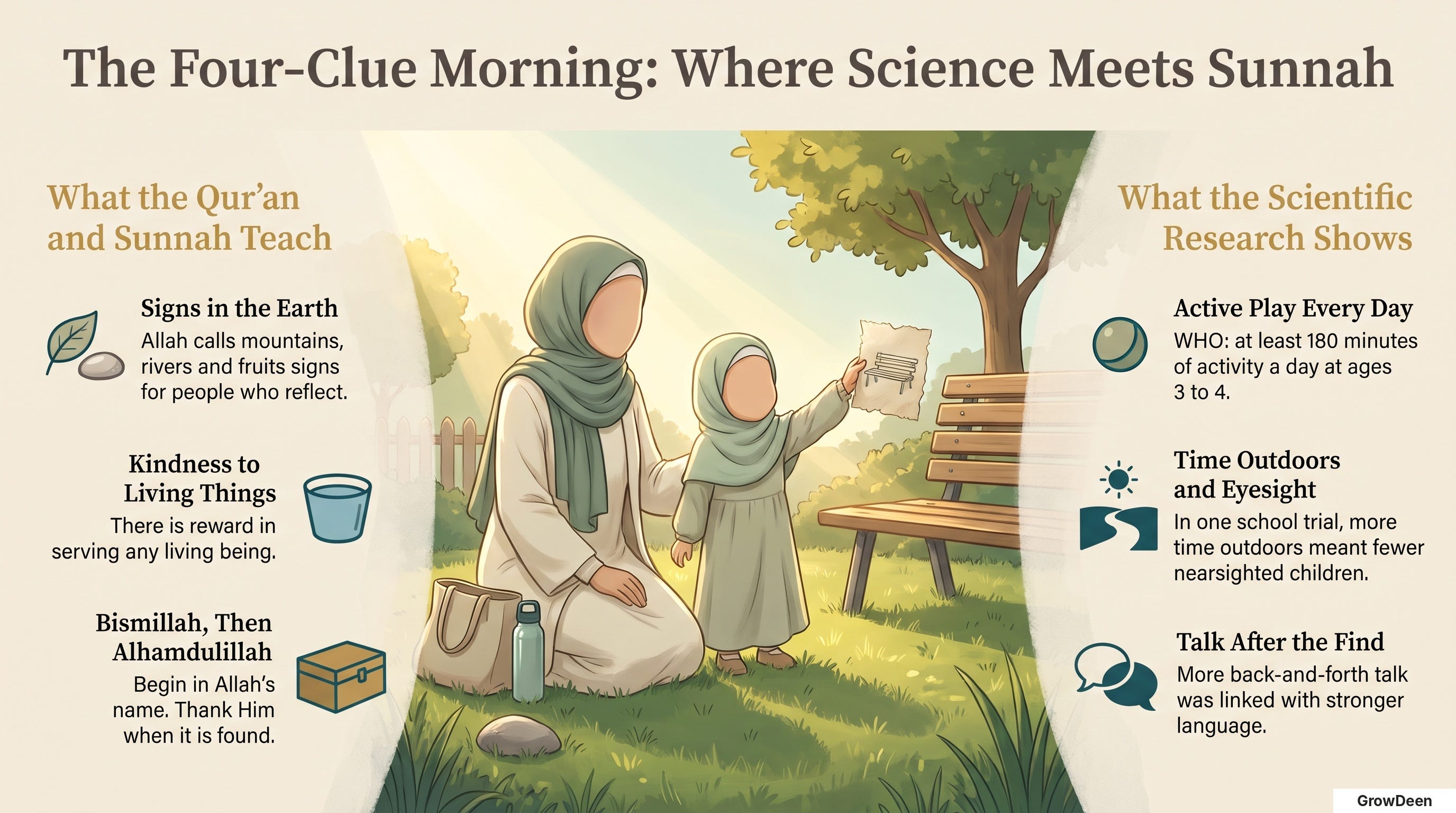
The World Health Organization's 2019 guidance says children aged 3 to 4 should get at least 180 minutes of physical activity a day. At least 60 of those minutes should be moderate to vigorous. Screen time while sitting should be no more than 1 hour, and less is better. [3]
Who wrote it: the World Health Organization (international), 2019; no review date is given. How strong this is: Strong, an official guideline.
In a national US survey of 8,950 preschool-aged children, parents reported that 51% went outside to play with a parent at least once a day. [4] That leaves about half who did not.
Who was studied: a nationally representative US sample; ethnicity, family income and additional needs are not given in the study summary. How strong this is: Suggestive, one large survey that describes habits and cannot show cause.
Time outdoors may also matter for eyesight.
A trial in Guangzhou, China, randomly chose six of 12 primary schools to add one 40-minute outdoor class each school day. Parents in those schools were encouraged to take children outdoors after school. Over three years, 30.4% of children in those schools became nearsighted (short-sighted), against 39.5% in the schools that changed nothing. [5]
Who was studied: 1,903 first-grade children aged 6 to 7 in China; family income and additional needs are not given in the study summary. How strong this is: Suggestive, one well-designed randomized trial, in children a little older than this guide's readers. The study's authors note that earlier studies linked the protection with total time outdoors; indoor sport showed no such link. [5]
The talk after the find has its own evidence.
Scientists at MIT recorded the home language of 36 children aged 4 to 6. Children who had more back-and-forth conversational turns with adults showed more activity in Broca's area, a language area of the brain, during a story task. This held regardless of family income, IQ or how much adults talked, and it helped explain the link between home talk and verbal skill. [6]
Who was studied: 36 children aged 4 to 6 across income levels. Country, ethnicity and additional needs are not given in the study summary. How strong this is: Suggestive, one small study; it shows a link and cannot show cause.
What we do not know yet: no study has tested treasure hunts themselves. No study has yet tested any of this with Muslim families.
What this means for you: moving, being outdoors and talking it over each have evidence behind them, and one clue hunt holds all three.
What the Qur'an and Sunnah Teach
وَهُوَ ٱلَّذِى مَدَّ ٱلْأَرْضَ وَجَعَلَ فِيهَا رَوَٰسِىَ وَأَنْهَـٰرًۭا ۖ وَمِن كُلِّ ٱلثَّمَرَٰتِ جَعَلَ فِيهَا زَوْجَيْنِ ٱثْنَيْنِ ۖ يُغْشِى ٱلَّيْلَ ٱلنَّهَارَ ۚ إِنَّ فِى ذَٰلِكَ لَـَٔايَـٰتٍۢ لِّقَوْمٍۢ يَتَفَكَّرُونَ
And it is He who spread the earth and placed therein firmly set mountains and rivers; and from all of the fruits He made therein two mates; He causes the night to cover the day. Indeed in that are signs for a people who give thought.
Ar-Ra'd 13:3 · Sahih International [7]
Text. Allah names the earth, its mountains and rivers, its fruits, and the night covering the day. Then He calls them signs for people who give thought.
In his tafsir, Ibn Kathir explains that rivers, springs and streams water fruits and plants of every color, shape, taste and scent. Day and night pursue each other, one arriving as the other leaves. These are signs for people who reflect on Allah's signs and the evidence of His wisdom. [8]
Our reflection. The tafsir speaks to adults and does not mention children or play, so the link here is one of principle. Still, a 4-year-old turning a pointed leaf to see both sides is doing a small, early version of that looking. That kind of looking is part of your child's tarbiyah (raising a child toward good), and may be where it begins.
The Prophet ﷺ told of a thirsty traveler who drank from a well and climbed out.
"Meanwhile he saw a dog panting and licking mud because of excessive thirst. … So, he went down the well again and filled his shoe with water and watered it. Allah thanked him for that deed and forgave him." … He replied: "Yes, there is a reward for serving any animate (living being)."
Sahih al-Bukhari 2466 · sunnah.com [9]
Text. The Prophet ﷺ taught that serving any living being carries a reward.
Our reflection. A child who lifts a stone and finds a beetle has a small choice to make. Shown how to look first and touch gently, they learn adab (good conduct) toward a living thing. An excited child is often ready to learn it.
Our reflection. Say Bismillah as you hand over the first clue, and Alhamdulillah out loud when the treasure is found. Two seconds each. Your child hears that finding something good and thanking Allah belong together.
Your child crouched over a beetle is not wasting the morning. That close look may be where reflection begins.
The Lab Verdict
The science: time outdoors, active play and back-and-forth talk each have evidence behind them for young children. (Strong for the activity guideline; Suggestive for the eyesight and conversation findings.)
The Qur'an and authentic Sunnah: Allah calls the earth, its rivers and its fruits signs for people who give thought. The Prophet ﷺ taught that serving any living being carries a reward.
Where they meet: the science shows why a morning outside, a puzzle and a talk help. The Sunnah gives the looking its purpose and its gentleness. One shows what helps the child; the other shows why we look.
So at home: plan four clues, step back, look closely together, and talk when it's found.
Knowledge in Practice: The Four-Clue Morning
Knowing why the hunt works is half the work. Knowledge bears fruit only when it reaches the yard.
If you can only do one thing, do step 1. It is enough.
1. Plan the trail backwards (15 minutes). Start at the end. Decide where the treasure goes, then build the trail in reverse.
Say the treasure is under the slide. The clue for the slide hides at the water faucet (tap), and the clue for the faucet sits on the bench. The clue for the bench goes in your child's hand.
Four stops is plenty. Six is too many for most children under 5.
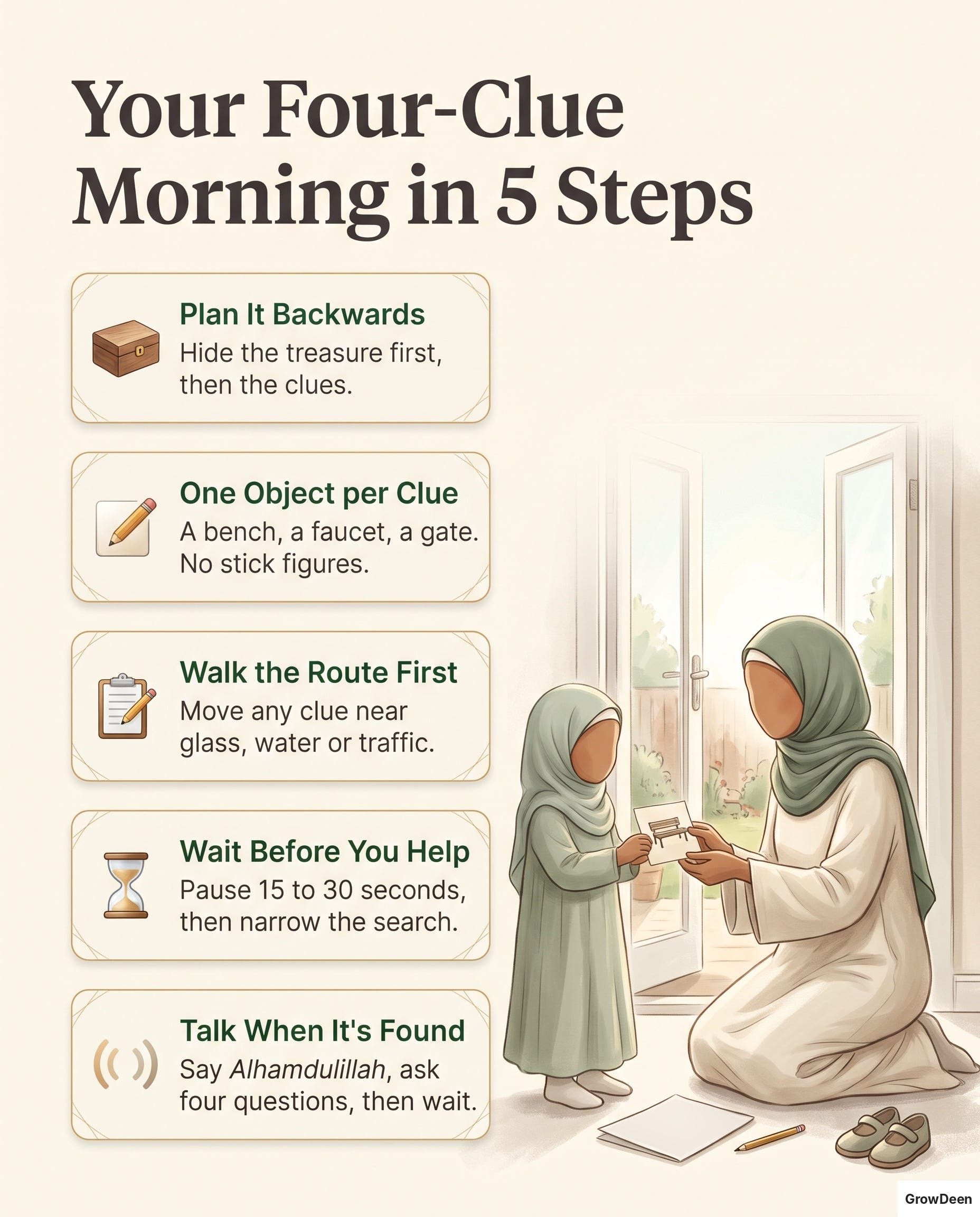
Draw one clear object per clue, with nothing else on the paper: a bench, a faucet, a gate. Objects and places work. Stick figures do not: a child can match a drawn bench to a real one, but a stick figure matches nothing.
Drawing objects also avoids a question some Muslim families have about drawing living beings. For your family's view, ask your local imam or a local scholar, and share the details with him.
The treasure comes from your own house: a bright ball, a wooden spoon, an old set of keys, a soft toy.
Most children who die from choking are under 5, and balls, marbles, toy pieces and balloons are among the most common causes. [10] So keep the treasure too big to fit in the mouth of the smallest child coming along.
Hide everything while someone else keeps your child busy, and keep one spare clue in your pocket.
Say this: "I've hidden something for you. Do you want to find it?" (Say it in the language your child knows best.)
No printer: a pencil and four scraps of paper are enough.
2. Walk the route and say the boundary (5 minutes). Before you hide anything, walk the route yourself. Look for broken glass, cans or sharp metal, and for needles, animal mess or standing water.
Move any clue within reach of a road, parking lot (car park) or driveway. Skip any spot that would make your child climb higher than they can get down from. Pack a water bottle, and check the sun for the time of day you are going.
A hazard is a reason to move a clue, not a reason to watch more carefully.
Then say the boundary out loud and have your child point it back to you. By 3, most children avoid touching hot objects when warned, so a clear, early warning can land. [11] Thirty seconds now, and you stop being the person shouting across a park.
Say this: "Bismillah. Here is your first clue. You can go as far as that tree, that fence, and that gate. Show me where you can go."
3. Hand over clue one, then step back (as long as the hunt lasts). Your job now is to watch. When your child stalls, wait 15 to 30 seconds before you say anything, as experts in the Canadian statement suggest. [1]
Then give help that does not look like rescue. Narrow the search area, ask what the picture reminds them of, or walk beside them.
A child who finds the treasure with three hints has still found it. The looking is the lesson, not the treasure.
Say this: "It's somewhere between the gate and the bench."
Instead of: "Be careful." Try: "How will you get down from there?"
Instead of: "Look, it's right there on the bench." Try: "What does this picture remind you of?"
Under 3: clue-following is usually still out of reach. Run a collection hunt: a bag, and a short list you read aloud, such as a round pebble, a pointed leaf and a feather. Then sort the bag together.
By 3, most children can string large beads and ask "who," "what," "where" or "why" questions, the skills a collection hunt uses. [11]
3–5: picture clues fit well. By 4, most children name a few colors and tell what comes next in a well-known story. [12] Keep the trail short and stay in sight.
5 and 6: try one short written sentence per card, or a rough map with an X.
Show this: point to the picture, then sweep your hand toward the area to search. For some children, keep the treasure in view the whole time and make the walk toward it the game. One clue and one short walk can be the whole hunt.
4. When they lift a stone, slow down (1 minute). A snail or a beetle under a stone is a chance to show how to treat a living thing. Look first, touch gently or not at all, then put the stone back exactly as you found it.
Say this: "Look first. What has Allah put under here? Gently, or not at all. It is alive."
5. Sit down and talk when it's found (5 minutes). The pull is to clap and head home. Sit on the bench instead.
Say Alhamdulillah out loud, then ask the questions one at a time and wait after each. The waiting is what turns a question into a conversation, and back-and-forth talk is what the MIT study linked with language. [6]
Say this:
"Which clue was the hardest?"
"What did you think it was at first?"
"What did you see on the way that you did not expect?"
"What should we hide next time?"
Make It Work in Your Home
No yard (garden)? A hallway, a stairwell, two rooms and a balcony all work, and so does a corner of the park. Indoors, you lose the outdoor time, so head outside when the weather allows. [5]
Several children? Give each child their own color of clue. Or let the older one hide the treasure and run the hunt, so it never becomes a race.
On your own with a baby? Draw and hide indoor clues the night before, after bedtime. Then the morning needs nothing but the first clue.
Tempted by a sweet prize? If the treasure is always chocolate, the chocolate becomes the point and the searching stops being the fun part.
Say this to the adult who keeps your child busy (your spouse, a grandparent, an older sibling): "You're so good with her. Could you read with her by the window for ten minutes? I'm hiding something for her to find."
The family question: ask your own mother or father, "What did you play outside when you were small?"
Plan backwards, step back, look closely, then talk: that is the whole morning.
If Things Don't Go to Plan
If your child gets stuck and wants to quit: narrow the area and walk with them. A finish with help is still a finish.
If the hunt is over in five minutes: spread the clues further apart next time, or add one stop.
If your child squashes a creature: stay calm. Say, "It was alive. Next time, we look first." Then carry on with the hunt.
If you start doubting yourself: Am I only doing this to get an hour of quiet? Wanting a calmer morning is allowed.
You planned something for your child, and you will sit and talk with them after. That is care.
If you lose your patience: it happens. Sit down beside your child and say, "I'm sorry I got cross. Can we find the next one together?" Repair is part of the lesson.
Speak to someone if: the game keeps showing you something you had half-noticed. Your child may struggle every time to match a drawing to a real object, or drift off within seconds every time. They may not turn to their name, or may squint at things in plain view.
Write down what you saw. "She walked past the paper on the bench three times" gives a doctor something to work with.
Signs are clearer looking back. Seeing them late is not neglect.
For questions of deen, ask your local imam or a local scholar, and share the details with him.
Who to turn to: your child's doctor or pediatrician. In an emergency, call your local emergency number.
Support Muslim Parenting Lab ❤️
Would you like the reward of every parent who acts on what they read here? Fund it with the button below and it is yours.
The Prophet صلى الله عليه وسلم said whoever guides to good has a reward like the one who does it. (Sahih Muslim 1893a)
Your Companion Pack: Clue Trail Pack
Free to download, three printable pages:
Page 1, The Backwards Trail Planner: a fill-in sheet with the treasure slot first and four clue slots running back to the first clue. Four boxes let you draw your clues and cut them out.
Page 2, The Sixty-Second Sweep: the route check, the boundary words for the first clue, and the four questions for when the treasure is found.
Page 3, Look, Don't Crush: the verse on the signs in the earth, with Ibn Kathir's explanation. It also holds the hadith of the man who watered a thirsty dog, and three lines for when your child lifts a stone.
Parents Also Ask
What age can a child do a treasure hunt?
Picture clues often suit children from about 3, once they can match a drawing to a real thing. Under 3, a collection hunt works better: a bag and a short spoken list of things to find. The age lines under step 3 explain more.
How many clues should a treasure hunt for a 4-year-old have?
Four or five is a good start. Six is where it often tips over for children under 5, and a hunt that ends in tears is worse than a short one. You can always add a stop next time.
How do you make a treasure hunt for kids who can't read?
Use picture clues, with one clear object on each paper: a bench, a faucet, a gate. Plan it backwards from the treasure, as step 1 shows.
Can you do a treasure hunt indoors?
Yes. A hallway, a stairwell, two rooms and a balcony all work. You lose the time outdoors, which one trial linked with fewer children becoming nearsighted, so go outside when you can. [5]
What can I use as the treasure?
Something from home: a bright ball, a wooden spoon, an old set of keys. Keep it too big to fit in the mouth of the smallest child coming along. The American Academy of Pediatrics lists small balls, marbles, coins and toys with small parts as choking hazards. [10]
What do I do when my child gets stuck on a clue?
Wait 15 to 30 seconds, then narrow the search area instead of pointing at the answer. "It's somewhere between the gate and the bench" keeps the finding theirs. The Canadian Paediatric Society statement suggests questions that help a child think. [1]
Final Reflection
Dear parent,
You read a whole guide about one ordinary morning. That care says something good about you.
If the tablet was the answer some mornings, you did your best on tired days. Children are shaped slowly, over months and years.
You do not need a perfect hunt. Open a kitchen drawer today and choose one treasure. Put it where you will see it on your next free morning.
Make your intention to give your child your time for the sake of Allah. Small is enough.
Often, the child who asked what to do six times needs four clues, then five minutes of your questions.
A Du'a for This
For you:
رَبَّنَا هَبْ لَنَا مِنْ أَزْوَٰجِنَا وَذُرِّيَّـٰتِنَا قُرَّةَ أَعْيُنٍۢ وَٱجْعَلْنَا لِلْمُتَّقِينَ إِمَامًا
Rabbanā hab lanā min azwājinā wa dhurriyyātinā qurrata a'yunin waj'alnā lil-muttaqīna imāmā
"Our Lord, grant us from among our wives and offspring comfort to our eyes and make us an example for the righteous."
Al-Furqan 25:74 · Sahih International [13]
With your child: Rabbi zidnī 'ilmā, "My Lord, increase me in knowledge." (Ta-Ha 20:114) [14] Say it together as you hand over the first clue. For a child who doesn't speak yet, say it over them.
Share the Khayr
Think of one parent. Maybe the sister at the masjid whose 4-year-old is on the tablet more than she'd like. Or the cousin in an apartment (flat) who thinks no yard rules her out. Send this to her today. A free plan is a small, real thing to hand someone who is tired.
Tell us in the comments: what did your child say when you asked which clue was hardest? We'd love to know.
Parents Also Read
Parents who read this guide also found these helpful.


References
[1] Beaulieu E, Beno S; Canadian Paediatric Society, Injury Prevention Committee. (2024). Healthy childhood development through outdoor risky play: Navigating the balance with injury prevention. Paediatrics & Child Health, 29(4), 255–261.
[2] Center on the Developing Child at Harvard University. A Guide to Executive Function.
[3] World Health Organization. (2019). To grow up healthy, children need to sit less and play more. World Health Organization news release, 24 April 2019.
[4] Tandon PS, Zhou C, Christakis DA. (2012). Frequency of Parent-Supervised Outdoor Play of US Preschool-Aged Children. Archives of Pediatrics & Adolescent Medicine, 166(8), 707–712.
[5] He M, Xiang F, Zeng Y, Mai J, Chen Q, Zhang J, Smith W, Rose K, Morgan IG. (2015). Effect of Time Spent Outdoors at School on the Development of Myopia Among Children in China: A Randomized Clinical Trial. JAMA, 314(11), 1142–1148.
[6] Romeo RR, Leonard JA, Robinson ST, West MR, Mackey AP, Rowe ML, Gabrieli JDE. (2018). Beyond the 30-Million-Word Gap: Children's Conversational Exposure Is Associated With Language-Related Brain Function. Psychological Science, 29(5), 700–710.
[7] Qur'an, Ar-Ra'd 13:3. Translation: Sahih International.
[8] Tafsir Ibn Kathir on Ar-Ra'd 13:3.
[10] American Academy of Pediatrics. (2026). Choking Prevention for Babies & Children: What Every Parent Needs to Know. HealthyChildren.org.
[11] Centers for Disease Control and Prevention. (2026). Milestones by 3 Years. Learn the Signs. Act Early.
[12] Centers for Disease Control and Prevention. (2026). Milestones by 4 Years. Learn the Signs. Act Early.
[13] Qur'an, Al-Furqan 25:74. Translation: Sahih International.
[14] Qur'an, Ta-Ha 20:114. Translation: Sahih International.
We combine scientific research with Qur’an and authentic Sunnah, and we cite our sources. Even so, this is general guidance and no substitute for a doctor who can examine your child.
Sources & confidence
The hadith in this guide are from Sahih al-Bukhari and Sahih Muslim. Qur'an translations are Sahih International. Checked November 2026. Found a source that looks wrong? Email us at info@growdeen.com.
Words in this guide
executive function (scientific): the brain skills that help us hold information in mind, focus, plan and switch between tasks.
working memory (scientific): holding a picture or idea in mind while you use it, like a clue while you search.
conversational turn (scientific): one back-and-forth exchange, when a child speaks and an adult answers, or the other way round.
nearsighted (short-sighted, myopia) (scientific): seeing close things clearly while things far away look blurry.
risky play (scientific): thrilling, active play with some chance of a small injury, such as climbing or balancing.
choking hazard (scientific): an object or food small enough to block a young child's airway.
tafsir (Islamic): an explanation of the meaning of the Qur'an by a scholar.
tarbiyah (Islamic): raising a child toward good.
adab (Islamic): good conduct and manners, including toward living things.
Bismillah (Islamic): "in the name of Allah," said before starting something.
Alhamdulillah (Islamic): all praise is for Allah.
du'a (doa) (Islamic): supplication, asking Allah.
deen (Islamic): the way of life of Islam.
khayr (Islamic): good.
hadith (Islamic): a report of what the Prophet ﷺ said, did or approved.
ﷺ (Islamic): a prayer of peace and blessings said after the Prophet Muhammad's name.
treasure hunt (clue trail) (everyday word): a game where each clue leads to the next place, ending at a hidden treasure.
collection hunt (scavenger hunt) (everyday word): a game of finding things from a list, such as a leaf or a pebble.
yard (garden) (everyday word): the outdoor space around a home.
faucet (tap) (everyday word): where water comes out, outdoors or at a sink.
parking lot (car park) (everyday word): an outdoor area for parked cars.
apartment (flat) (everyday word): a home on one floor of a larger building.