

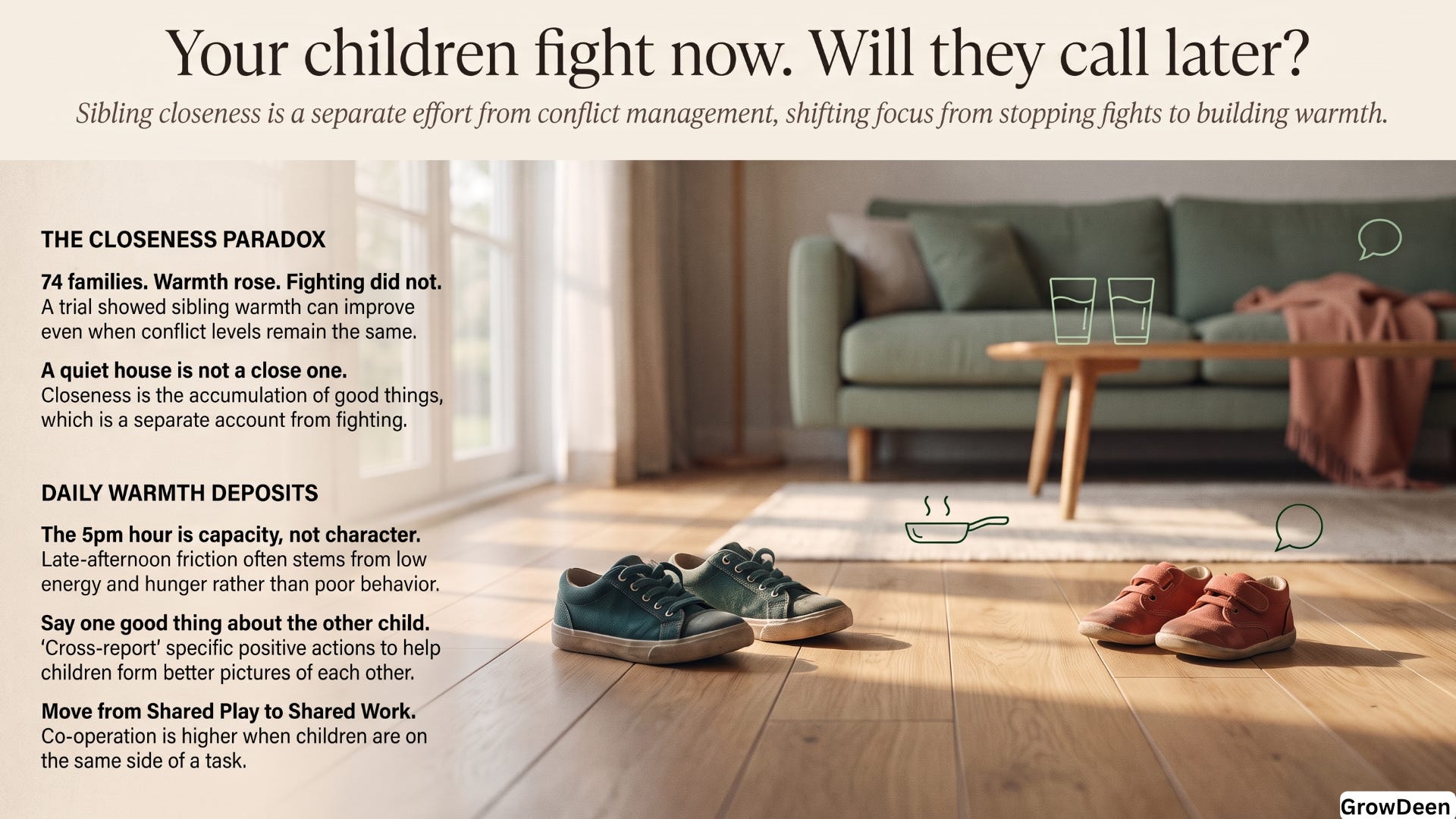
In a 2023 trial of 74 families, sibling warmth improved. Sibling conflict did not. [1]
Three pages. Fridge-ready. Nothing to sign up for.
It starts before you reach the door.
One of them is already crying. The other is already explaining. You have not seen what happened and you are about to be asked to judge it, and you have done this so many times this week that you could deliver the verdict without hearing the evidence.
So you do what you always do. You separate them, you make somebody apologise, and the house goes quiet for eleven minutes.
Nobody warns you about the next bit. You can get very, very good at ending fights and still lie awake wondering whether your children actually like each other.
That is the fear underneath it, and it rarely gets said out loud. Not “how do I stop the shouting.” Something quieter. Will they call each other when I am gone?
Hold that question. I am going to come back to it, because the answer is not what most parenting advice assumes.
Why this guide is different
Every claim here is tied to named research from 2022 to 2026, including two meta-analyses and a randomised controlled trial, cited so you can check them yourself.
The Islamic layer is not decoration. It addresses the exact thing the research cannot reach: what a parent can build, and what only Allah can give.
You already have the free Sibling Warmth Kit from the top of this page, so the practical work does not have to live in your memory.
The dial you have been turning
Almost every parent handles sibling conflict the same way. Something goes wrong, you intervene, you restore order. Repeat.
That is one dial. Call it the conflict dial, and you have been turning it for years.
The assumption underneath it is that the two things move together: less fighting means a closer relationship. Turn the conflict down far enough and warmth should appear in the space left behind.
It is a reasonable assumption. It is also wrong, and there is a trial that shows it.
Researchers in Australia ran a randomised controlled trial with 74 families, all of them parents worried about sibling conflict. Half attended a short group programme built specifically for that problem. Half went on a waitlist. [1]
The parents who attended saw real improvement in the warmth between their children, and improvement in the emotional difficulties of one of their children. What the programme did not significantly shift was the conflict itself. The researchers’ own conclusion was that the positive and negative sides of a sibling relationship may each need their own attention. [1]
Read that once more if you have spent three years trying to make your house quieter.
Two dials. Not one.
So why do the loud families sometimes turn out fine?
You already know a version of this. The two cousins who fought through every single Eid of their childhood and now speak every week. The two who never raised their voices and have not been in the same room since a wedding four years ago.
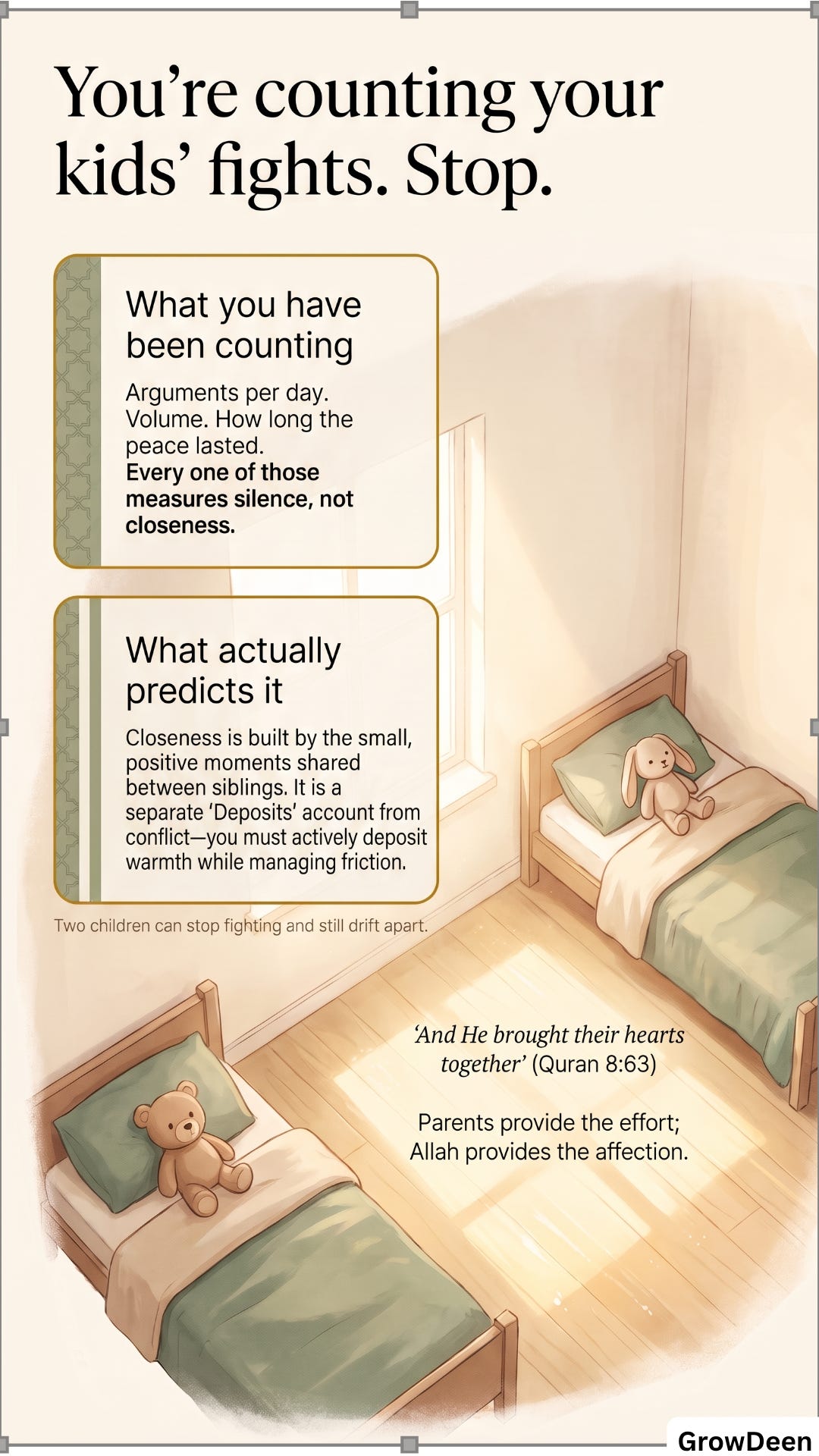
A quiet house is not a close one.
That sentence is worth keeping, because it explains something the conflict dial can never explain. Closeness is not the absence of friction. It is the accumulation of good things that happened between two people, which is a separate account entirely, and it can be left empty in a house where nobody ever shouts.
So the question shifts. How much have you been depositing into the other account while you were busy managing the first one?
Why the conflict dial is so stiff
Before the warmth side, it helps to know why the fighting resists you. It is not obstinacy. Four things are pressing on it at once.
Their brains have not finished. Settling a dispute means holding what you want, working out what the other person wants, weighing both, and then choosing a response other than your first impulse. That last move runs on impulse control, working memory and mental flexibility, all still under construction through early and middle childhood. [2] A meta-analysis examining aggression alongside theory of mind, meaning the ability to see that another person’s picture of events differs from your own, found the two are related in children. [3] A child who cannot hold his sister’s version in mind will defend his own with everything he has.
They came with different settings. One releases a grievance in a minute. One holds it for an hour and produces it again at bedtime with evidence. Work using a temperament-based approach has examined how the forms and functions of aggression develop across early childhood. [4] Same provocation, two different children, two entirely different reactions, and neither of them is choosing it.
They are keeping accounts. Listen for thirty seconds and one word surfaces: fair. Who was served first. Who got the larger half. Whose story was believed. This is the part that stings, because a meta-analysis of parental differential warmth and hostility found that when parents are warmer towards one child or harsher towards another, those differences show up in the children’s emotional and behavioural problems. [5] The bigger slice was never really about the slice.
They are copying you. Children absorb conflict the way they absorb an accent, long before anyone explains anything. A child who watches adults lower their voices and come back to a subject later will reach for that under pressure. A child who watches doors slam has been taught too.
And one habit makes all four worse.
The question that trains the wrong skill
“Who started it?”
It feels like justice. It is actually a lesson in advocacy. Ask it often enough and you produce two children who become expert at constructing a case and hopeless at solving a problem.
Swap it for: what did each of you want? Then hand the problem back. “What would be fair here?” A child who designs the solution keeps to it far more reliably than a child who receives a verdict.
There is a second habit worth naming, because it is common in Muslim homes and it backfires. Physical punishment. Research has mapped the parenting contexts in which corporal punishment predicts rising rather than falling aggression in children. [6] The American Academy of Pediatrics advises against physical punishment in any form, alongside shouting and shaming, because it achieves little immediately and carries real costs later. [7] Children who are hit are more likely to hit their siblings. The lesson lands cleanly even when the lecture attached to it does not.
There is a narration that puts this with uncomfortable clarity. Abu Mas’ud al-Ansari said he was striking a servant of his when he heard a voice behind him: Allah has more power over you than you have over him. He turned, and it was the Messenger of Allah ﷺ. [8] The narration concerns a servant rather than a child, so take the principle rather than stretching the text. The principle is about power held over someone who cannot push back. There is no clearer version of that anywhere in your house.
What actually moves the warmth dial
Here is where most articles would give you a bonding activity. That is not what the evidence points at.
Warmth between siblings is built in small, unremarkable deposits, and three of them cost almost nothing.
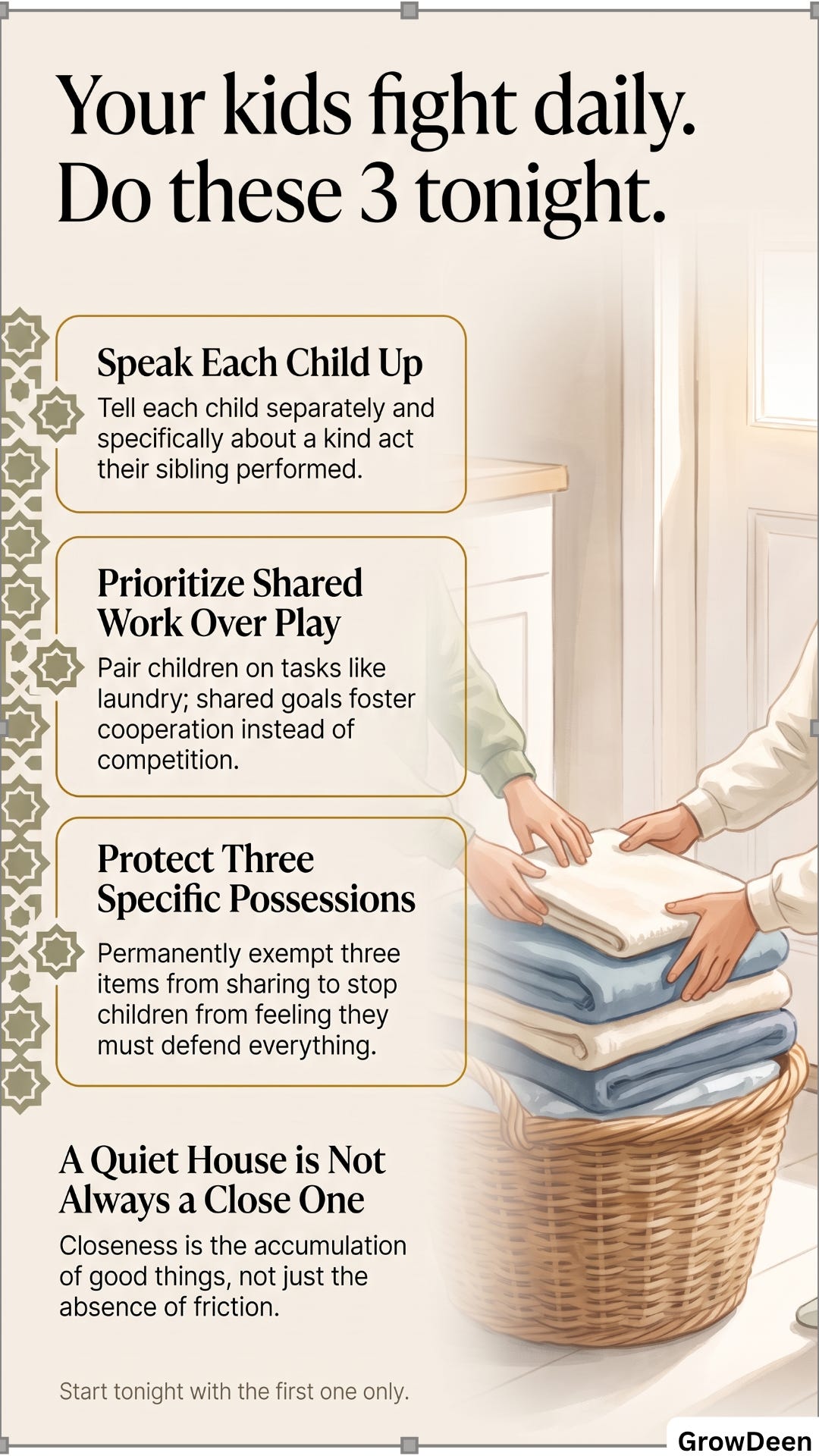
Cross-reporting. Tell each child, separately, one true and specific good thing the other one did today. Not “your sister is lovely.” Something like: “Your brother waited for you at the gate even though his friends had gone ahead.” Children form their picture of each other partly from what the adults around them say. Most of what they hear from you about their sibling is corrective. This flips the ratio without requiring either of them to change.
Shared work, not shared play. Two children with one toy between them are in competition. Two children folding washing, kneading dough, or setting up for guests are on the same side of a task. Cooperation per hour is far higher, and nobody has to be generous for it to happen.
Protected possessions. Choose three things per child that are exempt from sharing, permanently, and enforce it. Knowing three things are safe reduces the anxiety that makes a child fight over all the rest.
Then there is the part that runs alongside all of this, which is that the arguments themselves are not dead time. Work unpacking what actually passes between siblings during conflict has found that they shape one another through those exchanges. [9] Negotiating, holding your position without crushing someone, reading a face across a table: those get practised at a safe scale with a person who will still be there in the morning.
A quiet house is not a close one. Deposits are what make it close.
Before the shouting starts
Sibling fights are not evenly spread through the day. Keep a tally for a week and most households find the same three or four windows carrying the bulk of it.
The hour before dinner. The rush out of the door. Long car trips. Unstructured time with nothing planned and one attractive object in the room. The half hour after school, when a child who held it together all day finally puts the effort down.
None of that is character. It is capacity, and capacity is the one thing you can top up directly. Feed them earlier. Put the interesting toy away before the car rather than confiscating it on the motorway. Give each child something separate to do in the pre-dinner hour, in different rooms if that is what it takes.
Prevention is dull and it outperforms everything you can do once the volume rises.
I know that is a lot to hold in your head at 5pm with a pan on the hob. That is exactly why the free Sibling Warmth Kit exists: a seven-day warmth log, a flashpoint planner you fill in for your own household, and a reflection page for the harder evenings. The download button is at the top of this page, and there is a full description of what is inside it below.
What a parent can build, and what only Allah can give
You can set the rules, coach the apology, separate them before somebody gets hurt, and praise every repair. Every parent doing this work eventually meets the same wall: you cannot reach inside one child and install affection for the other.
Allah says of the believers, “And He brought their hearts together. If you had spent all that is in the earth, you could not have brought their hearts together, but Allah brought them together.” [10]
According to Tafsir Ibn Kathir, this describes the Aws and Khazraj, two clans of Madinah who had fought each other for years before Islam. He explains that the wealth of the whole earth could not have joined those hearts, because of the enmity and hatred already between them, and that Allah ended all of it. [10]
The verse addresses the believing community, not siblings, and that is worth saying plainly rather than stretching it. The principle still stands in a house: affection between two people who have hurt each other is something Allah gives.
Which leaves you the supplying side. And on that, the Prophet ﷺ said that the one who makes peace between people, conveying good or saying good, is not a liar. [11] Imam al-Bukhari placed that narration in his book of Peacemaking. When you tell one child that his sister felt bad about it afterwards, you are carrying good across a gap, and that act has a name in the Sunnah.
So do both halves. Make the deposits, and then ask Allah for the part your effort cannot reach.
When it stops being ordinary
Most sibling conflict is normal and it eases as they grow.
Some of it does not, and you deserve a clear line rather than a vague reassurance. Seek help if you see repeated physical aggression, threats, intimidation, deliberate humiliation, destruction of belongings, or any pattern that leaves one child frightened of another inside their own home. Sibling aggression has been described in public health research as widespread and largely invisible, partly because families assume it is simply what siblings do. [12]
It is not. Speak to a doctor, a paediatrician or a qualified counsellor, and do it earlier rather than later. Taking the means Allah has provided sits alongside tawakkul, never against it.
Your free Sibling Warmth Kit
If you have read this far, you are not looking for a quieter house. You are looking for two children who will still choose each other in twenty years. That is a different and much harder thing to want, and it says something about you.
Inside the Sibling Warmth Kit (one comprehensive PDF, 3 pages):
Page 1: The Seven-Day Warmth Log. A one-week grid where you record, for each child, one true and specific good thing their sibling did and the date you told them about it, with a tick column so you can see at a glance which child you have been forgetting. Designed as a fridge sheet you fill in while the kettle boils.
Page 2: Your Household Flashpoint Planner. A fill-in planner where you map your own four highest-risk windows, name what is actually running low in each one, and write the specific pre-emptive fix beside it, so you can cut the most predictable fights in your week in under fifteen minutes of planning.
Page 3: For the Parent Who Cannot Make Them Love Each Other. A reflection page built on Qur’an 8:63, in English with its source reference, on the one part of this work that was never yours to do, with a blank line where you write your own du’a for your children by name.
This is not a PDF to download and forget. It is built for the fridge door and the 5pm hour, where you will actually reach for it.
This Sibling Warmth Kit is what every subscriber receives with each article. Muslim Parenting Lab covers the full span of raising Muslim children, from newborns through the school years, with every recommendation tied to named research and rooted in the Qur’an and Sunnah.
If you want evidence-based guidance and Islamic perspective in the same place, subscribe free so future resources arrive before you need them.
Subscribe free for parenting resources backed by both science and Sunnah, guidance you will not find anywhere else. No spam, no clutter, just resources that matter.
One thing to do in the next five minutes
Go to whichever child is nearest. Tell them one true, specific good thing the other one did today. Ten seconds, then walk away without explaining why.
That is one deposit. Do it again tomorrow.
May Allah join your children’s hearts in a way your effort never could, and put barakah in every small thing you do while waiting for it.
Share this with someone who needs it
Think of one person right now. The sister who admitted at the masjid that her two boys have not played together in a month without it ending in tears. The friend whose voice messages always start with an apology for the shouting in the background. The cousin who told you she has stopped inviting people over.
This article could change what she is measuring. Send it to her today, not as advice, but because you know exactly how that hour before dinner feels.
Frequently asked questions
Is it normal for siblings to fight every single day?
Yes, particularly in the years before children have the brain machinery for handling disagreement well. Impulse control and perspective-taking are still developing through early and middle childhood. [2][3] Daily arguing is ordinary. What is worth watching is the pattern, not the frequency.
Should I let my children sort out their own fights?
Where nobody is at risk of being hurt, yes. A child who designs the solution keeps to it more reliably than one who receives a verdict, and a scoping review of sibling conflict management shows these strategies shift as children grow. [13] Step in for safety, not for every disagreement.
How do I stop favouring one child without realising it?
Start by cutting comparison out of your speech entirely, including the kind disguised as praise. A meta-analysis found that differences in parental warmth and harshness between siblings show up in children’s emotional and behavioural problems. [5] Then protect a short block of time alone with each child every week and keep it.
Does fighting now mean my children will not be close as adults?
No. Research following siblings across these years traces how closeness and conflict both shift from middle childhood onwards as the relationship is renegotiated. [14] Frequency of arguing is a poor predictor. What predicts closeness is how much good has accumulated between them alongside the friction.
What can Islam add to how I handle this?
Two things the research cannot reach. The Qur’an locates the joining of hearts with Allah rather than with human effort, [10] which takes a weight off you that was never yours. And the Prophet ﷺ named carrying good between two people in conflict as peacemaking rather than as bending the truth, [11] which turns a small daily act into something with a name.
When should I be worried about sibling aggression?
When one child is frightened of another in their own home, or when you see repeated physical aggression, threats, intimidation or deliberate humiliation. Sibling aggression has been described in public health research as widespread and largely invisible. [12] That is a reason to speak to a doctor or qualified counsellor, not to wait it out.
References
[1] Pickering, J.A., Crane, M.E., Hong, J., Nickel, A-K., Chainey, C., & Sanders, M.R. (2023). A randomized controlled trial of a parenting program to improve sibling relationships. Journal of Child and Family Studies, 32(5), 1438-1451.
[2] Center on the Developing Child at Harvard University. A Guide to Executive Function.
[3] Wang, Y., Shang, S., Xie, W., Hong, S., Liu, Z., & Su, Y. (2023). The relation between aggression and theory of mind in children: A meta-analysis. Developmental Science, 26(2), Article e13310.
[4] Ostrov, J.M., Murray-Close, D., Perry, K.J., Blakely-McClure, S.J., Perhamus, G.R., Mutignani, L.M., Kesselring, S., Memba, G.V., & Probst, S. (2023). The development of forms and functions of aggression during early childhood: A temperament-based approach. Development and Psychopathology, 35(2), 941-957.
[5] Eradus, M., Leijten, P., Melendez-Torres, G.J., Foo, X.Q., & Oliver, B.R. (2024). Parental differential warmth, hostility, and sibling differences in internalizing and externalizing behavior problems: A meta-analysis. Journal of Family Psychology, 38(3), 387-399.
[6] Peets, K., Hodges, E.V.E., & Kikas, E. (2022). Unravelling the parent-child contexts in which corporal punishment predicts increases vs. decreases in children’s aggression. Journal of Clinical Child and Adolescent Psychology, 51(2), 183-194.
[7] Sege, R.D., Siegel, B.S., AAP Council on Child Abuse and Neglect, & AAP Committee on Psychosocial Aspects of Child and Family Health. (2018). Effective Discipline to Raise Healthy Children. Pediatrics, 142(6), e20183112.
[8] Sahih Muslim 1659, narrated by Abu Mas’ud al-Ansari. Graded Sahih.
[9] Borairi, S., Plamondon, A., Rodrigues, M., Sokolovic, N., Perlman, M., & Jenkins, J. (2023). Do siblings influence one another? Unpacking processes that occur during sibling conflict. Child Development, 94(1), 110-125.
[10] Qur’an, Surah Al-Anfal 8:63, with Tafsir Ibn Kathir.
[11] Sahih al-Bukhari 2692, narrated by Umm Kulthum bint ‘Uqba. Kitab as-Sulh. Graded Sahih.
[12] Tucker, C.J., Whitworth, T.R., & Perkins, N.H. (2025). Sibling aggression and abuse: Invisible and widespread public health problems. American Journal of Public Health, 115(9), 1383-1387.
[13] Holmes, M.R., Johnson, L.R., O’Donnell, K.A., & Nunnery, A. (2026). Sibling conflict management in childhood and adolescence: A scoping review to inform developmental research and theory. Developmental Review, 80, Article 101267.
[14] McHale, S.M., Sun, X., Updegraff, K.A., & Whiteman, S.D. (2026). Patterns and correlates of changes in sibling intimacy and conflict from middle childhood through young adulthood. Developmental Psychology, 62(3), 665-677.