

Your breast is the wrong thing to measure. Fewer than 5 percent of mothers cannot produce enough milk, yet 57.8 percent of those who stopped feeding early said they had too little. [1][2]
Print it before tonight's 2am feed.
It is 2am and the breast feels empty.
You waited the three hours someone told you to wait, so the milk would have time to build up. The baby fed for forty minutes. Then she unlatched, arched, and started crying again. You press the breast with two fingers and find almost nothing there, and the sentence arrives fully formed: there is nothing left in me.
Nobody taught you how to measure this. You were handed a baby, a leaflet and a lot of opinions, and then left to work out from a soft breast and a crying mouth whether your body is feeding your child. That is not a failure of instinct. It is a missing instrument.
Here is the question to carry through the rest of this page. Why do the mothers whose babies feed most often get told to stretch the gaps, when stretching the gaps is the single change most likely to take their milk away?
Why This Guide Is Different From Generic Low Supply Advice
Every claim here is tied to primary research with dates attached, including the Australian measurement studies that established what normal actually looks like and the American cohort of 1,177 mothers that found why feeding stops. [2][3][4]
The Islamic layer is not decoration at the end. Provision, measure and asking are the frame the practical advice sits inside, because a mother who thinks her body has been singled out needs that answered before she needs a checklist.
You already have the free Supply Check Pack from the top of this page: a 24-hour log, a what-works card, and an Islamic reflection page built for the hour you will actually read it in.
The Myth That Is Costing You Milk
Think about where the waiting advice comes from. It sounds like common sense: the breast is a container, the container needs time to fill, so leave it alone and let it refill. Almost every mother who has been told to stretch her feeds has been told it kindly, by someone who believed it.
It is the wrong model, and it is the villain of this entire article.
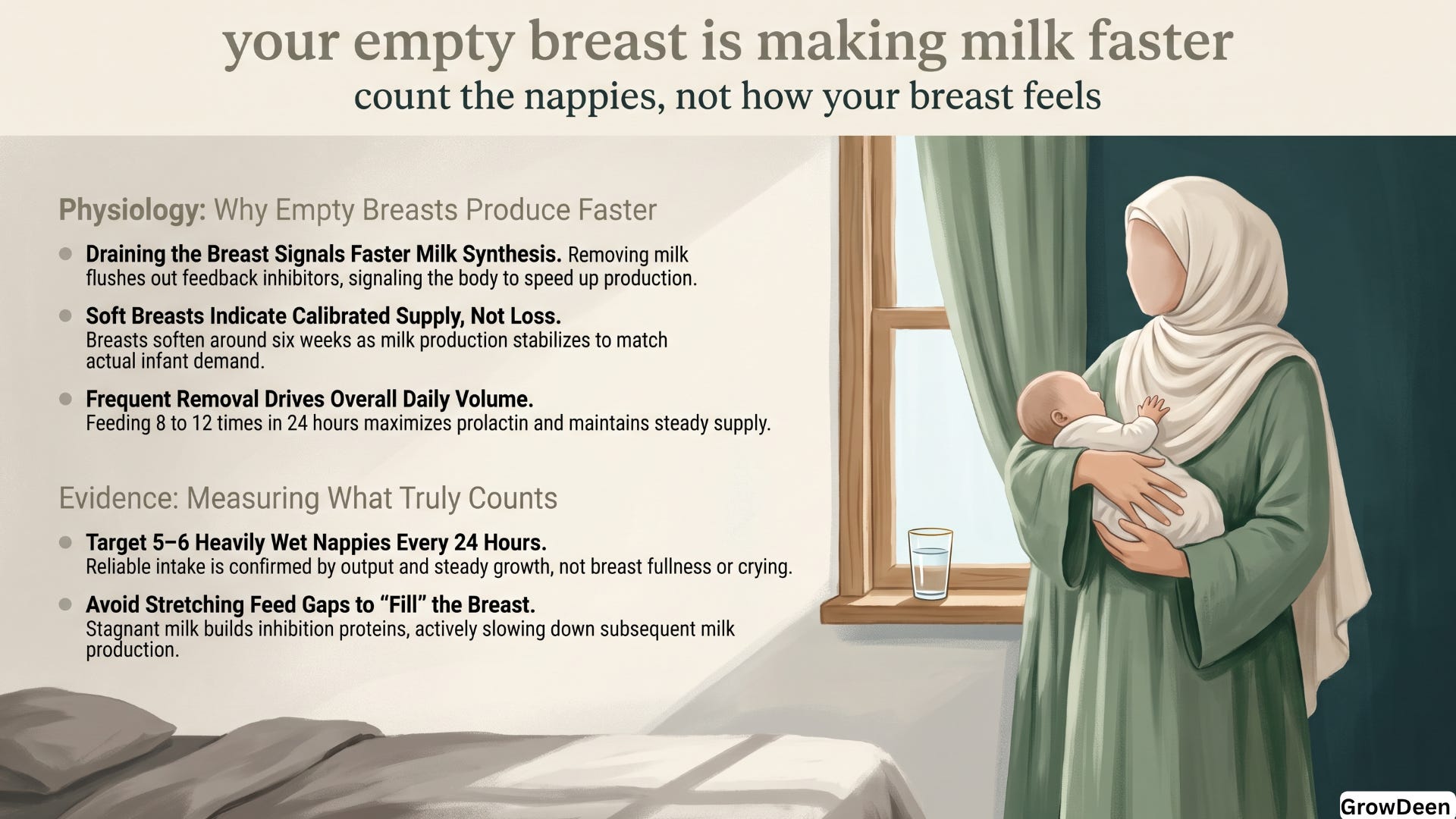
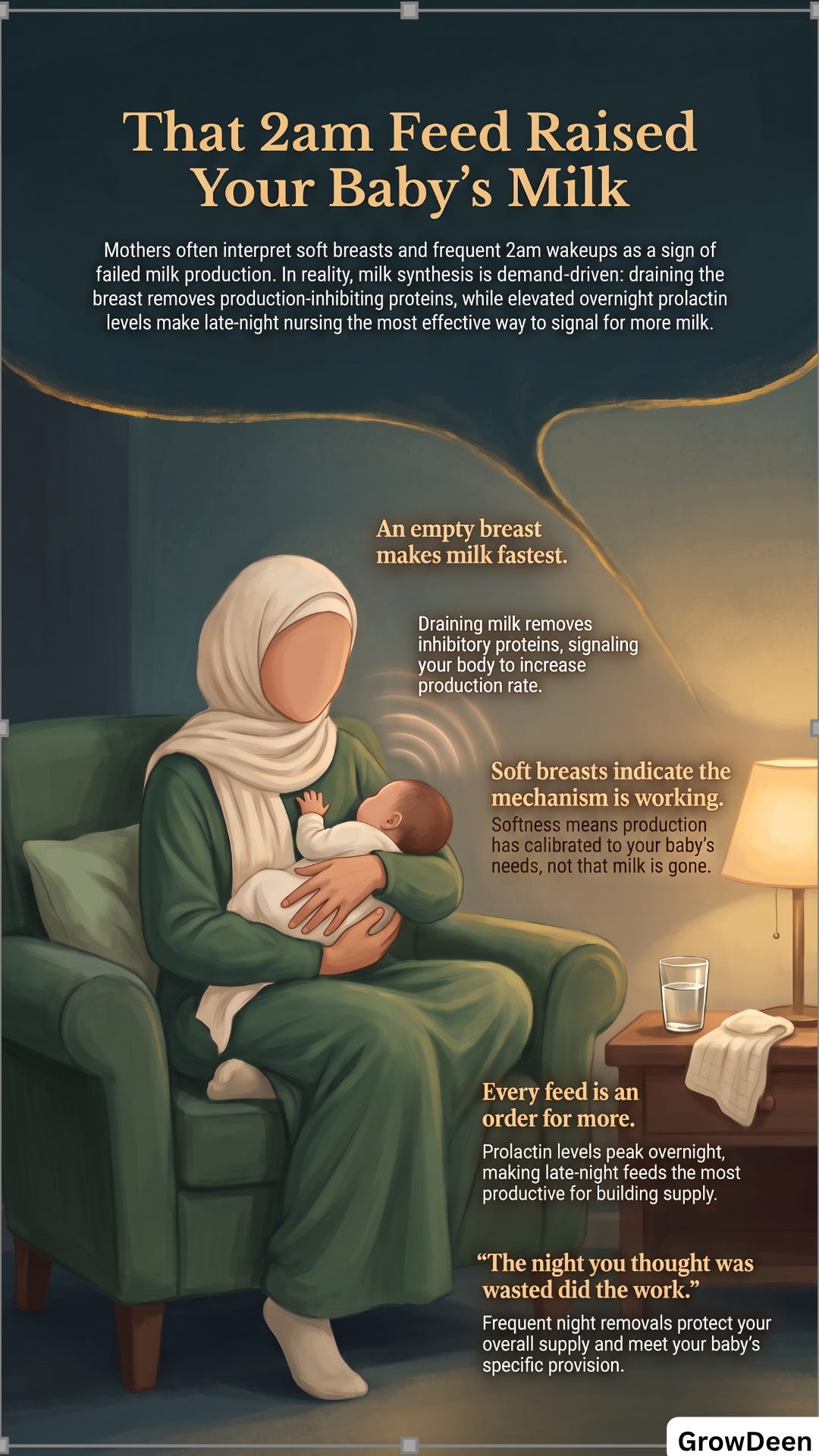
After the first couple of weeks, milk production is controlled at the breast itself, and the rate depends on how much milk leaves and how quickly. [3] Milk carries a protein called the feedback inhibitor of lactation. When milk sits in the breast, that protein accumulates and production slows down. Drain the breast and the protein leaves with it, and production speeds up. [5] A full breast also stretches the cells holding prolactin receptors so the hormone cannot act on them properly, while a drained breast lets those receptors work. [6]
An empty breast makes milk fastest.
Which means the soft breast that frightened you at 2am was not evidence of failure. It was the mechanism working. And the three-hour wait, the thing you did to protect your supply, was the instruction that slowed it.
This also explains the six week scare. Around then the breasts stop feeling full and start feeling soft nearly all the time. Production has settled rather than fallen, dropping back from overshoot to the volume your baby actually takes. [6]
But knowing the mechanism is only useful if you know what to measure instead.
What Your Baby's Nappies Say That Your Breast Cannot
Here is what counts as evidence. [7][8]
Output. After the first few days, at least six wet cloth nappies or five heavily wet disposables in twenty four hours, with pale or clear urine. Soft stools around three or four times a day while the baby is under six to eight weeks. Older babies pass stool less often and that alone is not a warning.
Weight. A small loss in the first week is normal. After that, weight, length and head circumference should climb on the chart your health service keeps. This is the most reliable measure a parent has.
The baby between feeds. Normal colour, normal muscle tone, alert stretches, settled periods.
Three findings override everything else and mean your baby needs to be seen today: no weight gain after the first week, output below those nappy counts, or a baby who is floppy, hard to rouse, or has stopped waking to feed.
Notice what is missing from that list. How full the breast feels. How long the feed lasted. Whether the baby cried afterwards. A cry is one output for a dozen inputs, including tiredness, wind, overstimulation and the simple want of being held by a body she recognises.

How Much Milk Is Normal? Wider Than You Think
Australian researchers measured exclusively breastfed babies between one and six months old, all healthy, all growing normally. The babies fed between 4 and 13 times in twenty four hours. Feeds ran from 12 to 67 minutes. Daily intake ranged from 478 to 1,356 millilitres. [4]
Read that again. A baby feeding thirteen times a day and a baby feeding four times a day can both be thriving.
Breasts differ in how much they hold between feeds, and the difference between women is large. Storage capacity governs how often a baby comes back rather than how much milk a mother makes across a day. [3][4] A mother with smaller capacity feeding eleven times and a mother with larger capacity feeding six times can deliver the same volume.
So here is the answer to the question planted at the top. The mother feeding eleven times is the one who looks abnormal to everybody around her, so she is the one who gets told to space the feeds. The advice is aimed at the symptom of her normal physiology, and following it removes the frequent drainage her supply depends on. The women most likely to be given the advice are the women it harms most.
A follow up study tracked the same babies over time. Between one and three months, feeds per day fell and sessions shortened, while the volume taken at each feed rose. Total daily intake stayed flat. [9] Babies get more efficient. Mothers read the shorter feeds as a drop in supply.
Why The First Week Does Not Count
None of those ranges apply to day two. In the first days the breast makes colostrum in volumes measured in teaspoons, matched to a stomach that is correspondingly small. [6] Mothers expecting the later pattern this early conclude within forty eight hours that they have failed, and some reach for formula before the mature milk has arrived at all. [7]
Mature milk usually comes in between day two and day five, later after a caesarean or a difficult birth. [6] Frequent feeding in those days is what brings it in sooner.
Growth spurts produce the same false alarm later. A baby who has been predictable suddenly wants the breast constantly for a day or two. She is placing an order. Supply follows demand with a lag, and the lag is what a mother experiences as running out. [3]
And when researchers looked at which problem most often ended feeding early, the answer surprised almost everyone.
Check The Latch Before You Buy Anything
In that cohort of 1,177 mothers, trouble with latching carried higher odds of stopping before intended than pain, engorgement or any other lactation problem measured. [2]
The mechanism is the same one as before. A baby who is poorly attached transfers milk badly. Milk that stays in the breast tells the breast to make less. A supply problem and a latch problem look identical from the outside, and only one of them is fixed by buying something.
So before you add feeds, buy capsules or order a pump, get somebody qualified to watch a whole feed. A feed that leaves cracked or bleeding nipples is not working. Pain is information.
Keeping It All Straight When You Are This Tired
Remembering nappy counts, feed counts and red flags at two in the morning is a lot to ask of anyone running on four hours of broken sleep. That is why the free Supply Check Pack exists: a 24-hour log you can fill in half asleep, a card showing what raises supply against what quietly lowers it, and an Islamic reflection page for the nights when the counting is not the hard part. The download button is at the top of this page, and there is a full description of what is inside it below.
Support Muslim Parenting Lab ❤️
Would you like a small amount of yours grown into something enormous? Give what you can spare with the button below.
The Prophet ﷺ said Allah grows a charity the size of a date until it is like a mountain. (Sahih al-Bukhari 1410)
What Actually Raises Supply
Everything below is one idea in different clothes: more milk out, more often.
Feed eight to twelve times in twenty four hours while you are building supply. [10] Frequency does more than duration.
Offer again after an unsettled feed. Twenty minutes later there will be milk, because the breast is never empty and refills fastest when emptiest. [3]
Keep the night feeds. Prolactin runs higher overnight, which makes those feeds more productive than their daytime equivalents. [11] This is the hardest line in this article to follow and the easiest to talk yourself out of.
Wake a sleepy baby in light sleep. Flickering eyelids and small mouth movements mean a baby who will often feed without properly waking.
Express after feeds, using hands as well as a pump. You are taking what the baby left.
Compress the breast during feeds. It improves flow and empties the breast more completely. [8]
Get skin to skin. A Cochrane review found breastfeeding rates of 67 percent at one to four months after early skin to skin contact, against 54 percent after standard contact. [12] Contact raises prolactin and oxytocin, and separate work links ordinary warmth and touch to lower stress and steadier maternal response. [13]
One more thing about oxytocin, because it explains an experience that terrifies mothers. Prolactin builds supply; oxytocin moves it. Stress interferes with the second one. A mother who is rushed, braced or being watched can have milk she cannot get out, which feels exactly like having none. The fix is unglamorous: a supported back, water in reach, the phone face down, and nobody asking how much longer this will take.
Many Muslim mothers find the feed settles when it is anchored to something familiar. Bismillah as the baby latches. Quiet recitation while she feeds. Nothing is missing if none of it happens, but a settled heart lets milk down more easily, and dhikr settles the heart.
What The Research Says Does Not Work
Galactagogues. A Cochrane review of oral galactagogues, herbal and pharmaceutical, found the evidence too poor to draw conclusions. [14] The Academy of Breastfeeding Medicine declines to recommend any specific one and makes the point that matters more than any product: nothing raises supply if the breast is not being drained often and well. [15] Fenugreek has caused severe allergic reactions in some mothers, so herbal does not mean harmless. [15]
Forcing fluids. A Cochrane review found one small, poor quality trial and concluded the effect of extra fluids remains unknown. [16] Drink to thirst. Dehydration is worth avoiding. Water-loading does nothing for supply.
Judging by the pump. A pump is far less efficient than a well attached baby. What comes out tells you about the pump, the flange and your let-down.
Unsupervised top ups. Every bottle given in place of a feed is a removal your breast never experiences, and supply adjusts down accordingly. If supplementing is medically needed, it can be done in a way that protects supply, which is exactly what qualified help is for.
There is one more piece, and it is the one most mothers actually need at 3am.
The Measure Already Set: What Islam Says About Provision You Cannot See
A mother counting nappies at three in the morning is doing work, not panicking.
Allah says, "And there is not a thing but that with Us are its depositories, and We do not send it down except according to a known [i.e., specified] measure." [17] According to Tafsir Ibn Kathir, the stores of every provision sit with Allah, and what comes down from them comes by a measure He determines out of wisdom and mercy rather than obligation. Ibn Kathir illustrates it with rain: no year receives more rain than another, but Allah distributes it across places as He chooses.
The verse speaks about provision in general rather than milk in particular. Even so, a mother convinced that her body alone has been singled out for failure is holding a belief this verse does not support. Supply is provision, and provision is apportioned by One who is merciful in how He apportions it.
An instruction comes attached to that comfort. In a narration the Prophet ﷺ reported from his Lord, Allah tells His servants that all of them are hungry "except for those I have fed", and tells them to seek food from Him so that He will feed them. [18] Asking belongs inside the practical work rather than around it. Feed the baby, express after the feed, book the appointment, and ask the One who holds the stores.
Islam also names the term plainly: "Mothers may nurse [i.e., breastfeed] their children two complete years for whoever wishes to complete the nursing [period]." [19] The World Health Organization and the American Academy of Pediatrics both now advise continued breastfeeding to two years or beyond. [10][20] The clause worth reading twice sits inside that same verse: "No person is charged with more than his capacity." [19] Allah placed the limit inside the instruction.
When Supply Really Is Low
Some mothers do everything correctly and still produce less than their baby needs. Previous breast surgery, certain hormonal conditions, retained placental tissue, heavy blood loss at birth and some medications all reduce production. [6] None of these is a moral failing, and none is diagnosed over the internet.
Contact a doctor, paediatrician, lactation consultant or child health nurse when weight gain stalls or drops across chart lines, when nappy output stays low, when feeding hurts or damages the nipples, when there is a hot red painful area on the breast with or without fever, when several days of frequent feeding change nothing, or when you are dreading feeds and crying through them. That last one counts as a medical reason too. How a mother feels about feeding predicts whether feeding continues. [2]
Your Free Supply Check Pack
If you have read this far, you are the kind of mother who wants to know what is actually true before she changes anything. That tells me something about the care you are already giving.
Inside the Supply Check Pack (one comprehensive PDF, 3 pages):
Page 1: The 24-Hour Supply Log. A single printable tally sheet for feeds, wet nappies and stools across one full day, with the three red-flag thresholds printed beside the boxes so you can see at a glance whether your numbers are fine or whether today is an appointment day. Designed as a fridge sheet you fill in half asleep, one tick at a time.
Page 2: Raises Supply / Lowers Supply. A two-column quick reference card setting the five things that really increase milk removal against the five that quietly reduce it, with the 72-hour rebuild plan printed underneath, so you can act tonight without rereading this article.
Page 3: The Measure Already Set. An Islamic reflection page carrying the verse on Allah's stores of provision and the narration on asking Him for food, each with its English meaning and its full source reference, plus a short reminder that taking the means and asking Allah belong in the same hour. For the nights when counting nappies is not the hard part.
It is built to live on your fridge and in the drawer beside your feeding chair, where you will reach for it at the hour you need it.
The Supply Check Pack is what every subscriber receives with each article. Muslim Parenting Lab covers the whole span of raising Muslim children, from the newborn weeks through the early school years, with every recommendation tied to current research and rooted in Qur'an and Sunnah.
One Thing To Do Tonight
Before the next feed, write two numbers on a piece of paper and stick it to the fridge: today's wet nappy count, and the number of feeds since you woke up. That is it. Tomorrow you will have data instead of a feeling, and most mothers who do this discover their numbers were fine all along.
May Allah place barakah in what your body produces, make what is difficult in it light, and reward every hour you have been awake for a child He placed in your care.
Share This With Someone Who Needs It
Think of one person right now: the sister in your family who had her baby six weeks ago and has gone quiet, the friend who mentioned in passing that she is "topping up a bit", the woman at the masjid who said her milk dried up and changed the subject.
She may be three days away from stopping something she did not want to stop. Send her this today, not as advice, but because somebody should tell her that an empty breast makes milk fastest and that her nappy counts matter more than how she feels at 2am.
Frequently Asked Questions
Q: How do I know if my baby is getting enough breastmilk? A: Count nappies and watch the scale, not the breast. At least six wet cloth nappies or five heavily wet disposables in twenty four hours after the first few days, plus steady weight gain on the chart, means your baby is getting enough. [7][8] For the full picture, see "What Your Baby's Nappies Say That Your Breast Cannot" above.
Q: My breasts feel empty and soft. Have I lost my milk? A: Almost certainly not. Around six weeks the breasts stop feeling full between feeds because production has settled to match your baby instead of overshooting. [6] A soft breast actually makes milk faster than a full one. [3]
Q: How often should a newborn feed to increase milk supply? A: Aim for at least eight to twelve feeds in every twenty four hours while you are building supply, and offer the breast again twenty minutes after an unsettled feed. [10] Frequency raises supply more reliably than longer feeds do.
Q: Do lactation cookies, fenugreek or supplements increase milk supply? A: The evidence does not support them. A Cochrane review found the quality of evidence too poor to draw conclusions, and the Academy of Breastfeeding Medicine declines to recommend any specific galactagogue. [14][15] Nothing works if the breast is not being drained often and well, and fenugreek has caused severe allergic reactions in some mothers. [15]
Q: Does drinking more water increase breastmilk? A: Not beyond drinking to thirst. A Cochrane review found only one small, poor quality trial and concluded the effect of extra fluids remains unknown. [16] Avoid dehydration, but water-loading is not a supply strategy.
Q: How long does Islam say I should breastfeed? A: The Qur'an names two complete years for those who wish to complete the nursing period, and both the World Health Organization and the American Academy of Pediatrics now advise continued breastfeeding to two years or beyond. [19][10][20] The same verse adds that no person is charged with more than their capacity.
Q: When should I see a doctor about low milk supply? A: When weight gain stalls or drops across chart lines, when nappy output stays below the thresholds above, when feeding is painful or damaging, when you have a hot red painful area on the breast, or when several days of frequent feeding change nothing. Dreading feeds counts too. [2]
References
[1] Neifert, M., DeMarzo, S., Seacat, J., Young, D., Leff, M., & Orleans, M. (1990). The influence of breast surgery, breast appearance, and pregnancy-induced breast changes on lactation sufficiency as measured by infant weight gain. Birth, 17(1), 31-38
[2] Odom, E.C., Li, R., Scanlon, K.S., Perrine, C.G., & Grummer-Strawn, L. (2013). Reasons for earlier than desired cessation of breastfeeding. Pediatrics, 131(3), e726-e732
[3] Daly, S.E.J., & Hartmann, P.E. (1995). Infant demand and milk supply. Part 2: The short-term control of milk synthesis in lactating women. Journal of Human Lactation, 11(1), 27-37
[4] Kent, J.C., Mitoulas, L.R., Cregan, M.D., Ramsay, D.T., Doherty, D.A., & Hartmann, P.E. (2006). Volume and frequency of breastfeedings and fat content of breast milk throughout the day. Pediatrics, 117(3), e387-e395
[5] Wilde, C.J., Addey, C.V., Boddy, L.M., & Peaker, M. (1995). Autocrine regulation of milk secretion by a protein in milk. Biochemical Journal, 305(1), 51-58
[6] Lawrence, R.A., & Lawrence, R.M. (2021). Breastfeeding: A guide for the medical profession (9th ed.). Elsevier
[7] National Health and Medical Research Council. (2012, updated 2015). Infant feeding guidelines: Information for health workers. NHMRC
[8] Royal Women's Hospital. (2019). Low milk supply (fact sheet). The Royal Women's Hospital, Melbourne
[9] Kent, J.C., Hepworth, A.R., Sherriff, J.L., Cox, D.B., Mitoulas, L.R., & Hartmann, P.E. (2013). Longitudinal changes in breastfeeding patterns from 1 to 6 months of lactation. Breastfeeding Medicine, 8(4), 401-407
[10] American Academy of Pediatrics. Where we stand: Breastfeeding. HealthyChildren.org
[11] Brodribb, W. (Ed.). (2019). Breastfeeding management in Australia (5th ed.). Australian Breastfeeding Association
[12] Moore, E.R., Bergman, N., Anderson, G.C., & Medley, N. (2016). Early skin-to-skin contact for mothers and their healthy newborn infants. Cochrane Database of Systematic Reviews, 2016(11), CD003519
[13] Takahashi, T. (2021). Sensory stimulation of oxytocin release is associated with stress management and maternal care. Frontiers in Psychology, 11, Article 588068
[14] Foong, S.C., Tan, M.L., Foong, W.C., Marasco, L.A., Ho, J.J., & Ong, J.H. (2020). Oral galactagogues (natural therapies or drugs) for increasing breast milk production in mothers of non-hospitalised term infants. Cochrane Database of Systematic Reviews, 2020(5), CD011505
[15] Brodribb, W., & the Academy of Breastfeeding Medicine. (2018). ABM Clinical Protocol #9: Use of galactogogues in initiating or augmenting maternal milk production, second revision 2018. Breastfeeding Medicine, 13(5), 307-314
[16] Ndikom, C.M., Fawole, B., & Ilesanmi, R.E. (2014). Extra fluids for breastfeeding mothers for increasing milk production. Cochrane Database of Systematic Reviews, 2014(6), CD008758
[17] Qur'an, Surah Al-Hijr 15:21 — Tafsir Ibn Kathir: Ibn Kathir on 15:21
[18] Sahih Muslim 2577a — Narrated by Abu Dharr — Graded: Sahih
[19] Qur'an, Surah Al-Baqarah 2:233
[20] World Health Organization. Infant and young child feeding (fact sheet)
We combine scientific research with Qur’an and authentic Sunnah, and we cite our sources. Even so, this is general guidance and no substitute for a doctor who can examine your child.