

Your child is asking about a death, and you don't know what to say?
The free Grief Words Pack gives you the words for the six questions children ask.
AGES 3–8 YEARS · 15 MIN READ
Someone your child loves has died. You kneel down to tell them.
You reach for the softest words you know. Grandpa has gone to sleep.
It feels kind. Weeks later, bedtime turns into a fight, and you can't see why.
Did I say the wrong thing? What do I say when the questions keep coming?
You did what loving parents do. Most of us were taught gentle words, not clear ones.
This guide brings together scientific research and the Qur'an and authentic Sunnah. You'll find words for the six questions children ask, and what helps afterward.
A note before you read: this guide is about the death of someone your child loves. If you need only the words today, skip to Knowledge in Practice.
The Short Answer
Right for your child? Children around ages 3 to 8, after the death of someone close.
What's probably happening: young children hear words as they are said. Many don't yet know death is permanent.
Try tonight (1 minute): use the word "died". Say, "Their body stopped working, and it can't start again."
You'll know it's working when: your child keeps bringing their questions to you. Asking again is a sign of trust.
Get help if: months later, your child has lost interest in everything, or blames themselves. Start with your child's doctor or pediatrician.
The rest of this guide explains why, and what to do next.
How to Read This Guide
3 minutes: The Short Answer above is enough for tonight.
7 minutes: The Short Answer, then Knowledge in Practice and If Things Don't Go to Plan.
The whole guide: read on for the scientific research, the Qur'an and Sunnah, and the References.
To share: the bold lines and the pull quotes are made to be shared.
To listen: open this guide in the free Substack app and tap Listen.
Inside This Guide
The kindest words for a young child are often the plainest ones. Say the word, then stay.
Myth Check: "Soft Words Protect Young Children"
When someone dies, many of us soften the news: "passed away", "lost", "sleeping".
What this belief gets right. Your child does need gentleness. A calm voice, a hand to hold and a slow pace all matter.
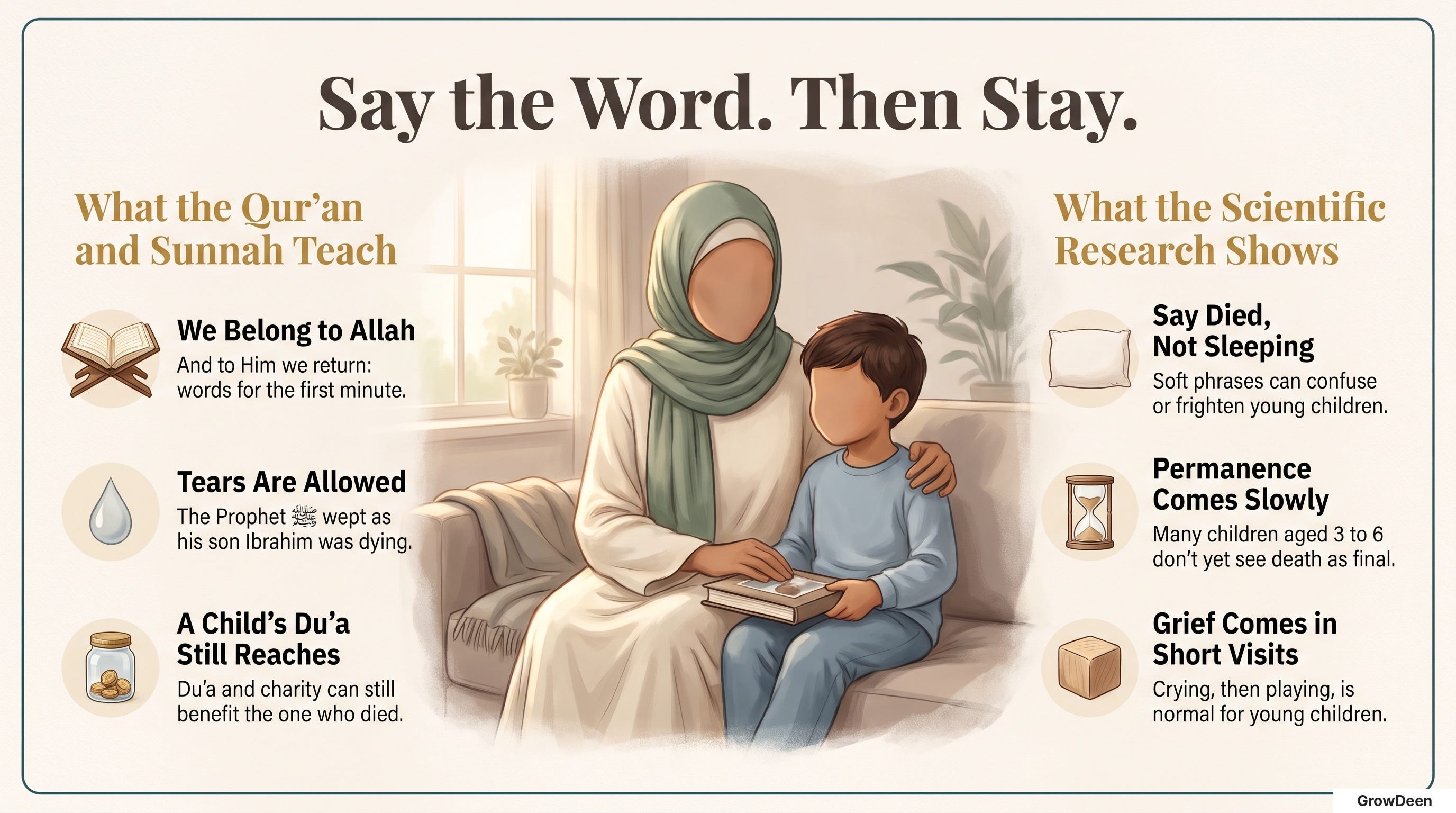
What the evidence says. Children's health services advise the opposite of soft phrases. Raising Children Network recommends the words "death" and "died", and warns that "gone to sleep" may confuse or frighten a child. [1]
A child who hears that someone has "gone to sleep forever" may become afraid of going to sleep. [1] Children's Hospital Colorado also advises against "fell asleep", "passed away" and "went away", because they can make a child think the person will come back. [2]
So keep the gentleness in your voice and your arms. Let the words be plain.
Why This Happens
Why does my child keep asking when they're coming back?
Understanding death is not one idea. It is built from several pieces, learned over years. [3]
One piece is that everything living dies. Another is that death can't be undone. A third is that the body stops working completely. The last is what causes death. [3]
Between about ages 3 and 6, many children don't yet understand that death is final. [2] A partial grasp of the first three pieces usually develops between 5 and 7. A fuller understanding, including causes, comes around age 10. [3]
So the question "When is Nanna coming home?" is not coldness. Your child is checking whether the answer still holds.
Why does my child take my words at face value?
To a young child, "sleeping" means a person who wakes up. "Lost" means someone who can be found.
When the words don't match what happens, children fill the gap themselves. Sometimes they fill it with fear.
Why is my child playing when they should be sad?
A grieving child can cry one minute and play the next. [4] This does not mean they didn't care, or that they have finished grieving.
Play can be a way to stop big feelings from becoming overwhelming. [4] Think of grief in a young child as short visits, not one long stay. They step in, step out, and come back later.
Some children seem to accept a death without much emotion at all. [1] Others go backward for a while. Younger children may start wetting the bed again or slip back into baby talk. [4]
A child who plays after crying is still grieving. Young children grieve in short visits.
What the Scientific Research Shows
The clearest summary of how children understand death comes from a 2015 review. It drew on decades of work on four parts of the death concept. [3]
A partial understanding that all living things die, that death is permanent and that the body stops working usually develops between 5 and 7. A more adult-like understanding tends to emerge around 10 to 12. [3]
Who was studied: a review of earlier studies · country, ethnicity and additional needs: not given in the review.
How strong this is: Suggestive. A review of many studies that point the same way, focused on development rather than one program.
A second line of work looks at what happens when grief does not ease. In a 2024 study of 159 bereaved children aged 8 to 18, those with more negative thoughts and more avoidance had more severe prolonged grief. [5]
Who was studied: 159 children aged 8 to 18, each with a caregiver, before treatment in a trial · country, ethnicity and additional needs: not given in the study summary.
How strong this is: Early. One study, with older children than this guide covers. It shows a link, not a cause.
Most bereaved children don't develop lasting problems. [5] Around 10% of bereaved young people show symptoms of prolonged grief disorder, a condition now recognized in both major diagnostic systems. [6]
How strong this is: Suggestive. A figure reported in a study's background, drawn from earlier studies.
What we do not know yet: few studies look at how Muslim families talk with young children about death. The steps in Knowledge in Practice come from children's health guidance and everyday practice. They have not been tested as a program.
What this means for you: use plain words, answer the same question as often as it comes, and keep the subject open at home.
What the Qur'an and Sunnah Teach
Islam gives you an answer to the hardest question: where has the person gone?
ٱلَّذِينَ إِذَآ أَصَـٰبَتْهُم مُّصِيبَةٌ قَالُوٓا۟ إِنَّا لِلَّهِ وَإِنَّآ إِلَيْهِ رَٰجِعُونَ
Who, when disaster strikes them, say, "Indeed we belong to Allāh, and indeed to Him we will return."
Al-Baqarah 2:156 · Sahih International [7]
Text. Ibn Kathir explains that the patient say these words to comfort themselves in their loss. They know they belong to Allah, and that no deed is lost with Him. [8]
Our reflection. This verse gives you the answer to "Where are they now?" It also gives your child a sentence for a moment when they have none.
The Prophet ﷺ taught a du'a to add to these words. Whoever says it in a calamity, Allah gives them something better. Umm Salamah reported it: "O Allah, reward me for my affliction and give me something better than it in exchange for it." [9]
Text. When her husband Abu Salamah died, Umm Salamah said these words. Allah then gave her the Prophet ﷺ himself as her husband. [9]
Our reflection. Say it out loud in front of your child, Arabic first and then the meaning. Children learn how to grieve by watching how we do it.
The eyes are shedding tears and the heart is grieved, and we will not say except what pleases our Lord.
Sahih al-Bukhari 1303 · sunnah.com [10]
Text. The Prophet ﷺ said this as his young son Ibrahim was dying. Anas bin Malik saw his tears. [10]
Our reflection. Tears are not a failure of patience. What the Sunnah restrains is striking the face, tearing clothes and wailing, as people did before Islam. [11] So you can cry in front of your child. Tell them, "I'm crying because I miss him. Crying is allowed."
Your child can also do something for the person who has died. The Prophet ﷺ said that when a person dies, their deeds end except three. They are ongoing charity, knowledge that benefits people, and a pious child who prays for them. [12]
Text and what scholars say. The hadith names a person's own child. Scholars teach that du'a from any Muslim can benefit the one who has died. The Qur'an praises believers who pray, "Our Lord, forgive us and our brothers who preceded us in faith" (Al-Hashr 59:10). [13]
Our reflection. A grandchild's du'a for Grandpa counts. So does a small charity in his name: the Prophet ﷺ told a man he could give charity on behalf of his mother who had died. [14]
Your child's du'a for the person who died is something real they can still give.
The Lab Verdict
The science: young children often don't yet understand that death is permanent, take words at face value, and grieve in short bursts. Plain words are the standard advice. (Suggestive)
The Qur'an and authentic Sunnah: we belong to Allah and return to Him. Tears are allowed, and wailing is not. A child's du'a and charity can still reach the one who died.
Where they meet: the science says children need clear, honest answers. The Qur'an and Sunnah give Muslim parents a true answer to "where?" and a task for the child. Neither proves the other.
So at home: say "died", answer the same questions with the same calm, let your child see your tears, and give them something to do.
Knowledge in Practice: The Words for the First Weeks
Knowing how children understand death is half the work. Knowledge bears fruit only when it reaches your kitchen table.
If you can only do one thing, do step 1. It is enough.
1. Use the word "died", and explain it with the body (2 minutes). Tell your child yourself if you can, and soon. A child who hears it from a half-heard phone call has a second hurt to carry.
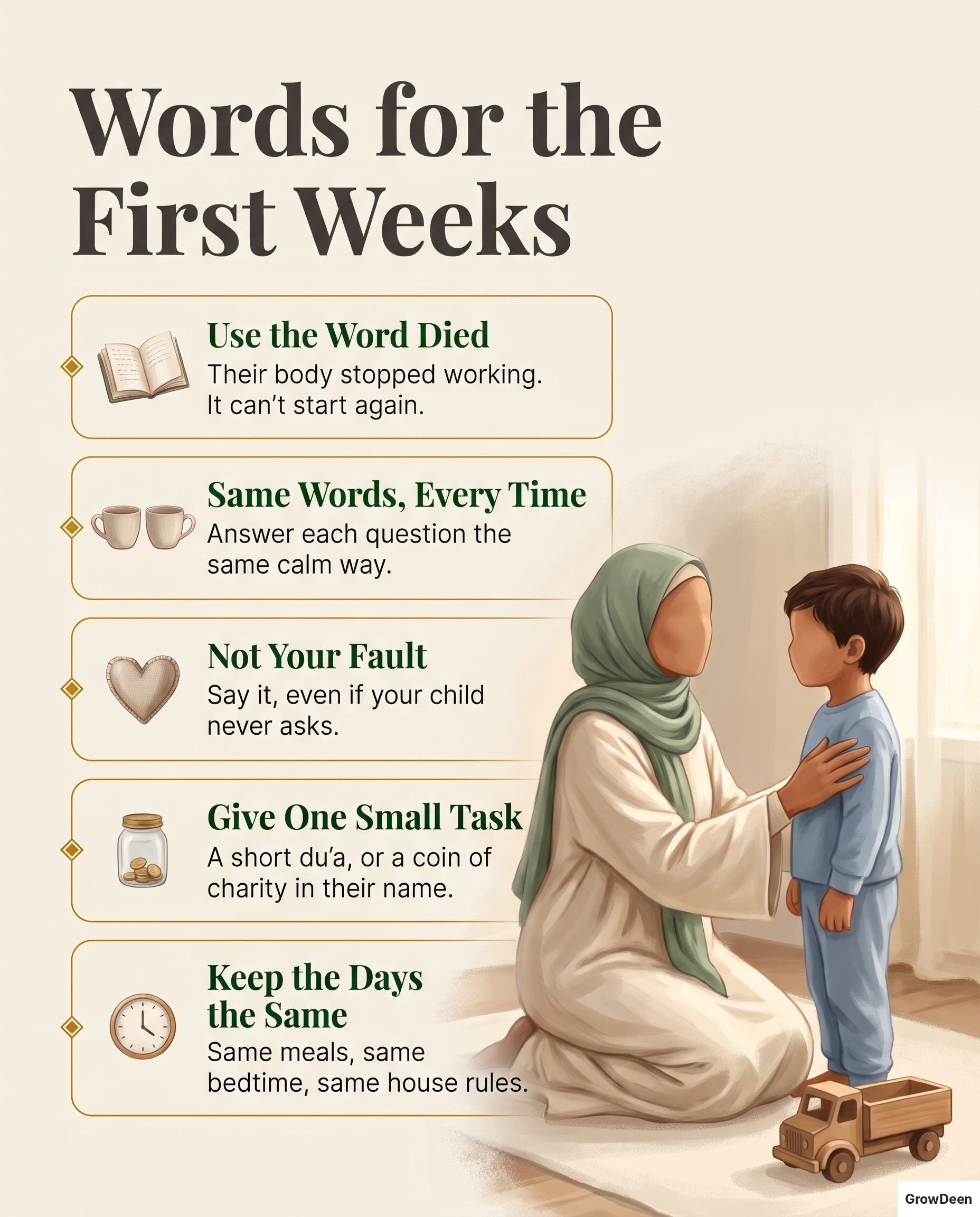
Say this: "Grandpa died. When someone dies, their body stops working. It doesn't breathe or feel hungry or cold. And it can't start again." (Say it in the language your child knows best.)
Instead of: "Grandpa has gone to sleep." Try: "Grandpa died. His body stopped working."
3–5: keep it to two or three short sentences, and expect the same question tomorrow. 6–8: they may ask about causes. Answer in a few true words.
2. Answer the six questions with the same words each time (1 minute, as often as needed). Children ask the same few questions, again and again. [1] Pick your answer once, and keep it steady.
Why did they die? "His heart was old and it stopped working. The doctors tried, and they couldn't fix it."
Will you die? Will I die? "Most people live until they are old. I expect to be here for a long, long time."
Where are they now? "His soul has gone back to Allah. His body is in the grave, and it doesn't feel cold or sore."
Was it my fault? "Nothing you said, thought or did made this happen. Not one thing."
Can they hear me? "I don't know. What I do know is that when you make du'a for him, Allah hears it."
When are they coming back? "He isn't coming back. I know that's hard to hear."
Say "Was it my fault?" out loud even if your child never asks it. Many young children wonder silently.
3. Say "I don't know" when you don't (1 minute). You don't need every answer.
Say this: "I don't know. I'll ask someone who might, and then I'll tell you."
It protects your child's trust that what you tell them is true.
4. Give your child one thing to do for the person who died (5 minutes a day). Grieving children often have nothing to hold. A small task gives the feeling somewhere to go.
Choose one: a short du'a at a fixed time, such as after Maghrib or at bedtime. A few coins from their own money, given as charity in the person's name. Or helping carry food to the grieving family: when Ja'far died, the Prophet ﷺ told the Muslims, "Prepare food for the family of Ja'far." [15]
Some families also recite a short surah with the person in mind. Scholars differ on whether its reward reaches the dead, so ask your local imam or a local scholar.
Say this: "Let's make du'a for Grandpa together. You can say it in your own words."
5. Keep the days the same (all day). Children find great comfort in routines. [4] Keep the same wake time, meals and bedtime. Keep the usual house rules, too.
Say this: "Some things feel different now. Bedtime is still the same. Story, du'a, then sleep."
Make It Work in Your Home
On your own, or working long shifts? Do step 1 and the "Was it my fault?" answer. That is enough for this week.
More than one child? Talk to each one at their own level. An older child may need more detail. A younger one may need only two sentences.
A grandparent or elder lives with you? Share the six answers with them, so your child hears the same words from everyone.
Say this to your spouse: "Can we agree on the same words for the children? Let's both say 'died', not 'sleeping'."
Say this to Grandma: "Mama, the children ask us the same questions again and again. If they ask you, could you say 'he died' and that his soul is with Allah?"
The family question: ask an elder, "When you were small and someone died, what did the adults tell you? What helped?"
If Things Don't Go to Plan
If your child asks the same question for the tenth time: answer it the same way, with the same calm. Each time, they are testing whether it still holds.
If bedtime becomes hard: stay a little longer for a while. If you used "sleeping" before, say gently, "I said Grandpa went to sleep. That was a mix-up. He died. Sleeping is safe, and you will wake up."
If your child goes backward: bedwetting or baby talk can return for a while. [4] Respond gently and keep routines steady.
If you already used soft words: it is not too late. Correct them calmly. Children cope well with "I explained it in a confusing way."
If the death was sudden or traumatic: give less detail, not more, and get professional advice early.
Speak to someone if: months on, your child has lost interest in things they enjoyed, or sleep and eating haven't settled. The same goes for a firm belief that the death was their fault, severe trouble separating from you, or a lasting change at school. [2]
And you? If your own grief makes everyday things hard, even after some time, talk to someone you trust, or get support. [1] Seeking help is one of the means Allah has given us.
Signs are clearer looking back. Seeing them late is not neglect.
For questions of deen (the way of life of Islam), ask your local imam or a local scholar, and share the details with him.
Who to turn to: your child's doctor or pediatrician, your child's school, or a grief counselor. In an emergency, call your local emergency number.
Support Muslim Parenting Lab ❤️
Would you like the reward of every parent who acts on what they read here? Fund it with the button below and it is yours.
The Prophet ﷺ said whoever guides to good has a reward like the one who does it. (Sahih Muslim 1893a)
Your Companion Pack: The Grief Words Pack
Free to download. One PDF, three printable pages, made to keep close for the nights the questions come:
What to Say First: the six questions children aged 3 to 8 ask after a death. Each has words to say back and a note on what to do next.
What Your Child Can Still Do: four things a child can do for the person who died. It has circles to tick and a box on when to ask for help.
The Du'a for the Moment It Happens: Al-Baqarah 2:156 and the du'a of Umm Salamah, in Arabic, transliteration and meaning. It adds three moments to say them together.
Parents Also Ask
How do I explain death to a 4-year-old?
Use the words "dead" and "died", and explain that the body has stopped working and can't start again. [1] Keep it short, and expect to repeat it. Knowledge in Practice has the words.
Should I tell my child Grandpa is sleeping?
It is best not to. Phrases like "gone to sleep" can confuse or frighten young children, and some become afraid of sleeping. [1] Say "died" instead.
At what age do children understand that death is permanent?
Many children aged 3 to 6 don't yet understand that death is final. [2] A partial understanding usually develops between 5 and 7, and a fuller one around 10. [3]
Is it normal for my child to play or laugh after someone dies?
Yes. A grieving child can cry one minute and play the next. It doesn't mean they have stopped being sad. [4]
Should my child go to the funeral or janazah?
There is no single answer. If your child goes, tell them beforehand what they will see and hear. Let them know they can leave, and ask one trusted adult to stay with them. Never force it.
Is it okay to cry in front of my child?
Text and our reflection. Yes. The Prophet ﷺ wept as his son Ibrahim was dying, and said the heart grieves (Sahih al-Bukhari 1303). [10] Islam restrains wailing and striking oneself, not tears. [11]
When should I get help for a grieving child?
Speak to your child's doctor if, months later, your child has lost interest in everything or blames themselves. The same goes for sleep or eating that hasn't settled. [2] About 1 in 10 bereaved young people show symptoms of prolonged grief disorder. [6]
Final Reflection
Dear parent,
You are reading this because you want to get one of the hardest conversations right. That care is already a gift to your child.
If you used soft words before, you were doing what most of us were taught. You were trying to protect them. You can still correct it gently.
You don't need perfect answers. Tonight, say the word "died", and stay close. Let that be enough for now.
We belong to Allah, and to Him we return. He sees every tear you hold back, and every one you let fall.
Say the word, then stay. Your child will remember that you told them the truth.
A Du'a for This
For you:
اللَّهُمَّ أْجُرْنِي فِي مُصِيبَتِي وَأَخْلِفْ لِي خَيْرًا مِنْهَا
Allāhumma'jurnī fī muṣībatī wa akhlif lī khayran minhā
"O Allah, reward me for my affliction and give me something better than it in exchange for it."
Sahih Muslim 918b · sunnah.com [9]
With your child: Innā lillāhi wa innā ilayhi rāji'ūn. "Indeed we belong to Allāh, and indeed to Him we will return" (Al-Baqarah 2:156). [7] Say it together, from about age 3. Then let your child make du'a for the person who died, in their own words.
Share the Khayr
If you know a parent whose child has lost a grandparent, send this to them. It may also help the friend who said, "I didn't know what to tell him." The Prophet ﷺ said that one who guides to something good has a reward similar to that of its doer (Sahih Muslim 1893a). [16]
Parents Also Read
Parents who read this guide also found these helpful.


References
[1] Raising Children Network (n.d.). Talking to children about death: tips. Raising Children Network, Australia. (Australia · Suggestive)
[2] Children's Hospital Colorado (n.d.). How to Talk to Kids About Death and Grief. (US · Suggestive)
[3] Bates, A. T., & Kearney, J. A. (2015). Understanding death with limited experience in life: dying children's and adolescents' understanding of their own terminal illness and death. Current Opinion in Supportive and Palliative Care, 9(1), 40–45. (Review · Suggestive)
[4] Ehmke, R. (n.d.). Helping Children Deal With Grief. Child Mind Institute. (US · Suggestive)
[5] Boelen, P. A., & Spuij, M. (2024). Individual and systemic variables associated with prolonged grief and other emotional distress in bereaved children. PLOS ONE, 19(4), e0302725. (Country not given in the study summary · Early)
[6] Van Dijk, I., Boelen, P. A., de Keijser, J., & Lenferink, L. I. M. (2023). Assessing DSM-5-TR and ICD-11 prolonged grief disorder in children and adolescents: development of the Traumatic Grief Inventory-Kids-Clinician-Administered. European Journal of Psychotraumatology, 14(2), 2197697. (Suggestive)
[7] Qur'an, Al-Baqarah 2:156. Translation: Sahih International.
[8] Tafsir Ibn Kathir on Al-Baqarah 2:156.
[9] Sahih Muslim 918b.
[10] Sahih al-Bukhari 1303.
[11] Sahih al-Bukhari 1294.
[12] Sahih Muslim 1631.
[13] Qur'an, Al-Hashr 59:10. Translation: Sahih International.
[14] Sahih al-Bukhari 2760.
[15] Sunan Abi Dawud 3132. Graded Hasan (Al-Albani).
[16] Sahih Muslim 1893a.
We combine scientific research with Qur’an and authentic Sunnah, and we cite our sources. Even so, this is general guidance and no substitute for a doctor who can examine your child.
Sources & confidence
The hadith in this guide are from Sahih al-Bukhari, Sahih Muslim and Sunan Abi Dawud (graded Hasan). The Qur'an verses are quoted from Sahih International. Checked October 2026. Found a source that looks wrong? Email us at info@growdeen.com.
Words in this guide
du'a (doa): supplication
deen: the way of life of Islam
janazah: the Muslim funeral prayer
khayr: good
sadaqah: charity
Sunnah: the teachings and practice of the Prophet ﷺ
surah: a chapter of the Qur'an
bereaved: having lost someone close to death
grief: the deep sadness after someone dies
prolonged grief disorder: grief that stays intense and disabling for many months, recognized by doctors as a condition with treatment
pediatrician (paediatrician)
counselor (counsellor)