

Your preemie seems behind on the milestone chart? The free Preemie Pace Kit does the corrected-age sum for you and gets your next appointment ready.

AGES 0–3 YEARS · 15 MIN READ
Your baby is six months old and not sitting up yet.
At a family dinner, an aunt mentions a cousin who sat at five months. She means well. The sentence still follows you home.
Later, the house is quiet. You open a milestone chart on your phone, again.
She came ten weeks early. So is she behind, or are we reading the wrong number?
You are asking the right question. Many parents of babies born early carry this same worry, often in silence.
This guide brings together scientific research and the Qur'an and authentic Sunnah. You'll see which age to use, when to stop correcting, and what to say at the next appointment.
The Short Answer
Right for your child? Babies born before 37 weeks, from birth to about age 2. Older? Ask if your baby's doctor still corrects.
What's probably happening: most charts count from birth. Counted from the due date, your baby may be right on track.
Try tonight (5 minutes): find the due date. Take your baby's age and subtract the weeks born early. Read every chart with that number.
You'll know it's working when: the chart starts to match the baby in front of you. A skill that has not shown up yet is not a failure.
Get help if: a skill stays behind by corrected age, or limbs feel stiff, floppy or one-sided. Start with your baby's doctor or pediatrician.
The rest of this guide explains why, and what to do if it does not work.
How to Read This Guide
3 minutes: The Short Answer above is enough for tonight.
7 minutes: The Short Answer, then Knowledge in Practice and If Things Don't Go to Plan.
The whole guide: read on for the scientific research, the Qur'an and Sunnah, and the References.
To share: the bold lines and the pull quotes are made to be shared.
To listen: open this guide in the free Substack app and tap Listen.
Inside This Guide
Counting from the due date is not making excuses. It is reading your baby fairly.
Myth Check: "My Preemie Should Hit Milestones by Her Birthday Age"
What the belief gets right. The birthday is a real date. It goes on every form, and it is the day your baby arrived. Relatives who compare mean well. The American Academy of Pediatrics (AAP) notes that family and friends often worry when a preemie looks behind for her age from birth. [1]
What the evidence says. For development, the AAP advises using corrected age during the first 2 years. [1] Its own example: a baby born at 32 weeks was 8 weeks early. At 4 months old, her corrected age is 2 months, so expect the skills of a 2-month-old. [1]
So: keep the birthday for forms. Use the due date for milestones.
Why This Happens
Why does my baby look behind on the chart?
Your baby has two ages. Age from birth counts every week since delivery. Corrected age counts from the due date. [1]
A chart that counts from birth asks your preemie for skills a baby born at term would not have yet.
The sum takes a minute. Subtract the weeks your baby was born early from her age now. [1] To find the weeks early, subtract her weeks of pregnancy at birth from 40. [1]
Eleven weeks old and born 8 weeks early? Her corrected age is 3 weeks. So compare her with a 3-week-old.
Six months old and born 10 weeks early? That is about 2.5 months early, counting 4 weeks to a month. [2] Her corrected age is about 3.5 months. Sitting up is not expected yet: the AAP lists sitting briefly without support at 6 months. [2]
How long do I keep correcting?
The AAP advises using corrected age to track development until about age 2. [1,2] Your baby's doctor also plots growth, and may have a plan for how long to correct each one. Ask which they use, so you read the file the way they do.
What if she is still behind after correcting?
By age 2, most children born early have caught up to the typical milestone range, the AAP says. Those who have not may need extra support for longer. [2] So if a gap stays after correcting, stop subtracting and ask.
Corrected age clears away the false gap. It was never meant to hide a real one.
Did I cause this?
Many parents carry this thought quietly. The World Health Organization (WHO) says most preterm births happen spontaneously, and often no cause is identified. [3] A cause no one could find is not a failing you have to carry.
The other half of the weight is the fear of missing something now. That instinct is right, and the steps below give it a target.
What the Scientific Research Shows
The strongest finding is about what helps after you go home. A 2024 Cochrane review pooled 44 trials with 5,051 preterm babies. [4] The programs began in the first year, and the newer ones often supported both the baby and the parent-baby bond. [4]
Who was studied: babies born before 37 weeks, in trials mainly from middle- and high-income countries. Ethnicity and family income are not given in the review summary, and neither is whether children with additional needs took part. No study has yet tested this with Muslim families.
What was measured: thinking skills and movement, in infancy, at preschool age and at school age.
What changed: at preschool age, children who had a program scored higher on thinking skills (9 trials, 1,524 children, high-certainty evidence). [4] The gain in infancy was smaller and less certain. No clear benefit was shown at school age, and gains in movement were small. [4]
How strong this is: Strong for thinking skills at preschool age. The school-age picture is uncertain.
How common early birth is. About 13.4 million babies were born preterm in 2020, more than 1 in 10 babies. [3] The WHO groups them by weeks of pregnancy: before 28, from 28 to under 32, and from 32 to 37. [3]
Catching up. By age 2, most children born early have caught up to the typical milestone range. [2] The AAP adds that ongoing challenges are more likely in babies who were the smallest at birth. [2] Suggestive (expert guidance from the AAP, US, updated 2024).
The harder outcomes. One large UK and Ireland study followed children born before 26 weeks in 1995. At age 11, 23% had a psychiatric disorder, against 9% of classmates born at term. [5] ADHD was found in 11.5% against 2.1%, and autism in 8.0% against 0%. [5] Suggestive: one large cohort, of the earliest babies only.
In hospital. The WHO's 2022 guidelines advise skin-to-skin contact with a caregiver straight after birth, without a first period in an incubator. [6] Breastfeeding is strongly recommended; when the mother's milk is not available, donor human milk is the best alternative. [6] Strong (an official WHO guideline, 2022).
What we do not know yet: which programs help most, whether gains last into school, and how this looks in Muslim families.
What this means for you: read milestones by corrected age, and if a gap stays, ask early.
What the Qur'an and Sunnah Teach
ٱلَّذِى خَلَقَ فَسَوَّىٰ وَٱلَّذِى قَدَّرَ فَهَدَىٰ
Who created and proportioned, And Who destined and [then] guided
Al-A'la 87:2–3 · Sahih International [7]
Text. Tafsir Ibn Kathir explains that Allah created what exists and fashioned every creation in the best of forms. Then He decreed a set measure and guided creation to it. [8] Ibn Kathir cites a narration in Sahih Muslim about this. Allah ordained the measure of all creation fifty thousand years before He created the heavens and the earth. [8]
Our reflection. Your baby's pace was measured long before any chart. Comparing her with a cousin who sat at five months misses this. Her measure was set before either child was born.
The Prophet ﷺ said, "Allah says: 'I am just as My slave thinks I am, (i.e. I am able to do for him what he thinks I can do for him) and I am with him if He remembers Me…'"
Sahih al-Bukhari 7405 · sunnah.com [9]
Text. What a servant expects of Allah matters, and Allah is with the one who remembers Him.
Our reflection. A parent reading risk numbers at midnight is forming an expectation about a child's future. This narration treats that expectation as something that matters, not as private weather. So both belong in your day: good expectation of Allah, and a phone call when something looks wrong.
Expect well of Allah. Then phone the clinic in the morning.
The Lab Verdict
The science: in the first 2 years, corrected age is the fair way to read milestones (Suggestive). Early support after discharge improves preschool thinking skills (Strong).
The Qur'an and authentic Sunnah: Allah created, proportioned, measured and guided each creation, and He is as His servant thinks of Him.
Where they meet: the science tells you which number to read; the Sunnah shapes how you carry the worry. Held together, a fair count and trust in Allah's measure let you watch closely without fear.
So at home: count from the due date, expect well of Allah, and raise any gap that stays.
Knowledge in Practice: Count From the Due Date
Now the number needs to leave your head. These four steps put it on the fridge door and into the clinic room.
If you can only do one thing, do step 1. It is enough.
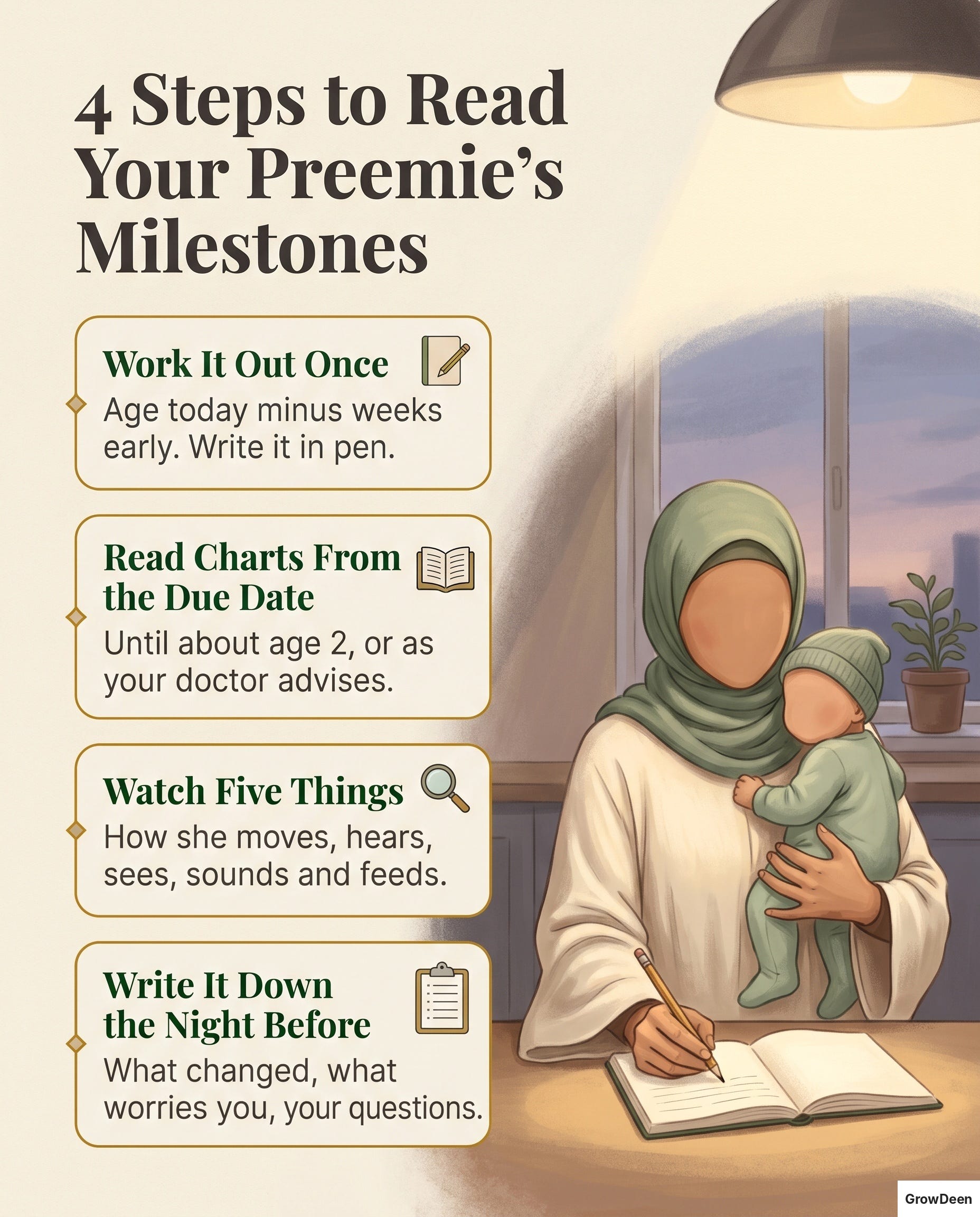
1. Work out the corrected age once, in pen (5 minutes). Write the due date, the birth date and the weeks early. Then do the sum: age today minus weeks early. [1] Written once, the sum stops running in your head at night.
Say this: "Bismillah. You're three months old today, counted your way." (Say it in the language your child knows best.)
Instead of: "Why isn't she sitting yet?" Try: "Counted from her due date, she's three and a half months. Sitting comes later."
When family asks, choose one of these:
"She came 8 weeks early, so her doctor counts from her due date."
"By her corrected age, she's right on time."
"We check her chart with her doctor. Thank you for caring about her."
No printer? Write the three dates inside the cover of her health record, or in a phone note you can find fast.
2. Read every chart from the due date (2 minutes, once a month). Use the corrected age on every milestone list. The AAP's preemie list, read by corrected age, includes these: [2]
Around 2 months: smiles back at you, and keeps her head steady when held sitting. Around 4 months: turns to voices, and props on elbows and wrists on her tummy. Around 6 months: babbles ("da," "ba"), rolls from back to tummy, and sits briefly without support. Around 9 months: sits well without support, and turns when her name is called. Around 12 months: takes first steps, and says one word besides "Mama" or "Dada."
3. Watch five things at home (a few minutes a day). You see your baby for hours that no clinic can.
How she moves: favoring one side, or limbs that feel stiff or floppy, belongs in a call this month. [10]
How she hears: turning toward voices around 4 months, corrected. [2] A baby who stops turning to sound needs a check, even after a normal newborn hearing screen.
How she sees: following your face, with eyes that look straight by about 3 to 4 months. [2,11]
How she sounds: babbling around 6 months, corrected. [2] If the sounds stop or never start, ask.
How she feeds: feeds that distress her, or weight gain that stalls.
Say this: "I'm right here. Can you find my voice?"
4. Fill in the appointment page the night before (10 minutes). Write what has changed since last time, what is worrying you, and three questions. Include the things that feel too small to mention. You know your baby best, and a worry only helps if it is said out loud in the room.
A follow-up visit checks progress over time. Bring these questions:
"Until what age will you correct for prematurity, and is that different for growth and development?"
"Is anything today outside what you'd expect at this corrected age?"
"Is there anything you'd want me to come back sooner about?"
Say this to the doctor: "Before we start, I've written down a few things. Can we go through them together?"
Make It Work in Your Home
On your own, or on the night shift? Do step 1 once, on any evening that allows it. Tape the page inside a cupboard door, and the sum is done for months.
Twins or triplets? Babies born together share a corrected age, but give each one a milestone sheet of her own.
Our reflection: many Muslim homes already have daily anchors: salah (prayer) times, Bismillah before food, adhkar (remembrance of Allah) morning and evening. They give a baby's day calm, familiar repeats, with no program to buy.
Say this to Grandma: "Mama, you raised us with so much care. She came ten weeks early, so her doctor counts from her due date. By that count she's on time. Will you help me watch for her next new skill?"
Say this to your spouse: "Can you take the baby while I fill in the appointment page? Then tell me what you noticed this week."
The family question: ask an elder, "When babies came early in our family, what helped you most?"
Read from the due date, and take your written page to every visit.
If Things Don't Go to Plan
If family keeps comparing: use the swap line once more, then change the subject kindly. Their worry comes from love. They are using the wrong number.
If your baby is still behind after correcting: that is the signal corrected age exists to show. Ask your baby's doctor about early intervention, extra support some babies receive to help them develop. [2] Early programs have the strongest evidence of anything in this guide. [4] A referral is an assessment, not a diagnosis.
If you start doubting yourself: Did I cause this, and am I missing something now? Often no cause is found for an early birth. [3] A parent who keeps notes and keeps asking is often the one who catches a change. Signs are clearer looking back. Seeing them late is not neglect.
If the appointment feels rushed: hand over your page at the start.
Already in the system? If a therapist or specialist already sees your baby, take page 2 of the Kit to that team too.
And you? Months of hospital visits and home care can wear a parent down. If you feel low, anxious or numb most days, tell your own doctor or midwife.
Speak to someone if: a skill stays well behind by corrected age, your baby loses a skill, or something feels wrong that you cannot name. For questions of deen (Islam as a way of life), ask your local imam or a local scholar, and share the details with him.
Who to turn to: your baby's doctor or pediatrician. For your own health, your doctor or midwife. In an emergency, call your local emergency number.
Support Muslim Parenting Lab ❤️
Would you like the most rewarded kind of charity there is? Use the button below now, while you are well, rather than later.
Asked which charity is best, the Prophet ﷺ said the one given while you are healthy, not deferred until death is near. (Sahih al-Bukhari 1419)
Your Companion Pack: The Preemie Pace Kit
Free to download: one PDF of three printable pages, for a fridge door or a hospital bag.
Page 1, The Corrected Age Worksheet: the sum as a fill-in line, two worked examples and a twelve-row milestone sheet read from the due date.
Page 2, The Appointment Page: what changed, what worries you, three questions and seven signs to call sooner.
Page 3, Allah Proportioned the Pace: Al-A'la 87:2–3 with Ibn Kathir's explanation, and the hadith on expecting well of Allah.
Parents Also Ask
How do you calculate corrected age for a premature baby?
Take your baby's age in weeks since birth and subtract the weeks she was born early. [1] To find the weeks early, subtract her weeks of pregnancy at birth from 40. [1] A baby who is 11 weeks old and was born 8 weeks early has a corrected age of 3 weeks.
Until what age should I use corrected age?
The AAP advises using corrected age to track development until about age 2. [1,2] Your baby's doctor may correct growth and development for different lengths of time, so ask which plan they follow.
Do premature babies catch up by age 2?
Most do. The AAP says that by age 2, most children born early have caught up to the typical milestone range. [2] Those who have not may need extra support for longer. [2] Why This Happens explains more.
When should a premature baby sit up?
Read it by corrected age. The AAP lists sitting briefly without support around 6 months and sitting well around 9 months. [2] A baby born 10 weeks early is judged against those ages from her due date.
Are premature babies more likely to have autism or ADHD?
The chance is higher, mostly in the earliest-born babies. One UK and Ireland study followed children born before 26 weeks. At age 11, 8.0% had autism and 11.5% had ADHD, against 0% and 2.1% of classmates. [5] Most of those children had neither, and a rate across a group is not a prediction about your child.
Should I wait and see, or ask about early intervention?
Ask. Early developmental programs after discharge improved thinking skills at preschool age in a 2024 review of 44 trials. [4] A referral gets you an assessment and clear information.
Did I do something to cause my baby's early birth?
Most preterm births happen spontaneously, and often no cause is identified, the WHO says. [3] If a specific question stays with you, your own doctor or midwife can go through your pregnancy with you.
Final Reflection
Dear parent,
You are reading about milestones while caring for a baby who needed extra care. That takes love and stamina.
If you have been counting from the birthday, you used the number everyone uses. Changing it takes one sum.
You don't need to settle every worry this week. Do step 1 tonight, in pen. Make the niyyah (intention) that this is care. Your baby is an amanah (a trust) from Allah.
You are not behind. You are not failing her. You are learning to read her fairly.
Often, your preemie isn't behind. She is right on time, counted from the day she was due.
A Du'a for This
For you:
رَبَّنَا هَبْ لَنَا مِنْ أَزْوَٰجِنَا وَذُرِّيَّـٰتِنَا قُرَّةَ أَعْيُنٍ وَٱجْعَلْنَا لِلْمُتَّقِينَ إِمَامًا
Rabbanā hab lanā min azwājinā wa dhurriyyātinā qurrata a'yunin waj'alnā lil-muttaqīna imāmā
"Our Lord, grant us from among our wives and offspring comfort to our eyes and make us an example for the righteous."
Al-Furqan 25:74 · Sahih International [12]
With your child: Bismillāh, "In the name of Allah." (Al-Fatiha 1:1) [13] Say it over your baby before each feed and each tummy time. When she begins to talk, say it together.
Share the Khayr
Think of one parent whose baby came early: the sister who stopped posting photos, or the cousin driving to the neonatal unit twice a day. Send it to her as company. The Prophet ﷺ said, "One who guides to something good has a reward similar to that of its doer." [14]
Tell us in the comments: what was your baby's corrected age tonight, and what did it change for you? We'd love to know.
Parents Also Read
Parents who read this guide also found these helpful.


References
[1] American Academy of Pediatrics. (2018). Corrected Age For Preemies. HealthyChildren.org, adapted from Understanding the NICU (2017).
[2] American Academy of Pediatrics. (2024). Your Preemie's Growth & Developmental Milestones. HealthyChildren.org.
[3] World Health Organization. (2023). Preterm birth. WHO fact sheet.
[4] Orton, J., Doyle, L.W., Tripathi, T., Boyd, R., Anderson, P.J., & Spittle, A. (2024). Early developmental intervention programmes provided post hospital discharge to prevent motor and cognitive impairment in preterm infants. Cochrane Database of Systematic Reviews, 2024(2), CD005495.
[5] Johnson, S., Hollis, C., Kochhar, P., Hennessy, E., Wolke, D., & Marlow, N. (2010). Psychiatric disorders in extremely preterm children: Longitudinal finding at age 11 years in the EPICure study. Journal of the American Academy of Child & Adolescent Psychiatry, 49(5), 453–463.
[6] World Health Organization. (2022). WHO advises immediate skin to skin care for survival of small and preterm babies. WHO news release on the WHO recommendations for care of the preterm or low-birth-weight infant.
[7] Qur'an, Al-A'la 87:2–3. Translation: Sahih International.
[8] Tafsir Ibn Kathir on Al-A'la 87:3.
[10] National Institute of Neurological Disorders and Stroke. Cerebral Palsy. National Institutes of Health.
[11] Children's Hospital of Philadelphia. Crossed Eyes (Strabismus).
[12] Qur'an, Al-Furqan 25:74. Translation: Sahih International.
[13] Qur'an, Al-Fatiha 1:1. Translation: Sahih International.
[14] Sahih Muslim 1893a.
We combine scientific research with Qur’an and authentic Sunnah, and we cite our sources. Even so, this is general guidance and no substitute for a doctor who can examine your child.
Sources & confidence
The hadith in this guide are from Sahih al-Bukhari and Sahih Muslim. Health guidance follows the AAP, the WHO and the US National Institutes of Health. Checked October 2026. Found a source that looks wrong? Email us at info@growdeen.com.
Words in this guide
preterm or premature baby (preemie) · scientific term: a baby born before 37 weeks of pregnancy.
corrected age (adjusted age) · scientific term: age since birth minus the weeks born early, used for milestones.
chronological age · scientific term: age counted from the day of birth.
due date · scientific term: the day a baby was expected, around 40 weeks of pregnancy.
developmental milestones · scientific term: skills most babies show by a certain age, such as smiling, sitting and first words.
early intervention · scientific term: extra support some babies and children receive to help them develop.
neonatal unit (NICU) · scientific term: the hospital ward that cares for babies born early or sick.
skin-to-skin contact (kangaroo mother care) · scientific term: holding a baby in a diaper (nappy) against a caregiver's bare chest.
cerebral palsy · scientific term: a group of conditions affecting movement and posture.
strabismus (squint) · scientific term: eyes that do not look in the same direction.
amanah · Islamic term: a trust from Allah, such as a child in a parent's care.
niyyah · Islamic term: intention, the purpose held in the heart behind an act.
deen · Islamic term: the way of life Islam teaches.
salah (namaz, solat) · Islamic term: the five daily prayers.
adhkar · Islamic term: words of remembrance of Allah.
sadaqah · Islamic term: charity given for the sake of Allah.
khayr · Islamic term: good.
tafsir · Islamic term: a scholar's explanation of the Qur'an.
hadith · Islamic term: a report of what the Prophet ﷺ said or did.
du'a (doa) · Islamic term: supplication, asking Allah.
Bismillah · Islamic term: "In the name of Allah".
Al-A'la · Islamic term: the 87th surah of the Qur'an.
diaper (nappy) · country word: nappy is the word used in the UK, Australia and New Zealand.
pediatrician (paediatrician) · country word: a doctor for babies and children.