

Found your child walking the house asleep? The free Sleepwalking Pack gives you a one-minute night sweep, a card for the hallway, and a card for the nights you lie awake.
AGES 3–8 YEARS · 16 MIN READ
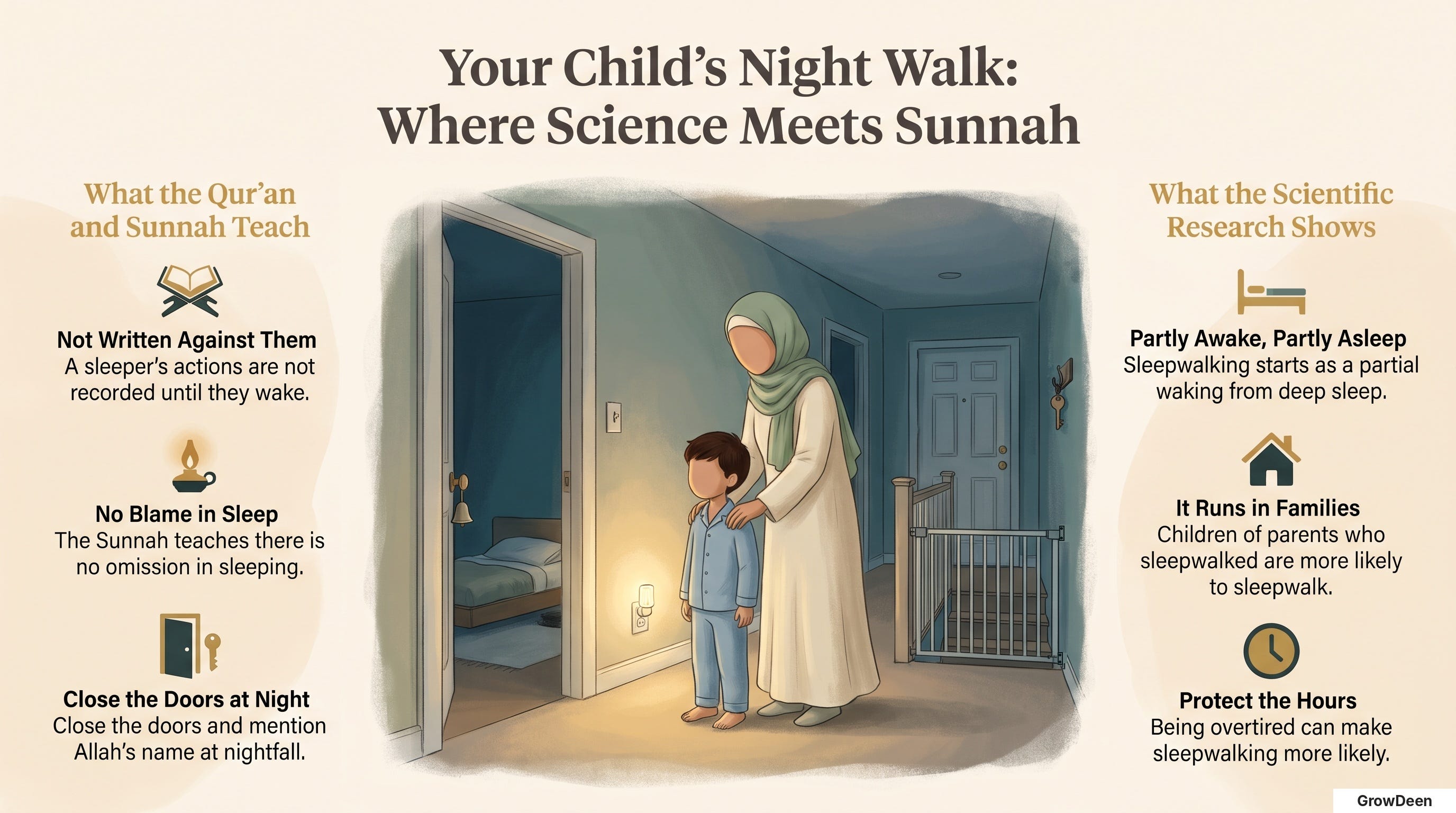
The hallway light is off. Your five-year-old is standing in it with his eyes open. He looks at you and through you at once. You say his name. Nothing. You say it louder and take his shoulders.
I was right in front of him, and he didn't know me. What is happening to my son?
He is not ignoring you. Part of him is still in deep sleep. You were doing the loving thing, and there is a calmer way through.
This guide brings together scientific research and the Qur'an and authentic Sunnah. You'll see why this happens, how to make your home safe, and what to do in the hallway tonight.
The Short Answer
Right for your child? Ages 3–8 who get out of bed or walk around while still asleep, usually early in the night.
What's probably happening: your child is partly awake and partly in deep sleep, so your voice may not reach them.
Keep safe: lock outside doors and windows before bed, because a sleepwalking child can walk outside.
Try tonight (1 minute): lock the front door and put the key above your child's reach. If they walk, speak softly and guide them back to bed.
You'll know it's working when: an episode ends with your child back in bed, calm. Another episode is not failure; episodes can come and go.
Get help if: episodes come most nights, your child is hurt or leaves the house, they snore most nights, or episodes look unusual. Start with your child's doctor or pediatrician.
The rest of this guide explains why, and what to do if it does not work.
How to Read This Guide
3 minutes: The Short Answer above is enough for tonight.
7 minutes: The Short Answer, then Knowledge in Practice and If Things Don't Go to Plan.
The whole guide: read on for the scientific research, the Qur'an and Sunnah, and the References.
To share: the bold lines and the pull quotes are made to be shared.
To listen: open this guide in the free Substack app and tap Listen.
Inside This Guide
Sleepwalking often runs in families. It is not a verdict on your parenting or your home.
Myth Check: "Wake Them Up So They Know Where They Are"
In a dark hallway, waking your child feels like the safe thing to do. You want them back with you, knowing where they are.
What this gets right. Your instinct is protective. A child walking in the dark does need an adult close by.
What the evidence says. Sleepwalking happens during a partial waking out of deep sleep. [1] One of the signs doctors use to recognize it is that the person responds poorly when others try to step in or redirect them. [1] So shouting or shaking rarely brings your child back quickly, and it may upset them more.
What works better. Keep your voice low. Steady them and walk them back to bed. Step 3 of Knowledge in Practice gives the four moves.
Why This Happens
Why does my child walk but not answer me?
Sleep has a deep stage, called slow-wave sleep. Sleepwalking begins when the brain partly wakes out of this deep stage. [1] Part of your child is awake enough to sit up and walk. The part that would notice you, and remember, stays mostly asleep. [1]
That is why your child may not answer, and may remember little or nothing in the morning. [1] It isn't your child hiding something.
Why does it happen early in the night?
Sleepwalking most often happens in the first third of a night's sleep. [2] That is when slow-wave sleep is most common. [3] For most children, this means the first few hours after lights-out.
Why my child?
Sleepwalking strongly runs in families. [4] In children, it is also seen as a fairly normal part of early sleep patterns. [2] Some children walk calmly toward a light or toward your bedroom. Others do strange things, and a few become agitated. [2]
Being overtired can lead to sleepwalking. [5]
The child in your hallway is not being defiant. Their legs are awake, and the rest is still asleep.
What the Scientific Research Shows
The strongest finding is about families. A study followed 1,940 children born in Quebec, Canada, through childhood. [4] Sleepwalking affected 22.5% of children with no parent who had sleepwalked. It affected 47.4% of children with one such parent, and 61.5% with two. [4]
Who was studied: children born in Quebec, Canada, in 1997 and 1998. Ethnicity or culture, family type or income, and children with additional needs were not given in the study summary. No study has yet tested this with Muslim families.
How strong this is: Suggestive. One large, long-running study, and the American Academy of Sleep Medicine (AASM) also notes that sleepwalking is more common when a parent sleepwalked. [3]
How common it is: the AASM says sleepwalking occurs in as many as 17% of children. [3] A review of 51 studies, covering more than 100,000 people, found that about 5% of children had sleepwalked in the past year. For adults, the figure was about 1.5%. [6] How strong this is: Strong for how common it is.
What sets an episode off: a laboratory study tested sleep loss and forced arousals out of deep sleep as triggers in people prone to sleepwalking. [7] Who was studied: a small laboratory group; country, background, income and additional needs were not given in the sources available. Mayo Clinic advises enough sleep, because being overtired can lead to sleepwalking. [5] How strong this is: Suggestive.
Snoring and breathing: a Stanford sleep clinic reviewed 84 children before puberty with sleep terrors, and 79 of them also sleepwalked. [8] Of these, 51 had another sleep disorder, such as breathing problems in sleep. In the 45 children treated for it, the sleep terrors and sleepwalking stopped. In the 6 children left untreated for their breathing problem, the episodes went on. [8]
Who was studied: children seen at a US sleep clinic, compared with 36 children without sleep problems. Ethnicity, family income and additional needs were not given in the study summary. How strong this is: Early. One small study that looked back at clinic records. The AASM also says that treating sleep apnea may improve sleepwalking. [2]
What we do not know yet: no trial has tested whether home safety steps reduce injuries in children who sleepwalk. The steps are here because a sleepwalking child can walk toward a window or go outside. [3]
What this means for you: sleepwalking has no off switch. You can still protect sleep and make the house safe, and if your child snores, tell your child's doctor.
What the Qur'an and Sunnah Teach
In a dark hallway at night, the mind can go somewhere older than medicine. Is something wrong with my child, or with this house?
وَهُوَ ٱلَّذِى يَتَوَفَّىٰكُم بِٱلَّيْلِ وَيَعْلَمُ مَا جَرَحْتُم بِٱلنَّهَارِ
And it is He who takes your souls by night and knows what you have committed by day.
Al-An'am 6:60 · Sahih International [9]
Text. Allah describes the night as a time when He takes our souls, and He knows what we have done by day. [9] Ibn Kathir explains this taking as what happens to us in sleep. [10]
When the Companions slept past the dawn prayer on a journey and whispered about their omission, the Prophet ﷺ told them: "There is no omission in sleeping."
Sahih Muslim 681 · sunnah.com [11]
"There are three (persons) whose actions are not recorded: a sleeper till he awakes, … and a boy till he reaches puberty."
Sunan Abi Dawud 4398 · Sahih (Al-Albani) · sunnah.com [12]
Text. In Arabic, this hadith opens with words meaning "the pen is lifted from three". [12]
Our reflection. Nothing your child does while asleep is written against them. So the child in the hallway is not being defiant. No text was found linking a child's sleepwalking to a home that is spiritually unprotected. If that worry stays with you, ask your local imam or a local scholar, and share the details with him.
The same narration in Sahih Muslim holds a quiet scene. One night while traveling, the Prophet ﷺ dozed and leaned to one side of his camel. Abu Qatadah supported him "without awaking him", more than once. [11] When the Prophet ﷺ learned of it, he said: "May Allah protect you, as you have protected His Apostle." [11]
Our reflection. Steadying a sleeper without waking him is a picture of the care your child needs in the hallway.
"Close the doors and mention the Name of Allah, for Satan does not open a closed door."
Sahih al-Bukhari 3304 · sunnah.com [13]
Text. The same hadith tells parents to keep young children close when night falls. [13]
Our reflection. A family that closes up at night with Bismillah already has the habit a sleepwalking child needs most: a closed, locked door.
Nothing your child does asleep is written against them. Your work tonight is a locked door and a steady hand.
The Lab Verdict
The science: sleepwalking comes from a partial waking out of deep sleep. It often runs in families, and being overtired can make it more likely. (Suggestive)
The Qur'an and authentic Sunnah: what a sleeper does is not recorded against them, and the Sunnah teaches closing the doors at night with Allah's name.
Where they meet: the science shows why the risk sits in the house. The Sunnah gives the calm and the nightly habit of closing up. Together, they ask the same of us: close the door, and stay gentle.
So at home: lock up with Bismillah, protect the hours of sleep, and guide your child back with a low voice.
Knowledge in Practice: The One-Minute Night Sweep
Knowing why this happens is half the work. Knowledge bears fruit only when it reaches the front door.
If you can only do one thing, do step 1. It is enough.
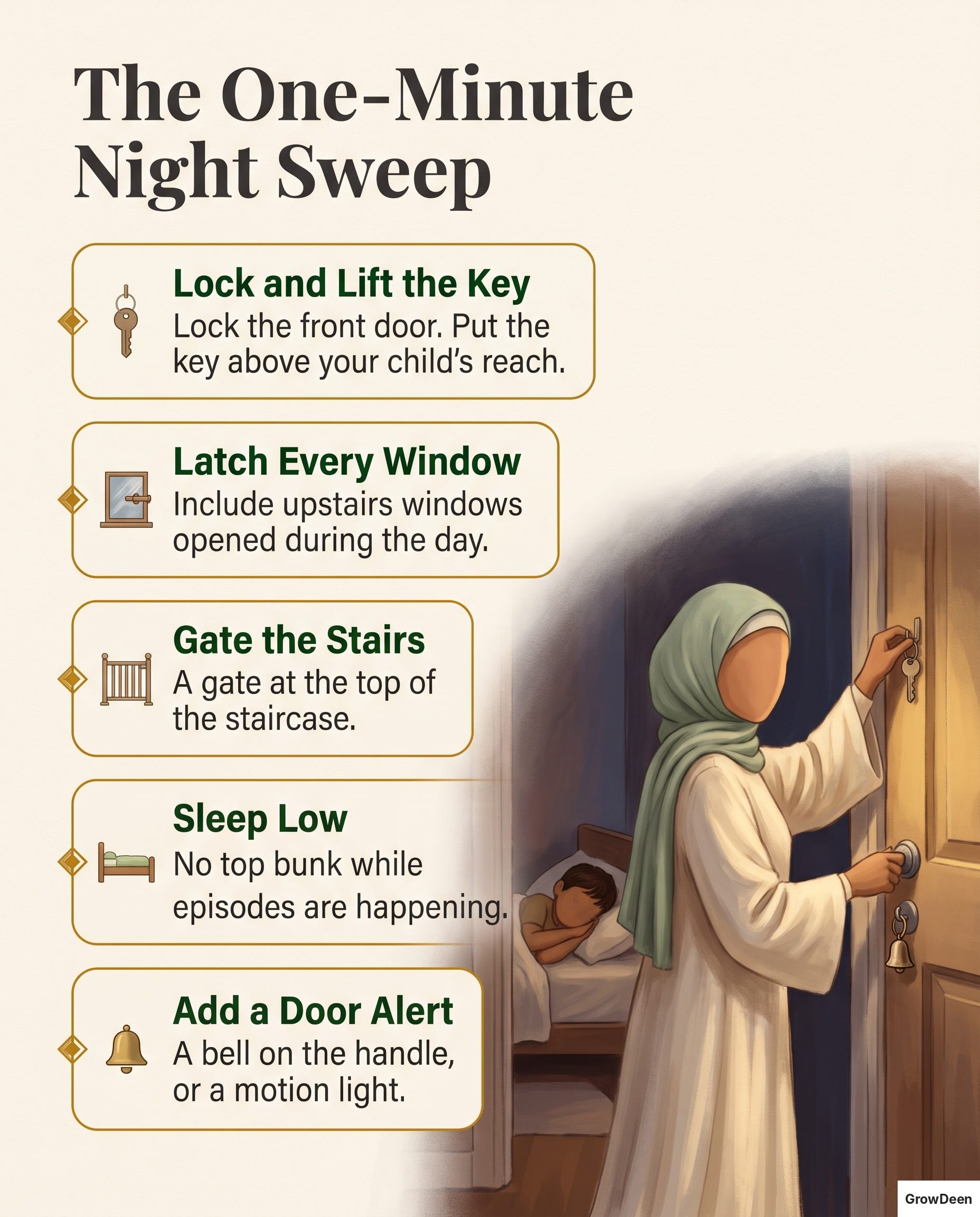
1. Walk the one-minute night sweep (1 minute, on your way to bed). A sleepwalking child can walk toward a window or go outside, so the house carries the risk. [3] There are seven stops:
Front and back doors locked. Deadbolt on, and the key moved somewhere above a child's reach.
Every window latched. Include upstairs windows, and any that were opened during the day.
A gate across the stairs. At the top of the staircase, or across the bedroom door for a younger child.
Sleeping low, not high. No top bunk, and no raised or loft bed, while episodes are happening.
A clear floor path to the bathroom. Lift toys, cables, laundry baskets and loose rugs out of the walking line.
Something on the door that wakes you. A bell on the handle, or a motion light on the landing.
Bedtime twenty minutes earlier. Step 2 explains why.
Say this (at bedtime): "Bismillah. Doors closed, lights low, time to sleep." (Say it in the language your child knows best.)
A small home or no spare money? A bell from an old key ring works as a door alert, and a high shelf works for the key.
2. Protect the hours (20 minutes, starting tonight). Being overtired can lead to sleepwalking, and enough sleep can sometimes prevent it. [5] [2] Moving bedtime about twenty minutes earlier is a small, practical way to add sleep.
Instead of: "Ten more minutes, then bed." Try: "Lights down now. We'll finish the story tomorrow night."
3. Use the four hallway moves (under a minute, during an episode).
Lower your voice, not your hands. Speak quietly or say nothing at all. A loud voice or a shake may upset a sleeping child.
Do not wake them. A sleepwalking child often responds poorly when others try to step in. [1] So guide them back instead.
Steady and walk, do not block. One hand at the shoulder, turn them gently toward the bedroom, and walk alongside. Stop at the bathroom first if that is plainly what they want. Sleepwalking can sometimes involve agitated or even violent behavior, so holding a child down or blocking them may make things worse. [2]
Say nothing in the morning. Unless your child raises it, leave it. Some people who sleepwalk feel embarrassed, and bedtime should feel safe. [5]
Say this (softly): "It's okay. This way. Back to bed now."
Instead of: "Wake up, what are you doing?" Try: "Shh, you're safe. This way, back to bed."
6–8: if your child asks about it later, keep it light: "You walked in your sleep. Lots of children do. You're safe."
4. Close up with the Sunnah (2 minutes, at bedtime). Close the doors and mention Allah's name, as the Prophet ﷺ taught. [13] Say the bedtime adhkar you know over your child. Add the words of protection the Prophet ﷺ said over al-Hasan and al-Husayn (in A Du'a for This). [14] Then leave the rest with Allah. Keep the same order each evening: wudu, pajamas, teeth, lights down, du'a, bed.
5. Note the start time (a few nights). Write down how many minutes after bedtime each episode starts. If the timing is steady, ask your child's doctor about anticipatory awakenings. This means waking your child about 15 minutes before the usual time, then letting them settle back to sleep. [5] Try it only with your doctor's guidance.
Make It Work in Your Home
On your own at night, or your spouse works nights? The door alert matters most when no other adult is awake. Make the sweep your last job before bed.
Several children sharing a room? Give the child who sleepwalks the lower bed, nearest the door you can hear.
Say this to Grandma: "Mama, he sometimes walks in his sleep, usually early in the night. If it happens, please keep your voice low, don't wake him, and walk him back to bed. Could you check that the front door and windows are locked before you sleep? Please call me if he leaves the house, gets hurt, or you're unsure what you're seeing."
For a sleepover host, the Away-From-Home Slip in the pack holds the same words. Hand it over before the night, not during it.
Say this to your spouse: "Can we take turns doing the door check at night? The front door matters most."
The family question: ask your parents or older relatives whether anyone in the family walked in their sleep as a child. Sleepwalking often runs in families, so the answer may surprise you. [4]
Try It Seven Times
Run the sweep any seven nights in the next week or two. Seven is a starting goal. Tick each stop, and note which one your home still needs. Tell us in the comments which stop your house needed.
Lock the door. Let the sleeper sleep. Most of the work happens before the first footstep.
If Things Don't Go to Plan
If your child wakes up mid-walk and is frightened: stay calm and quiet. Say, "You were sleepwalking. You're safe. Let's go back to bed."
If episodes keep coming after an earlier bedtime: this can happen, and it is not your failure. Keep the sweep going. Note the start times and share them with your child's doctor.
If you start doubting yourself: Did I do something to cause this? No. Sleepwalking strongly runs in families [4], and in children it is seen as fairly normal. [2] Your part is the door and the steady hand.
If you shouted or shook them: it happens to loving parents, half asleep themselves. Next time, lower your voice first. Tomorrow night is a fresh start.
Speak to someone if: episodes come most nights or several times a night. [5] The same goes if your child is hurt or leaves the house, or the household is losing sleep. [5]
Also speak up if your child snores most nights [8], if episodes began after a new medicine [5], or if the movements look unusual to you. Doctors usually diagnose sleepwalking from your description, and a sleep study is mainly used when episodes are unusual. [1]
Signs are clearer looking back. Seeing them late is not neglect. For questions of deen, ask your local imam or a local scholar, and share the details with him.
Who to turn to: your child's doctor or pediatrician. In an emergency, call your local emergency number.
Support Muslim Parenting Lab ❤️
Would you like the reward of every parent who acts on what they read here? Fund it with the button below and it is yours.
The Prophet ﷺ said whoever guides to good has a reward like the one who does it. (Sahih Muslim 1893a)
Your Companion Pack: Sleepwalking Pack
The free Sleepwalking Pack is one PDF of three pages. It turns this guide's safety work into something you can stick inside a cupboard door.
Page 1, The One-Minute Night Sweep: the seven stops, with a space beside each to note what your home still needs.
Page 2, Tonight's Corridor Card: the four hallway moves, large enough to read in the dark. It also holds an Away-From-Home Slip to fill in for a grandparent or a sleepover host.
Page 3, The Pen Is Lifted: the verse and the two hadith on sleep, for the nights when you are the one lying awake.
Parents Also Ask
Should you wake a sleepwalking child? Usually not. A sleepwalking child often responds poorly when someone tries to step in, and shaking or shouting may upset them. [1] Steady them and walk them back to bed instead. Step 3 of Knowledge in Practice gives the four moves.
Why does my child sleepwalk? Sleepwalking happens when the brain partly wakes out of deep sleep. [1] It strongly runs in families [4], and being overtired can make it more likely. [5] Why This Happens explains more.
Is it normal for a 5-year-old to sleepwalk? In children, sleepwalking is seen as a fairly normal part of early sleep patterns. [2] It occurs in as many as 17% of children. [3] Talk to your child's doctor if episodes are frequent, your child is hurt, or they snore most nights.
Is sleepwalking dangerous for my child? The main risk is the house. A sleepwalking child can walk toward a window or go outside. [3] That is why the one-minute night sweep comes first.
Will my child remember sleepwalking? Often not. Little or no memory of the episode is one of the signs doctors use to recognize it. [1]
Is sleepwalking linked to snoring? It can be. In one small clinic study, children treated for another sleep disorder, such as breathing problems in sleep, stopped having episodes. [8] The AASM says treating sleep apnea may improve sleepwalking. [2] Mention regular snoring to your child's doctor.
Will my child grow out of sleepwalking? Often, yes. The AASM says that in children it tends to go away as they enter the teen years. [2] About 5% of children sleepwalk in a given year, compared with about 1.5% of adults. [6]
Final Reflection
Dear parent,
You read this far about something that happens while you should be asleep. That care shows.
Maybe you woke your child in the hallway before. You were doing your best with what you knew. Sleepwalking often runs in families. It is not a verdict on you or your home.
You don't need to fix every night this week. Tonight, lock the front door and lift the key out of reach. Make your niyyah that this small act is care for a trust from Allah.
Your sleepwalking child can open the front door. Tonight, a locked door and a gentle hand help keep them safer.
A Du'a for This
For you, to say over your child at bedtime:
أَعُوذُ بِكَلِمَاتِ اللَّهِ التَّامَّةِ مِنْ كُلِّ شَيْطَانٍ وَهَامَّةٍ، وَمِنْ كُلِّ عَيْنٍ لاَمَّةٍ
A'ūdhu bi-kalimātil-lāhit-tāmmah, min kulli shayṭānin wa hāmmah, wa min kulli 'aynin lāmmah.
"O Allah! I seek Refuge with Your Perfect Words from every devil and from poisonous pests and from every evil, harmful, envious eye."
Sahih al-Bukhari 3371 · sunnah.com [14]
The Prophet ﷺ said these words over his grandsons, al-Hasan and al-Husayn, and said that Prophet Ibrahim used them for Isma'il and Ishaq. [14]
With your child (ages 3–8): say Bismillah (بِسْمِ ٱللَّهِ), "In the name of Allah", together as you close the front door at night. The Prophet ﷺ taught us to close the doors and mention the Name of Allah (Sahih al-Bukhari 3304).
Share the Khayr
If you know a parent who has found their child standing in a dark hallway, send this to them. The Prophet ﷺ said that one who guides to something good has a reward like the one who does it. [15]
Tell us in the comments: what did your child do the first time you walked them back instead of waking them? We'd love to know.
Parents Also Read
Parents who read this guide also found these helpful.


References
[1] Mainieri, G., Loddo, G., Provini, F., Nobili, L., Manconi, M., & Castelnovo, A. (2023). Diagnosis and management of NREM sleep parasomnias in children and adults. Diagnostics, 13(7), 1261.
[2] American Academy of Sleep Medicine. (n.d.). Sleepwalking. Sleep Education.
[3] American Academy of Sleep Medicine. (n.d.). Sleepwalking & sleep talking. AASM fact sheet.
[4] Petit, D., Pennestri, M.-H., Paquet, J., Desautels, A., Zadra, A., Vitaro, F., Tremblay, R. E., Boivin, M., & Montplaisir, J. (2015). Childhood sleepwalking and sleep terrors: A longitudinal study of prevalence and familial aggregation. JAMA Pediatrics, 169(7), 653–658.
[5] Mayo Clinic. (n.d.). Sleepwalking: Diagnosis and treatment. Mayo Clinic.
[6] Stallman, H. M., & Kohler, M. (2016). Prevalence of sleepwalking: A systematic review and meta-analysis. PLoS ONE, 11(11), e0164769.
[7] Pilon, M., Montplaisir, J., & Zadra, A. (2008). Precipitating factors of somnambulism: Impact of sleep deprivation and forced arousals. Neurology, 70(24), 2284–2290.
[8] Guilleminault, C., Palombini, L., Pelayo, R., & Chervin, R. D. (2003). Sleepwalking and sleep terrors in prepubertal children: What triggers them? Pediatrics, 111(1), e17–e25.
[9] Qur'an, Al-An'am 6:60. Translation: Sahih International.
[10] Tafsir Ibn Kathir on Al-An'am 6:60.
[11] Sahih Muslim 681.
[12] Sunan Abi Dawud 4398. Graded: Sahih, by Al-Albani.
[13] Sahih al-Bukhari 3304.
[14] Sahih al-Bukhari 3371.
[15] Sahih Muslim 1893a.
We combine scientific research with Qur’an and authentic Sunnah, and we cite our sources. Even so, this is general guidance and no substitute for a doctor who can examine your child.
Sources & confidence
The hadith in this guide are from Sahih al-Bukhari, Sahih Muslim and Sunan Abi Dawud. The verse translation is Sahih International. Checked November 2026. Found a source that looks wrong? Email us at info@growdeen.com.
Words in this guide
sleepwalking (somnambulism) · scientific term: getting up and walking around while still asleep.
parasomnia · scientific term: an unusual behavior during sleep, such as sleepwalking or sleep terrors.
slow-wave sleep (deep sleep) · scientific term: the deepest stage of sleep, most common early in the night.
partial arousal · scientific term: a half-waking out of deep sleep, where the body moves but awareness stays low.
sleep terrors (night terrors) · scientific term: sudden crying or screaming out of deep sleep, closely linked to sleepwalking.
sleep-disordered breathing (sleep apnea) · scientific term: breathing problems during sleep.
anticipatory awakening (scheduled waking) · scientific term: waking a child shortly before an episode usually starts, used with a doctor's guidance.
adhkar · Islamic term: words of remembrance of Allah, such as those said at bedtime.
Bismillah · Islamic term: in the name of Allah.
du'a (doa) · Islamic term: supplication, asking Allah.
deen · Islamic term: Islam as a whole way of life.
khayr · Islamic term: good.
niyyah · Islamic term: intention.
wudu · Islamic term: the washing before prayer.
ﷺ · Islamic term: "peace and blessings of Allah be upon him", said after the Prophet's name.
pajamas (pyjamas) · US spelling: night clothes.
pediatrician (paediatrician) · US spelling: a children's doctor.