

Children grasp that death is permanent between five and seven. [1] Around 10% of bereaved young people go on to develop prolonged grief. [2]
Printable. For the night the questions start.
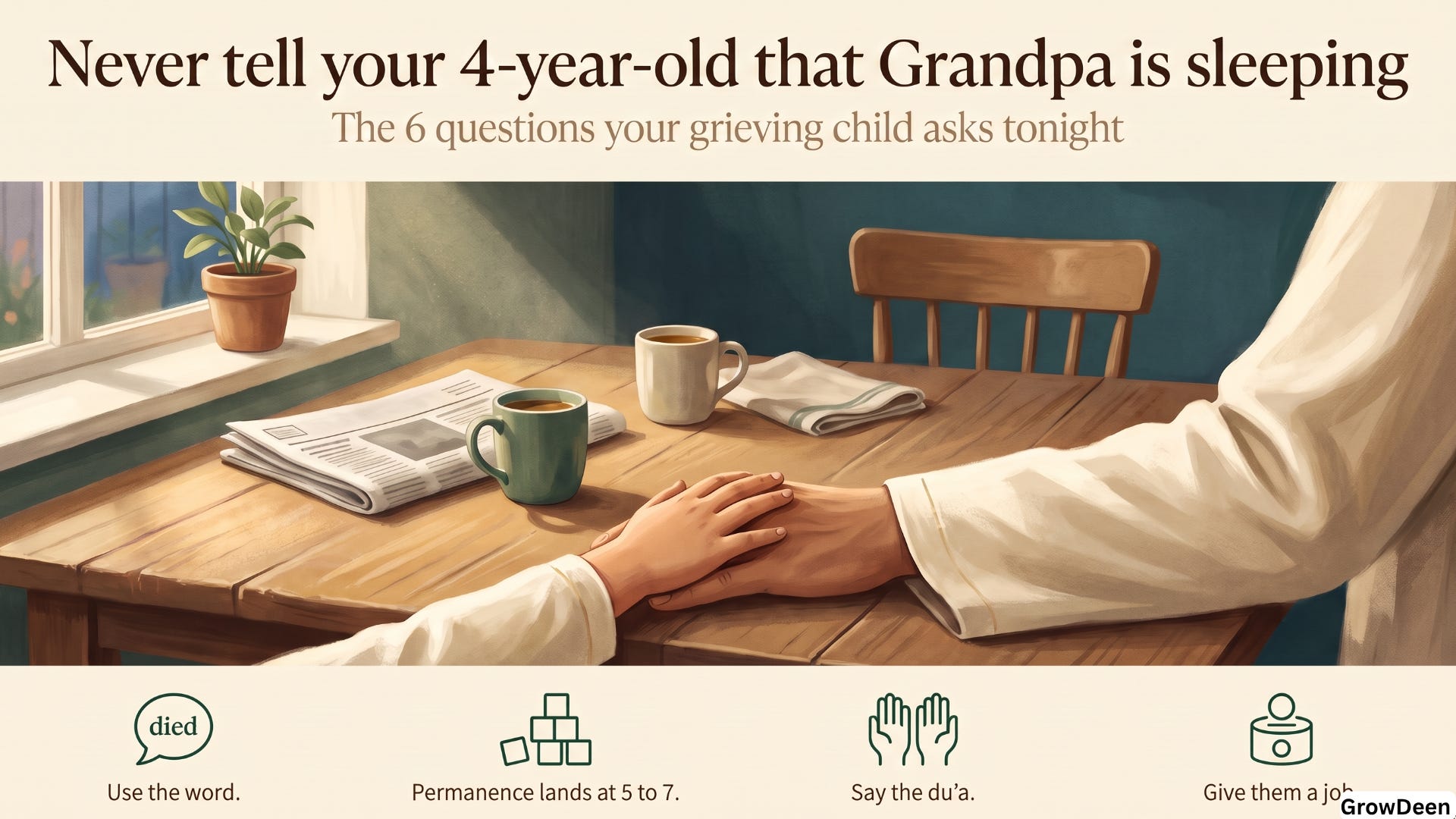
Someone has died. You say it gently.
You reach for the kindest words you own, the ones your own mother used, and you tell your four-year-old that Grandpa has gone to sleep and won’t wake up. It feels merciful. Three weeks later your child is screaming at bedtime and will not lie down, and you cannot work out why.
Almost every loving parent does this at least once. A literal mind met a poetic sentence, and the sentence won.
Here is the question to carry while you read, because it is the one that frightens parents most and gets explained least: why does a grieving child cry hard for ten minutes, then ask for a snack and go back to playing as though nothing happened? The answer is near the end, and it changes what you do in the weeks after.
What makes this approach different
Every claim here is tied to developmental research on how children build the concept of death, including the four sub-concepts researchers track and the ages each one tends to land. [1][3][4]
Islam gives a parent something a secular grief guide cannot: a definite answer to where the person has gone, a prescribed sentence to say in the first minute, and a task the child can perform for the deceased that is recorded as benefiting them. [8][11][14]
You already have the free Grief Words Pack from the top of this page, with the exact sentences for the six questions children ask, a card of what your child can still do for the person who died, and the du’a for the moment itself.
What does “died” actually mean to a five-year-old?
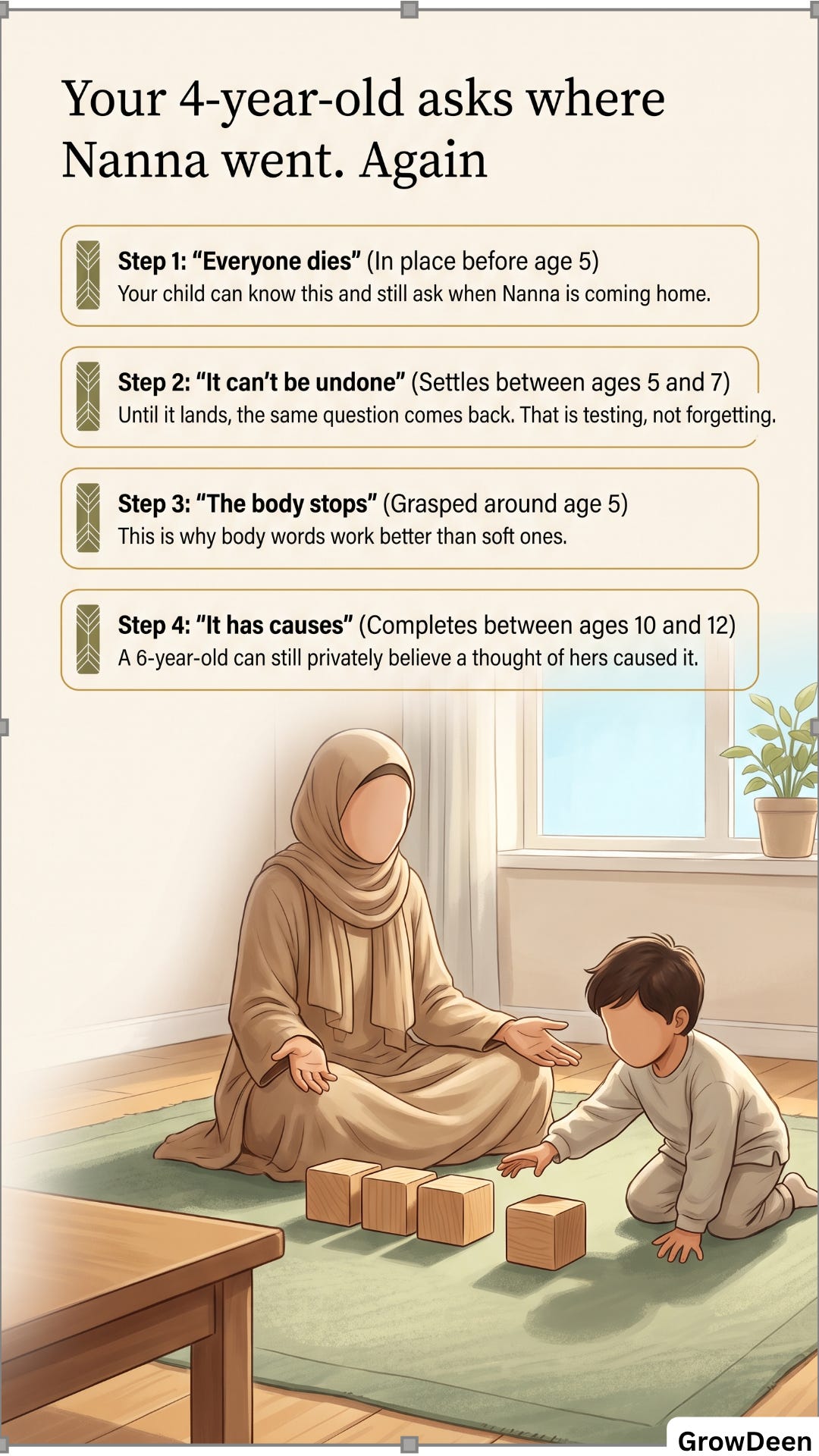
Your child asks when Nanna is coming home. You have already explained it twice. The third time, something in your chest drops, because you start to wonder whether your child is being cold.
They are not. They are building.
Researchers describe the concept of death as four separate pieces a child assembles over years, not one idea they either have or lack: universality, that everything living dies; irreversibility, that it cannot be undone; non-functionality, that the body stops completely; and causality, that death has physical causes. [3][4]
Universality usually arrives first, often before five. Irreversibility settles behind it. By about five most children understand that the body has stopped working, and by around six many grasp that death can be caused by many things rather than only by old age. [4] Causality lands last, and the full adult-shaped understanding often waits until ten to twelve. [1]
So the repeated question is a child running the same test again, checking whether the answer still holds. Under three, children have very little conceptual grasp of death at all and read the loss mainly through the distress of the adults around them, which is its own reason to keep the house steady. [10]
Which means your job is smaller than you think. Same words. Same calm. As many times as it takes.
What should I actually say in the first five minutes?
Tell your child early, and tell them yourself if you can manage it. A child who pieces the news together from half-heard phone calls carries two injuries instead of one: the death, and the discovery that the adults did not trust them with it.
Then use the word. “Died.” “Dead.” And define it in body terms a young child can picture: “When someone dies, their body stops working. It doesn’t breathe. It doesn’t feel hungry or cold or sore. And it can’t start again.”
Here is the part that surprises people: the gentlest phrases do the most damage. “Passed away.” “Gone.” “We lost her.” “Sleeping.” Children this age are literal, and paediatric guidance is consistent on it. A child told Grandpa went to sleep forever may refuse his own bed for months. A child told Grandma was lost may quietly wait for someone to find her. [5][6]
Say the word. Then stay.
And when you do not know, say that too. “I don’t know. I’ll ask someone who might, and I’ll come back and tell you.” Children take that far better than adults expect, and it protects the thing you will need most in the months ahead, which is their belief that what you tell them is true.
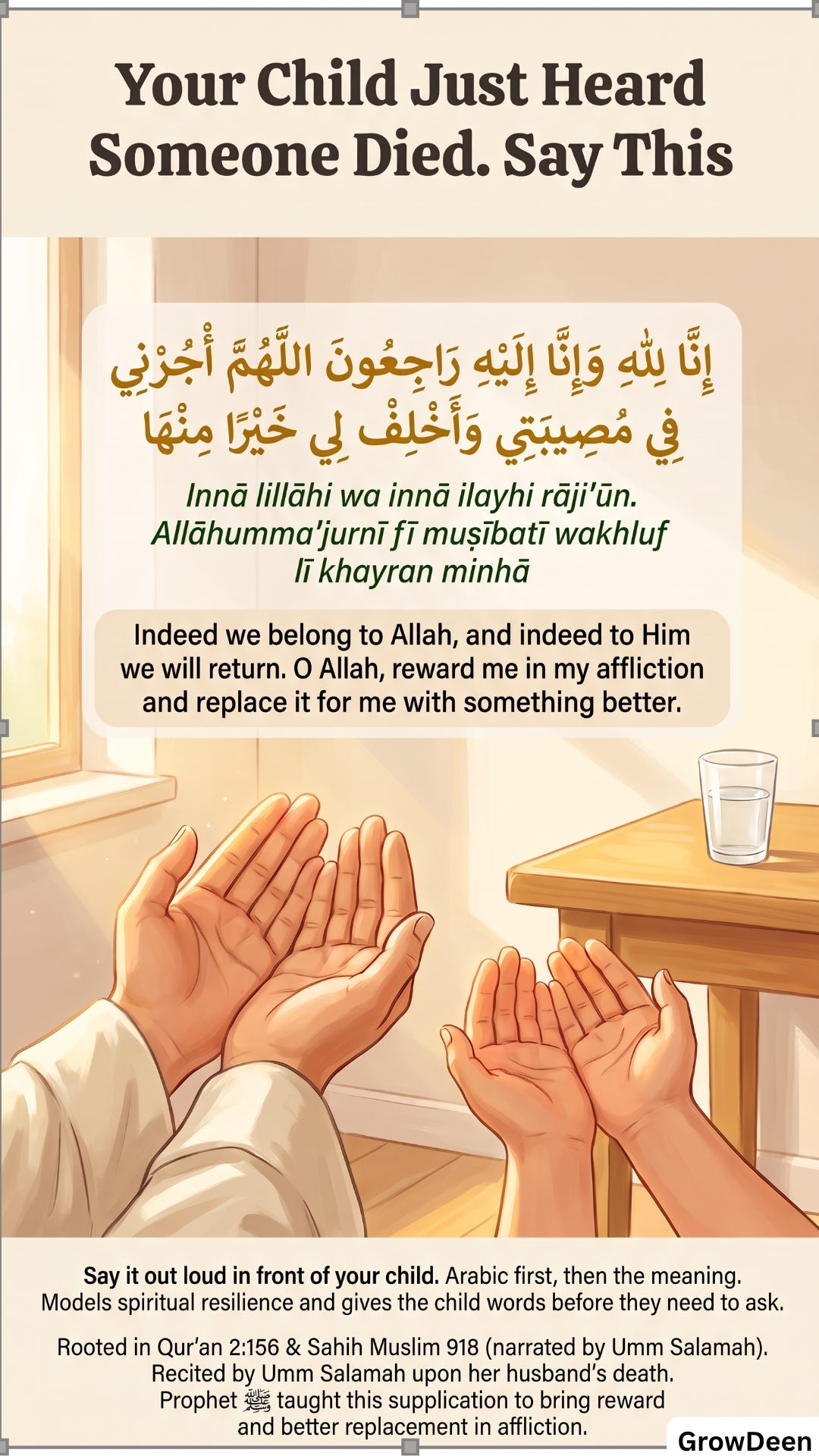
In the first minute, Muslim parents have a sentence ready that nobody has to invent. Umm Salamah reported that the Prophet ﷺ taught that when a person is struck by a calamity and says Innā lillāhi wa innā ilayhi rāji’ūn. Allāhumma’jurnī fī muṣībatī wakhluf lī khayran minhā, Allah rewards them in that affliction and gives them something better in its place. [11] She said it herself when her husband Abu Salamah died. Allah describes the patient in exactly these words: those who say, when disaster strikes them, “Indeed we belong to Allāh, and indeed to Him we will return.” [12] Say it out loud in front of your child, Arabic first and then the meaning. It hands them a sentence for a moment when they have none.
There is a lot to hold here, and almost none of it comes to mind when you are the one who has been crying. That is why the free Grief Words Pack exists: a three-page printable with the word-for-word answers to the six questions children ask, laid out so you can read one off the page at 9pm without composing anything. The download button is at the top of this page, and there’s a full description of what’s inside it below.
But here’s what most parents don’t realise about their own tears.
Is it wrong to cry in front of my child?
Many Muslim families have quietly absorbed the idea that visible grief is a failure of sabr. A child who watches a father swallow every tear learns that sadness is something to hide, and hidden grief is the kind that comes out sideways three years later.
Allah says: “Every soul will taste death. And We test you with evil and with good as trial; and to Us you will be returned.” [8] According to Tafsir Ibn Kathir, this verse establishes that no one was granted permanence in this world, the Prophet ﷺ included, and that Allah tests people through both hardship and ease to see who gives thanks and who despairs, before all are returned to Him. [8] Death belongs to the design rather than interrupting it. The test sits in the response.
And the response the Prophet ﷺ modelled was not a composed one. Abu Hurairah reported that he ﷺ visited the grave of his own mother, wept, and made those standing around him weep, then told the people to visit graves because they make a person mindful of death. [13] His mother died when he was a small boy. The tears came decades later, in public, in front of his companions.
So let your child see you cry, and narrate it plainly: “I’m crying because I miss him. Crying is allowed.” What Islam restrains is wailing, striking oneself, and speaking against the decree of Allah. Everything short of that is permitted, tears included.
What can my child actually do for someone who has died?
Watch a grieving child for a day and you will notice something underneath the sadness. In their own eyes they are useless, and that carries its own weight. The adults are busy. The phone keeps ringing. Nobody has given them anything to carry.
Islam hands you an answer that is practical rather than consoling. Abu Hurairah reported that the Prophet ﷺ said that when a person dies their deeds come to an end except for three: ongoing charity, knowledge people continue to benefit from, and a righteous child who makes du’a for them. [14]
Read that third one again. Your child is named in it.
So build it into the week, small enough that a five-year-old can hold it:
One fixed moment a day for du’a for the person who died, after a salah or at bedtime, so the child knows exactly when it happens.
A small sadaqah from the child’s own coins, given with the intention that its reward reaches the deceased.
A short surah learned and recited with that person in mind.
Carrying food to the bereaved household. When news of Ja’far’s death reached Madinah, the Prophet ﷺ instructed the Muslims to prepare food for his family because something had come upon them that occupied them. [15] A seven-year-old who helps carry a dish has a real, Sunnah-rooted job on the hardest day.
Children who are given a task ask fewer frightened questions, because the feeling finally has somewhere to go.
Support Muslim Parenting Lab ❤️
Would you like the reward of every parent who acts on what they read here? Fund it with the button below and it is yours.
The Prophet ﷺ said whoever guides to good has a reward like the one who does it. (Sahih Muslim 1893a)
Why is my child playing when they should be sad?
Here is the answer to the question planted at the start.
Expect bedwetting after a year of dry nights, baby talk, clinginess at the school gate, nightmares, stomach aches with no medical cause, flashes of anger, or a bright burst of play within an hour of sobbing. [5][6][7] All of it comes and goes for months.
That burst of play tells you nothing about how much your child cared. Young children can only hold grief for short stretches before it overwhelms the system, so they step out, play, and step back in. Adults grieve in a long wash. Children grieve in puddles.
Which means punishing the brightness teaches a child to grieve in secret, and secret grief is the kind that ends up in a clinician’s office at nineteen.
What steadies a child in these weeks is dull and repetitive. The same wake time. The same meals. The same bedtime routine. The same household rules about hitting and screens, enforced exactly as before. A grieving child who finds the limits still holding learns that the adults are still steering. [5]
When does grief in a child need professional help?
Most children come through bereavement with time, routine and adults who stay available. A minority do not, and that minority now has a name. Prolonged grief disorder was added to both ICD-11 and the DSM-5-TR, and in children it can be considered from six months after the death. Around one in ten bereaved young people show symptoms of it. [2][9]
Speak to your doctor, your child’s school, or a qualified counsellor if, several weeks on and especially several months on, your child shows a lasting loss of interest in everything they once enjoyed, sleep or appetite changes that do not settle, a persistent belief that the death was their fault, serious difficulty separating from you, or a marked and sustained drop at school. [5][6] Research on bereaved children points to persistent negative beliefs and avoidance as the patterns worth catching early, which is one more reason not to let the subject go quiet at home. [9]
Get support for yourself too. If your own grief is making ordinary daily tasks hard well after the loss, speak to a doctor or counsellor. Taking the means and relying on Allah belong together, and seeking help is one of the means.
If the death was sudden or traumatic, give your child less detail rather than more, and seek professional guidance early.
The Grief Words Pack
If you have read this far, you are the kind of parent who would rather be honest with your child than comfortable. That is harder, and it is the thing your child will remember.
Inside the Grief Words Pack (one comprehensive PDF, 3 pages):
Page 1: What to Say First. The six questions children aged three to eight ask after a death, each with the exact sentence to say back, written out word for word so you can read it off the page instead of composing it through tears, designed as a card you can keep on the fridge or folded in a pocket.
Page 2: What Your Child Can Still Do. A child-sized action card with four concrete things a child can do for the person who died, a space to record what they did and when, and a short watch-for strip telling you which signs mean it is time to ask a doctor or the school for more support.
Page 3: The Du’a for the Moment It Happens. The full istirja’ and the supplication Umm Salamah recited when her husband died, in Arabic with transliteration, meaning and source, plus the three moments in a week when a family says it together.
This isn’t just a PDF to download and forget. It’s a tool designed to stay on your fridge, where you’ll actually use it when you need it most.
This Grief Words Pack is what every subscriber receives with each article. Muslim Parenting Lab covers the whole span of raising Muslim children, from newborns to school age, all backed by research and rooted in the Qur’an and Sunnah.
Do this in the next five minutes
Pick one sentence from this article and say it out loud to yourself, once, in the kitchen. “Grandpa died. His body stopped working and it can’t start again.” Saying it when nobody has died yet is how you make sure you can say it when somebody has. Say the word. Then stay.
May Allah ease what you are carrying, place barakah in your patience, and make your honesty with your child a mercy for both of you.
Share this with someone who needs it
Think of one person right now: the friend whose father is in hospital and whose children have not been told anything yet, the cousin who lost a baby last year and still flinches when her toddler asks about it, the sister at the masjid who said “I just didn’t know what to tell him” and then changed the subject.
Send it to them today, the way you would want someone to send it to you at 11pm on the worst night. Sometimes the kindest thing we can pass on is the words themselves.
Frequently asked questions
Q: At what age do children understand that death is permanent?
A: Most children grasp permanence somewhere between five and seven, with the full adult-shaped understanding arriving closer to ten or twelve. [1][4] Under five, expect your child to ask when the person is coming back, and expect to answer it more than once.
Q: Should I say “died” or is that too harsh for a young child?
A: Say “died.” Softer phrases like “gone to sleep” or “we lost her” are taken literally by children this age and often create a new fear instead of removing one. [5][6] For the full wording, see “What should I actually say in the first five minutes?” above.
Q: Should a Muslim child attend a janazah or a burial?
A: There is no blanket answer, and it depends far more on preparation than on age. Describe exactly what they will see and hear beforehand, give explicit permission to leave at any point, and assign one trusted adult whose only job that day is your child. Never force it.
Q: Is it permissible to cry in front of my children in Islam?
A: Yes. The Prophet ﷺ wept at his own mother’s grave and moved those around him to tears. [13] What Islam restrains is wailing, striking oneself and speaking against Allah’s decree. The tears themselves are allowed.
Q: What can a child do for a relative who has died?
A: Make du’a for them. The Prophet ﷺ said a person’s deeds end at death except for three, one of which is a righteous child who supplicates for them. [14] Small sadaqah from the child’s own money and reciting a short surah with that person in mind work the same way.
Q: Why is my child playing and laughing days after the funeral?
A: Because children grieve in short bursts rather than a continuous wave, and stepping out to play is how a young nervous system takes a break. [5][7] It is not a sign they have stopped caring.
Q: When should I get professional help for a grieving child?
A: If several months on your child still shows lasting loss of interest, unsettled sleep or appetite, a persistent belief it was their fault, severe separation difficulty, or a sustained drop at school, speak to your doctor or the school. [5][6] Around one in ten bereaved young people develop prolonged grief disorder, which is a recognised diagnosis with real treatment. [2]
References
[1] Hinds, P.S., et al. (2012). Understanding death with limited experience in life: Dying children’s and adolescents’ understanding of their own terminal illness and death. Current Opinion in Supportive and Palliative Care.
[2] Assessing DSM-5-TR and ICD-11 prolonged grief disorder in children and adolescents: development of the Traumatic Grief Inventory Kids Clinician-Administered. European Journal of Psychotraumatology.
[3] Speece, M.W., & Brent, S.B. (1984). Children’s understanding of death: A review of three components of a death concept. Child Development, 55(5), 1671-1686.
[4] Menendez, D., Hernandez, I.G., & Rosengren, K.S. (2020). Children’s emerging understanding of death. Child Development Perspectives, 14(1), 55-60.
[5] Child Mind Institute. Helping children deal with grief.
[6] Children’s Hospital Colorado. How to talk to kids about death and grief.
[7] Lytje, M., Dyregrov, A., & Holiday, C. (2023). When young children grieve: Daycare children’s experiences when encountering illness and loss in parents. International Journal of Early Years Education, 31(1), 115-129.
[8] Qur’an, Surah Al-Anbya 21:35 · Ibn Kathir, Tafsir Ibn Kathir, Surah Al-Anbya 21:34-35 commentary.
[9] Boelen, P.A., et al. Individual and systemic variables associated with prolonged grief and other emotional distress in bereaved children. PLOS ONE.
[10] Norris-Shortle, C., Young, P.A., & Williams, M.A. (1993). Understanding death and grief for children three and younger. Social Work, 38(6), 736-742.
[11] Sahih Muslim 918b, narrated by Umm Salamah. Graded: Sahih.
[12] Qur’an, Surah Al-Baqarah 2:156 · Ibn Kathir, Tafsir Ibn Kathir, Surah Al-Baqarah 2:155-157 commentary.
[13] Sahih Muslim 976b, narrated by Abu Hurairah. Graded: Sahih.
[14] Sahih Muslim 1631, narrated by Abu Hurairah. Graded: Sahih.
[15] Sunan Abi Dawud 3132, narrated by Abdullah ibn Ja’far; also Jami’ at-Tirmidhi 998. Graded: Hasan.